The most repeated advice about auto Facebook ads is also the most expensive: switch Advantage+ on, pour volume into one campaign, and leave it alone until the learning phase clears. Media buyers repeat it because it's simple, and because Meta's onboarding rewards it. It's also the fastest way to spend a quarter's budget proving nothing.
Automation is a delivery decision. Measurement and creative intent are different decisions, and neither improves by being delegated. Meta optimises the events you send it, using the assets you uploaded, and it does both consistently. Consistency isn't correctness. If the purchase event is double-counted, or the winning image was one the system recropped past recognition, automated delivery will scale a result you can't explain or repeat.
The split is uncomfortable and simple. Automate budget allocation, placement selection and per-person assembly once you've written down the event, the concept and the off-switches. Keep event definitions, creative concepts, naming and exclusions under human control permanently.
Table of Contents
- What Auto Facebook Ads Actually Control
- Signal Quality Before You Trust the Algorithm
- How Advantage Plus Delivery Makes Decisions
- When Creative Automation Hides the Winner
- When to Keep the Next Campaign Manual
- How to Launch an Auto Campaign Without Losing the Test
What Auto Facebook Ads Actually Control
Auto Facebook ads aren't one toggle. Buyers use the phrase to cover three stacked handovers, and each one gives Meta a different class of decision with its own reversal path in Ads Manager.
The first handover is budget and audience inside the campaign. Advantage+ sales, app and leads campaigns let Meta move spend between ad sets and expand past a tight audience without asking. You still set the optimisation event, the country, the exclusions and the campaign budget. Reach isn't the constraint on that expansion: DataReportal's Digital 2025 global overview estimated Facebook ads could reach approximately 2.28 billion people globally at the start of 2025, up 93 million (4.3%) in twelve months and roughly 44% of the 5.24 billion social media user identities it reported. Broad delivery always has somewhere to go, which is why an unclean event gets expensive fast.
The second handover is placement. Advantage+ placements, the successor to automatic placements, picks the impression: Feed, Reels, Stories, Marketplace, Audience Network, one auction at a time. Placement expansion is the platform's oldest habit. Facebook ads launched in 2007, sponsored stories later reached the mobile News Feed, and advertising became the large majority of the company's revenue in that period, as Clarigital's history of Facebook ads sets out. A business built on filling every available surface will fill every available surface.
The third handover happens after you upload. Advantage+ creative and Flexible Ads remix crop, text, music, overlays and asset combinations per person. From that point, the file on your drive stops being the ad people see, and each added variant multiplies the combinations Meta can serve while thinning the data behind any one of them.
| Layer | Meta decides | Buyer still sets | Default risk |
|---|---|---|---|
| Advantage+ sales, app or leads | Budget mix across ad sets and broad audience expansion | Optimisation event, country, exclusions, campaign budget | Spend shifts into broad prospecting before the event is clean |
| Advantage+ placements | Feed, Reels, Stories, Marketplace, Audience Network mix | Which aspect ratios you actually upload | A square-only upload gets auto-cropped into 9:16 Reels and Stories, and the delivery report won't tell you it happened |
| Advantage+ creative enhancements | Crop, music, text variations, overlays, backgrounds | Original asset and which enhancement toggles stay off | Toggles re-enable on duplicate or after a bulk edit |
| Flexible or dynamic creative | Which image, video and copy combo each user sees | Asset pool size and the concept being tested | Delivery improves while the winning element stays unnamed |
Some enhancements start enabled, and the trap is the audit trail rather than the initial setting. Duplicate a proven ad, or run a bulk edit across fifty of them, and toggles you turned off can come back on. The gap between uploaded file and served ad compounds across a hundred-ad batch published in one go, and it is exactly the per-person remixing that makes the winning element hard to name afterwards. A campaign can report a falling CPA on an asset combination nobody chose and nobody can rebuild.
Operating rule: before enabling any layer, confirm which report would expose it misbehaving and who owns switching it back off. A handover you can't audit is a handover you can't reverse cleanly.
Signal Quality Before You Trust the Algorithm
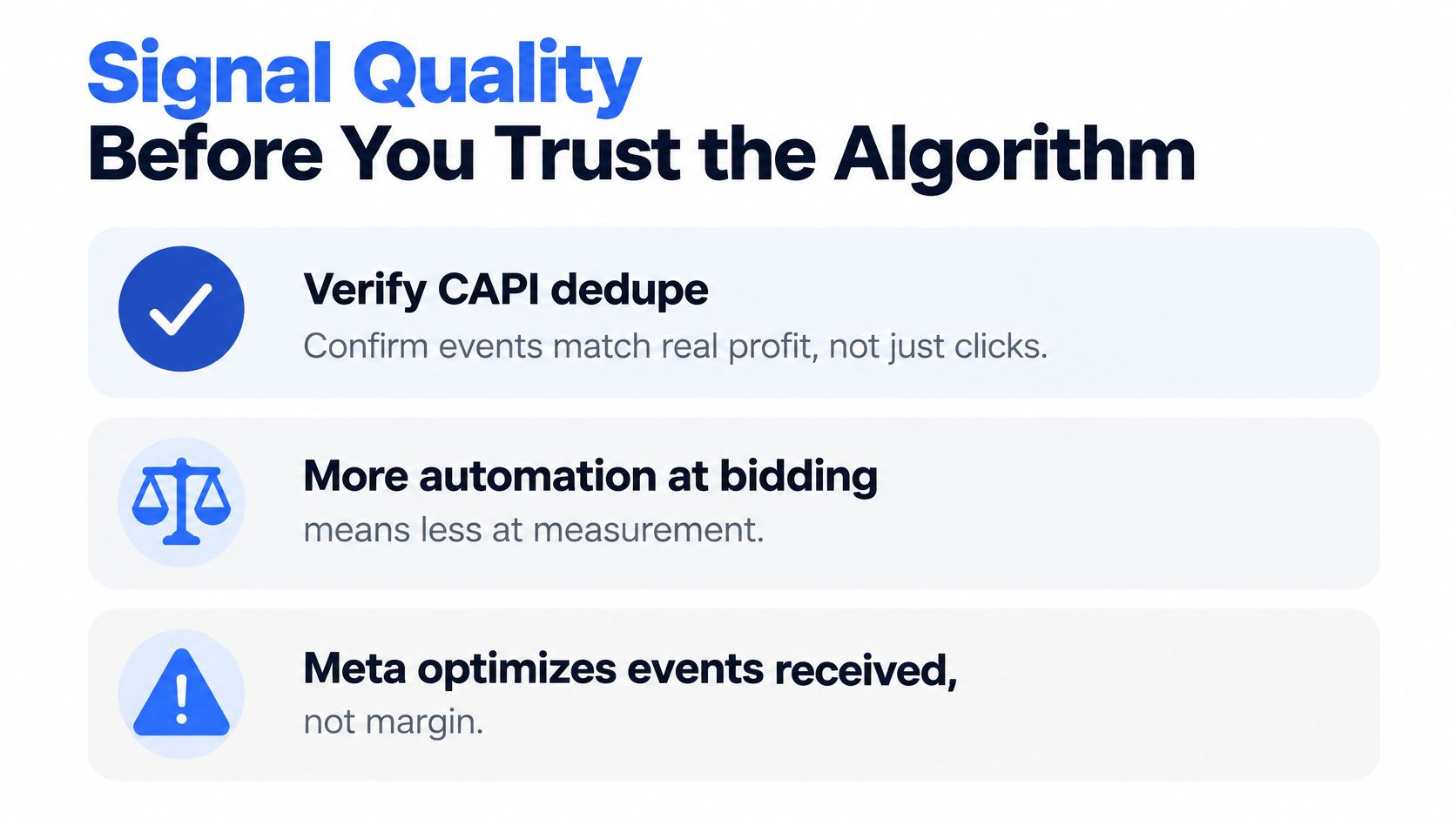
A bad signal doesn't slow automation down. It gives automation a confident, repeatable direction. Meta's delivery optimises the events it receives, and it has no visibility into margin, incrementality or whether the lead ever answered the phone. Double-count the purchase event and the system buys more of whatever produced the double count, reporting a falling CPA the whole way.
Incrementality is the counterweight. A Meta Conversion Lift study of Peugeot Turkey's electric E-3008 campaign reached 12.3 million people and estimated that exposure to Facebook and Instagram ads drove 11% of all paid-search visits and 13% of organic-search visits between 2 December 2024 and 31 March 2025, according to the Peugeot Turkey case study. Useful and self-interested in equal measure: Meta ran the study, and the lift shows up in Google's channel, not Meta's. Read it as a reason to measure incrementality, never as proof your account has any.
Audit the event before you audit the creative
- Pixel and Conversions API both fire, with deduplication. Pass a shared event_id on both paths so one purchase counts once. A deduplication failure reports double the conversions, and Advantage+ responds by shifting budget toward whichever audience produced the phantom events.
- Server-side match quality is high. Ad Times's report on Meta's Advantage+ creative automation cites advertisers with server-side matching covering more than 80% of conversion events seeing a 19–23% Advantage+ ROAS improvement, while only 54% of surveyed mid-market ecommerce advertisers had fully implemented CAPI. Read the pair together and the lift belongs to advertisers who had already fixed their signal, a setup most of the market still lacks.
- Consent loss is visible. If a meaningful share of browser events never arrives, automated budget is optimising a partial picture and calling it the market.
- Reporting splits new from returning customers. Left alone, Advantage+ will buy cheap repeat purchases all day and hand you a beautiful blended ROAS. A corrupted event paired with a dozen creative variants can produce a winner you cannot reproduce, because the delivery report names neither the audience it over-bought nor the element that converted.
Put a contribution-margin KPI beside platform ROAS, and run a holdout or geo test whenever last-click CPA looks too good. The event mechanics come first: our guide to conversion tracking on Facebook covers the client and server setup in the order it should be built.
Practical rule: more automation at bidding and creative requires less automation at the measurement layer.
Hand the campaign budget to Advantage+ when the event passes all four checks with room to spare. Otherwise the honest answer is no-go, and it changes the day the tracking does.
How Advantage Plus Delivery Makes Decisions
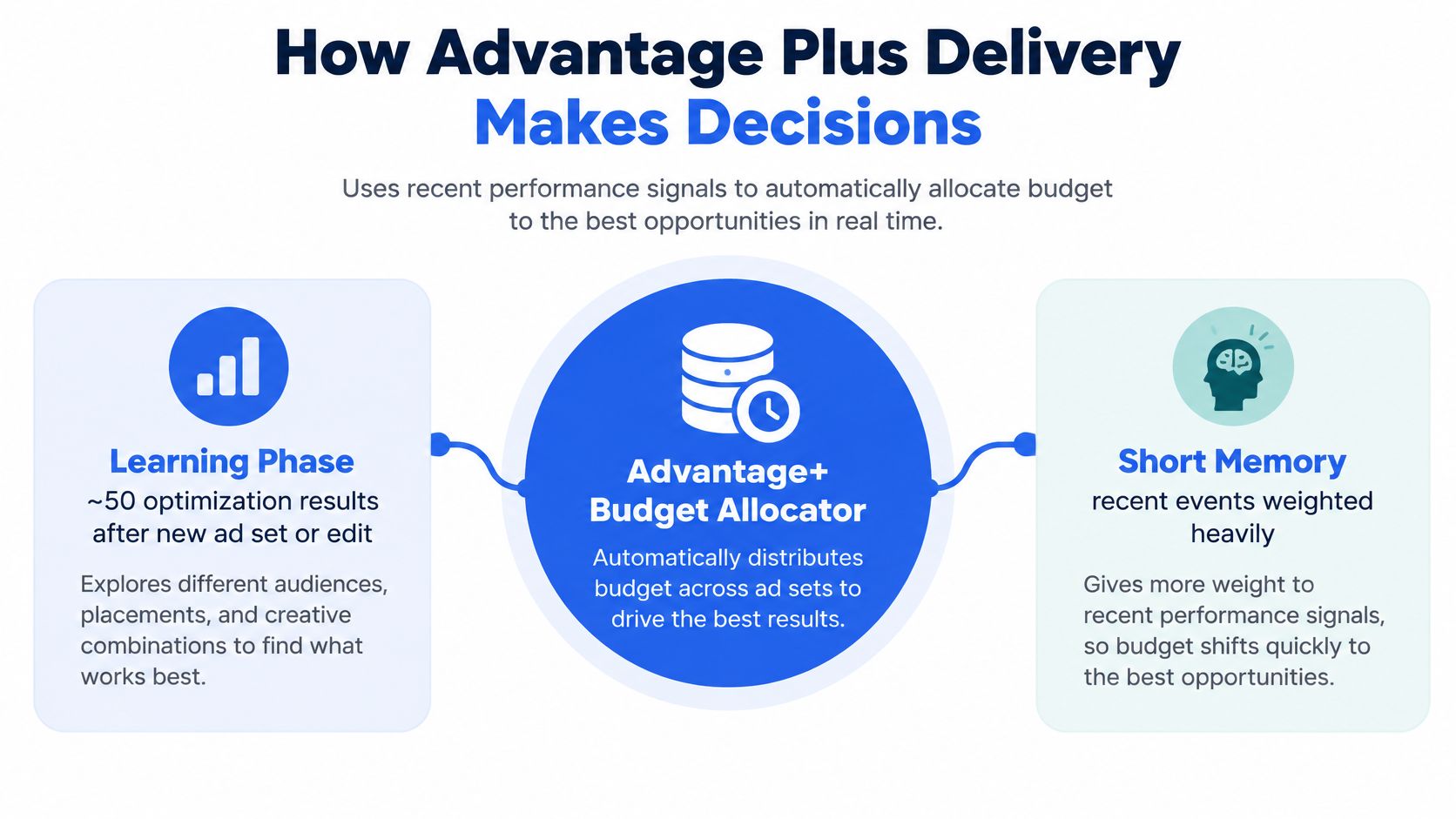
Advantage+ behaves like a budget allocator with a short memory. It weights recent events heavily, pushes spend toward whichever ad set or audience produced them, and drops that preference quickly once they stop. That's excellent for a clean account with volume, and rough for a new one.
The learning phase is where the memory resets. Meta's guidance on the learning phase states that an ad set typically exits after approximately 50 optimisation results in the week following its last significant edit. Delivery inside that window is deliberately unstable, because the system is exploring eligible people and placements. Any comparison you draw there is a comparison of noise.
What resets the learning clock
- Budget jumps: raising a daily budget by a multiple rather than a percentage restarts exploration.
- Bid and cost-cap changes: tightening a cost cap forces the system to re-explore cheaper inventory.
- Audience edits: adding or removing interests, lookalike percentages or geographies mid-test.
- A new optimisation event: moving from leads to purchases invalidates what the system knew about the old one.
- Swapping the lead creative: replacing the ad carrying most of the spend is effectively a new ad set.
Meta also names the usual causes of learning limited: small audiences, budgets too thin for the CPA, restrictive bid or cost controls, auction overlap, infrequent optimisation events, and too many ads running at once. All six are structural. You fix them by consolidating budget and conversion volume into fewer ad sets and changing one major variable at a time.
Budget control changes what a test means
Campaign budget lets Meta move spend across ad sets according to the campaign's optimisation logic, which is what you want for cheap reach and the opposite of what a geo or concept needs when it must hold a fixed share. Ad set budgets keep a floor under each cell. Targeting sits above both: expansion can walk straight past a saved audience, so exclusions and country settings stay human inputs, and our Meta Ads targeting guide covers how expansion interacts with saved and lookalike audiences. If you want a structured way to reason about when spend should move and when it should stay put, SellerAI's Meta Ads budget prompt walks through the reallocation logic in a form you can adapt to a live account.
Where the buyer still holds the switch
Creative automation has a control path, and it's worth knowing exactly where it lives. In Ads Manager the route is Ad setup → Ad creative → Set up creative → Enhancements, where individual options can be disabled and saved, per Meta's Advantage+ creative documentation. The advanced preview splits into separate Placements and Advantage+ creative tabs, so you can inspect how enhancements vary by placement before publishing. Available options shift with format, placements and whether a catalogue is in use, and some arrive enabled by default.
Teams with strict creative-control requirements audit those settings at creation and again after every bulk edit, rather than assuming the upload survived intact. The system optimises the event you send it. Not margin, not new-customer rate, not incrementality.
When Creative Automation Hides the Winner
Creative automation creates a governance problem before it creates a production advantage. Meta can emit a large number of variants from a single upload, and you may not preview every combination or know which version a given person received. That is fine for reach and awkward for learning.
Measurement is only starting to catch up with the feature set. A July 2025 Ads Manager update added creative-level breakdowns for flexible-format elements, as ppc.land reports on Brainlabs' warning that AI-generated creative could leave brands unsure what worked. Variation-level reporting remains an emerging capability, not a solved one.
A controlled asset test is not personalisation
An asset-level test changes one concept at a time with enhancements off, so the CPA difference has one plausible cause. Algorithmic personalisation changes crop, background, copy or music after upload, so a CPA drop has several causes and none of them are named. Run both at once and you can't brief the next production cycle, because you don't know what to brief.
| Change Meta may apply | Preview before publish | Report this, not the ad name |
|---|---|---|
| Crop or aspect remix for Reels and Stories | Yes, in the Placements preview | Original concept plus ratio, not the cropped child |
| Text variation or overlay | Partial; not every line | Approved copy variant only |
| Music, motion or background generation | Often only a sample | Concept with enhancements off, as the control |
| Flexible asset mixing inside one ad | No full user-level combo | Concept and offer, using breakdowns where Ads Manager exposes them |
| Enhancement toggled back on after duplicate | No, unless you re-open Enhancements | A settings audit, because the file did not change |
Report by concept, not by hundreds of superficial permutations. Log original files against modified ones so the next production cycle has a real brief instead of a screenshot of a winning ad nobody can reconstruct. Anything the system can rewrite gets brand and legal review before it ships, which usually means a fixed approved line and no overlay generation on regulated claims.
The discipline is easier to understand when you watch one buyer hold a small number of concepts steady while the system varies execution underneath:
The counterintuitive part is that more variants produce weaker evidence. Each remix dilutes delivery across permutations, so the winning cell has less spend behind it and the losing cells have more. Scaling asset volume can speed up delivery while making the result harder to attribute. For a test design that survives automation, our creative testing framework sets out how to keep one variable still while delivery moves.
When to Keep the Next Campaign Manual
The question isn't whether Advantage+ beats manual structure. It's which one the current account can support. Judge on account condition first, test design second, budget control third.
Meta separates campaign-level budget control from ad-set-level control, and the distinction matters more than the naming. Its budgeting documentation says advertisers can use ad set budgets when they want individual budgets for specific ad sets, which gives more control over delivery within them, per Meta's documentation on ad set budgets. That's a different system from campaign-level allocation, where delivery shifts spend across ad sets according to the campaign's optimisation logic. For a structured test it decides whether a concept, market or placement grouping reliably receives its budget at all.
| Account condition | Use this | Why |
|---|---|---|
| Under about 50 optimisation events a week or a new pixel | Manual ABO | Learning CPA is noisy and budget chases a weak event |
| Pixel and CAPI not deduped | Manual until the audit passes | Automation optimises the bad signal |
| Thin catalog or purchase volume | Manual with ad set budgets | Campaign budget starves the test cell |
| One creative variable must stay fixed | Manual ABO, enhancements off | Remix hides which element won |
| Legal must approve every line and crop | Manual | The system can rewrite copy, crop and overlays |
| A market or geo must not be outspent | Ad set budgets | Campaign budget migrates spend to the cheaper market |
| 50+ weekly events, exclusions set, saturated lookalike | Advantage+ sales or leads | Finds incremental reach outside the lookalike |
| Advantage+ prospecting plus broad manual prospecting | Do not run both | The two structures bid against each other |
The last row is the one buyers miss. An Advantage+ prospecting campaign running beside a broad manual prospecting ad set competes for the same impressions, and auction overlap is already a named cause of learning limited. Both structures keep resetting each other, and the report blames creative.
Test rule: if you can't name the single variable under test, you aren't ready to automate the budget.
Naming and configuration are what break when this goes multi-market, not the strategy. Rapid Ads launches a whole batch of ads to Meta Ads with one click, enforcing naming conventions at ad and ad set level so delivery stays interpretable across accounts. We're an Official Meta marketing partner, and 100 ads can go live in under 10 minutes. The bidding decision stays yours either way. Do not automate an event you wouldn't trust a junior buyer to optimise by hand.
How to Launch an Auto Campaign Without Losing the Test
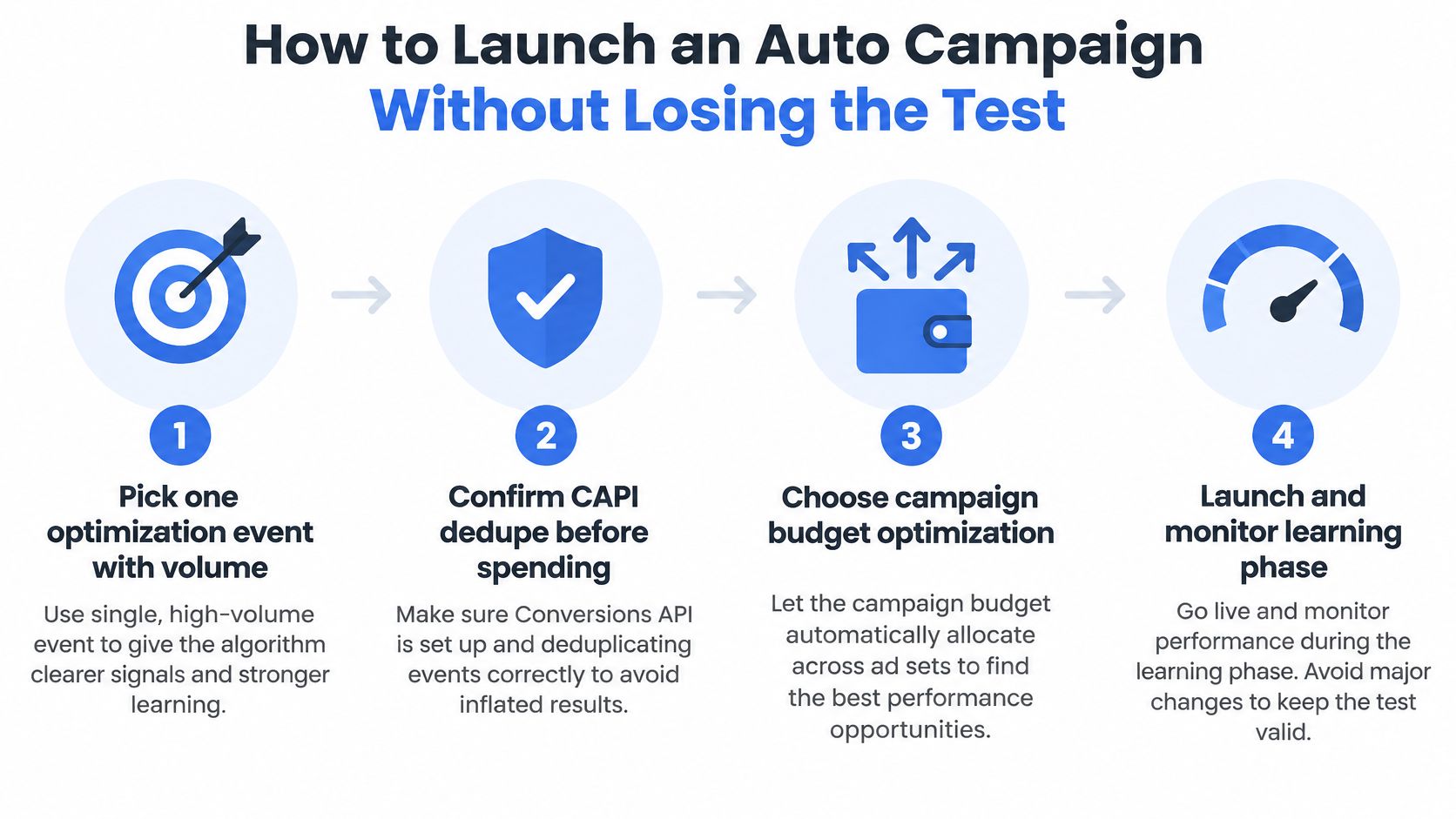
Six steps, in order, for a launch you can still read afterwards.
- Pick one optimisation event that already has volume. Purchases on a cold account fire too rarely to learn from. Choosing one that fires a dozen times a week guarantees learning limited.
- Confirm CAPI dedupe before you spend. A shared event_id on browser and server events. Skipping it means the first week of data is unusable and the budget is already gone.
- Choose budget control deliberately. Campaign budget only when you aren't comparing cells. Ad set budgets when each concept, geo or market needs a floor under it.
- Load a small asset pool per concept. One offer, a few hooks, matched 1:1 and 9:16. Hundreds of near-duplicates give the system more to explore and you less to learn.
- Turn off what brand hasn't approved, then check the preview. Music, text overlays and background generation come off first; the Placements and Advantage+ creative tabs show what's left.
- Name everything, then leave it alone. Campaign, ad set and ad carry concept, market and ratio so reporting survives. No edits during the learning window unless delivery breaks outright.
The bulk path, and where it breaks
Meta supports Import ads in bulk. From Ads Manager, open the Ads, Ad sets or Campaigns tab, choose More, then Import ads in bulk, and paste text or upload an Excel sheet, per Meta's bulk import documentation. A blank template sits behind Download Excel template for whichever level you're working at. It's the native route for spreadsheet batch work, and its limit is organisational rather than technical: asset mapping, UTM consistency and enhancement state have to be right one row at a time, and nothing in the import validates your concept naming.
That's the layer we built for. Creatives go in as a batch, naming conventions are enforced across ad sets, and an auto-disable keeps Advantage+ enhancements off after upload instead of flipping back on, which is the setting drift nobody catches in a 200-ad batch. Before you decide what counts as a single variable, a practical ad creative testing framework is a better use of ten minutes than another round of variants.
Benchmarks help you argue with a result without telling you whether your account is fine. In 2025, Facebook automotive repair-and-service campaigns recorded a 4.86% conversion rate, according to Demand Local's automotive advertising benchmark. Treat it as a number to interrogate, not a target to chase.
Rapid Ads exists for the part of this workflow that eats the week: uploading hundreds of creatives, enforcing naming and UTM conventions, and keeping Advantage+ enhancements off so a bulk edit doesn't undo your test. Drag in your assets, group them into ad sets, and push a whole batch to Meta in one click, with 100 ads live in under 10 minutes. Start on the free plan at Rapid Ads and keep the measurement layer manual, where it belongs.