There is no single PropellerAds CPM rate. Effective CPM is spend divided by delivered impressions, times 1,000, so $50 on 100,000 impressions is a $0.50 eCPM and the same $50 on 25,000 impressions is a $2.00 eCPM.
Roundups still tell you to bid under one borrowed average. That advice collapses as soon as the format, country, or buying model changes. A popunder thousand and a push thousand are different products, and a cheap clearing price can still miss CPA. Read the auction the way you already read a Meta CBO test: separate the cell, recompute yield, and refuse to scale a blend.
Table of Contents
- Why There Is No Single PropellerAds CPM
- CPM Benchmarks by Format and Buying Model
- GEO Device and Frequency Pressure on the Bid
- Why the Same Settings Print a Different CPM
- Campaign Math From Deposit to Effective CPM
- How to Optimize a PropellerAds CPM Test
- Decide Whether the CPM Is Worth Scaling
Why There Is No Single PropellerAds CPM
A single PropellerAds CPM would be a misleading benchmark. The price attached to 1,000 impressions varies by format, country, bid type, targeting, traffic quality, and device. The network first became known for popunder advertising and later added push notifications, display, and interstitial formats.
Effective CPM = total spend ÷ delivered impressions × 1,000.
That calculation gives buyers a comparable yield measure, but blending formats can still obscure performance. A popunder, an in-page push, and a display placement reach users in different contexts, so evaluate each one on its own rather than treating a blended average as a rate card.
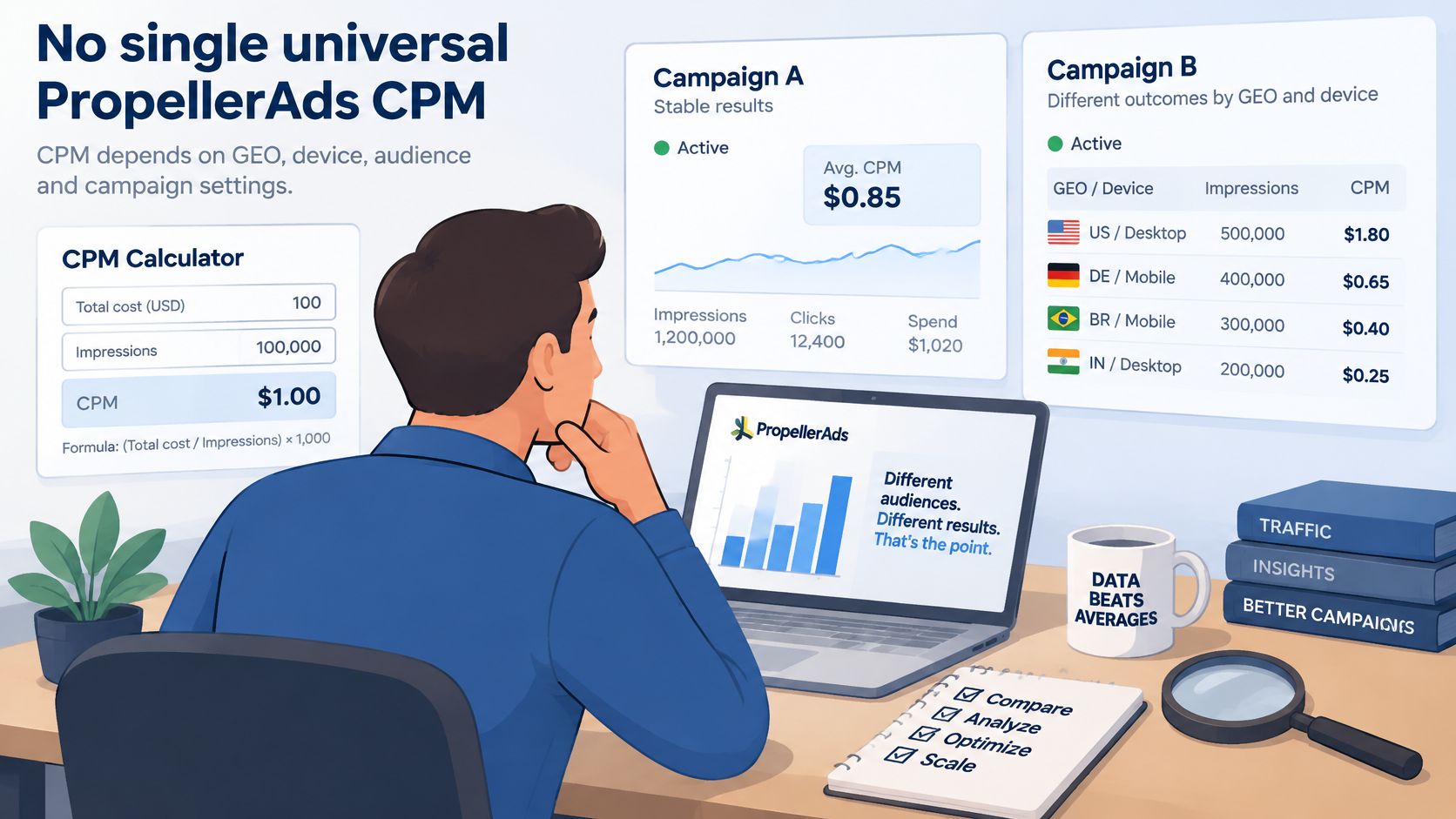
Treat quoted rates as directional, then compare realised eCPM with CTR, conversion rate, and CPA. A cheaper thousand impressions only helps if the resulting traffic meets the campaign's acquisition target.
CPM Benchmarks by Format and Buying Model
A borrowed CPM benchmark can look attractive and still buy the wrong inventory. Compare the format and billing model before setting a bid. PropellerAds' pricing-model help describes CPM as an advertiser-side price per 1,000 impressions and lists CPM bidding for OnClick, Classic Push, and In-Page Push, alongside CPC, SmartCPM, SmartCPC, and CPA Goal. The ranges below are directional reading rules, not official rates.
| Model or format | What you pay for | CPM bidding | Relative cost signal | Billing trap |
|---|---|---|---|---|
| Flat CPM | 1,000 impressions | Yes on OnClick, Classic Push, and In-Page Push | Your bid sets the requested rate | A low bid can win low-quality inventory |
| SmartCPM | Impressions under an algorithmic bid | Yes, up to your cap | Cap is not the average CPM | Do not report the cap as eCPM |
| CPC | A click | CPM is calculated after delivery | eCPM rises with CTR | Cheap clicks can still miss CPA |
| SmartCPC | A click with an automated bid | Resulting eCPM only | Variable versus a flat CPC | Compare realised eCPM, not the starting bid |
| CPA Goal | A conversion or acquisition | Resulting eCPM only | Varies with conversion rate | Judge CPA, not headline CPM |
| OnClick popunder | An under-page impression | CPM and SmartCPM are common | Often the cheapest source of scale | Do not average with display |
| Classic Push | An opt-in notification impression | CPM available | Mid-range, highly GEO-sensitive | Frequency caps change yield |
| In-Page Push | An in-page push-style impression | CPM available | Often between popunder and Classic Push | Not the same user as Classic Push |
| Display or interstitial | A placed view | Model dependent | Usually dearer than popunder | Keep separate from other formats |
What the headline rate actually means
With flat CPM, the bid is the requested price. With SmartCPM, it is a ceiling: the algorithm can clear below it, so using the cap as actual cost overstates spend. CPC and CPA Goal produce an eCPM after clicks or conversions. A low eCPM can still miss the CPA target, just as cheap clicks can fail to produce profitable conversions.
Keep the inventories separate. OnClick popunder can provide low-cost scale, but the landing page itself is the ad. Classic Push is an opt-in notification, while In-Page Push appears within a page and runs in a different context. Display and interstitial belong in their own comparisons; a placed view is not equivalent to a popunder impression.
Bid, publisher eCPM, and net yield
An advertiser's bid, a publisher's eCPM, and revenue after unsold impressions describe different parts of the transaction. Publisher eCPM is revenue divided by impressions, multiplied by 1,000. Publishers often use CPM or eCPM as their headline revenue metric, which is why a publisher screenshot can mislead a buyer: it does not show the buyer's cost, traffic quality, or conversion yield.
A lower CPM may be more profitable if it brings higher-quality users or steadier fill. A high headline CPM may reflect a narrow slice of inventory rather than scalable volume. Compare the same format and buying model when assessing how much TikTok ads cost or native advertising costs in 2026. The placement changes what the thousand represents.
GEO Device and Frequency Pressure on the Bid
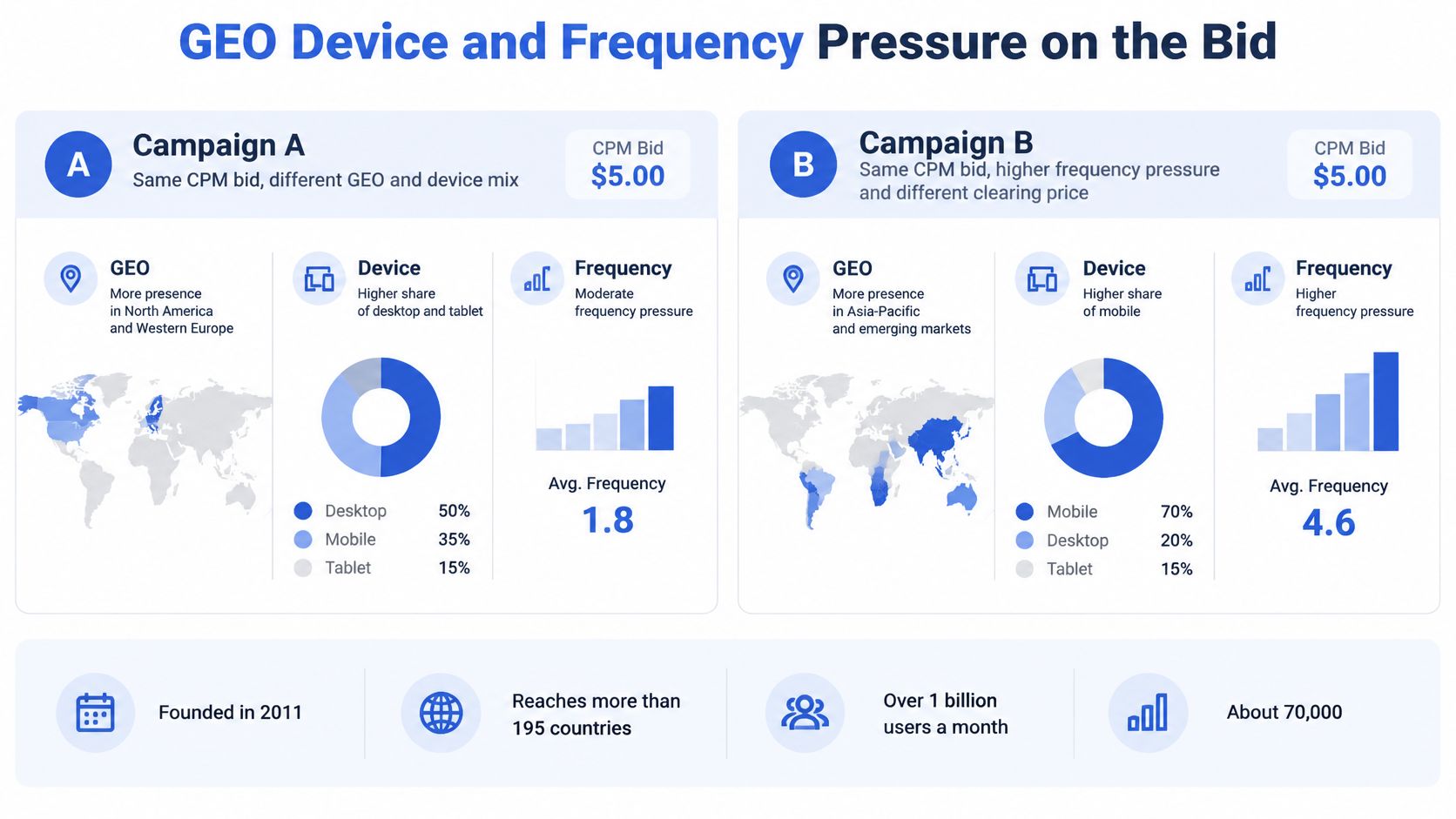
The same bid can buy different traffic once geography, device, and frequency settings change. PropellerAds reports a reach of more than 195 countries, over 1 billion monthly users, about 70,000 advertising campaigns per month, 60 million monthly conversions, and 32,000 active advertisers on its company page. Those figures describe the network's breadth, not the price or quality of any particular slice.
| Cut | Examples | Auction pressure | How to read the CPM |
|---|---|---|---|
| Tier 1 countries | United States, Canada, United Kingdom, Australia, Western Europe | Higher | Keep separate from lower-cost GEOs |
| Emerging markets | Countries across the network's footprint | Often lower headline CPM | Check CPA and traffic quality before scaling |
| City or state inside a country | A single metro versus nationwide | Can exceed the country average | Bid and report at the city or state targeted |
| Desktop | Desktop placements | Can differ from mobile | Track a separate eCPM |
| Mobile and iOS | Mobile web and iOS-device targets | Supply and conversion can diverge | Do not blend with desktop |
| Frequency cap | First impression versus a repeated user | Tighter caps can raise effective cost | Compare yield per user, not CPM alone |
Why the country label loses
Competitive demand can push prices higher in the United States, Canada, the United Kingdom, Australia, and Western Europe. A lower CPM in an emerging market is only a saving if the traffic produces acceptable conversions and lead quality. City or state targeting can also price above a national average, so a broad “US CPM” can conceal materially different auction conditions.
Mobile and iOS slices can diverge from desktop because their supply and conversion rates differ. Separate reporting by format, country, operating system, device, and date makes the comparison more useful. The same placement-level discipline applies to Facebook advertising revenue by placement, where a blended account average can obscure which inventory earns.
Frequency is a hidden rate
The first impression and the fifth may deliver different value. A tighter cap can reduce repeat exposure while raising the cost of each impression; a looser cap can make the CPM look cheaper as repeat users add volume. Compare yield per user alongside CPM before scaling. A live estimator or the campaign's own delivery is more useful than a country label alone.
Why the Same Settings Print a Different CPM
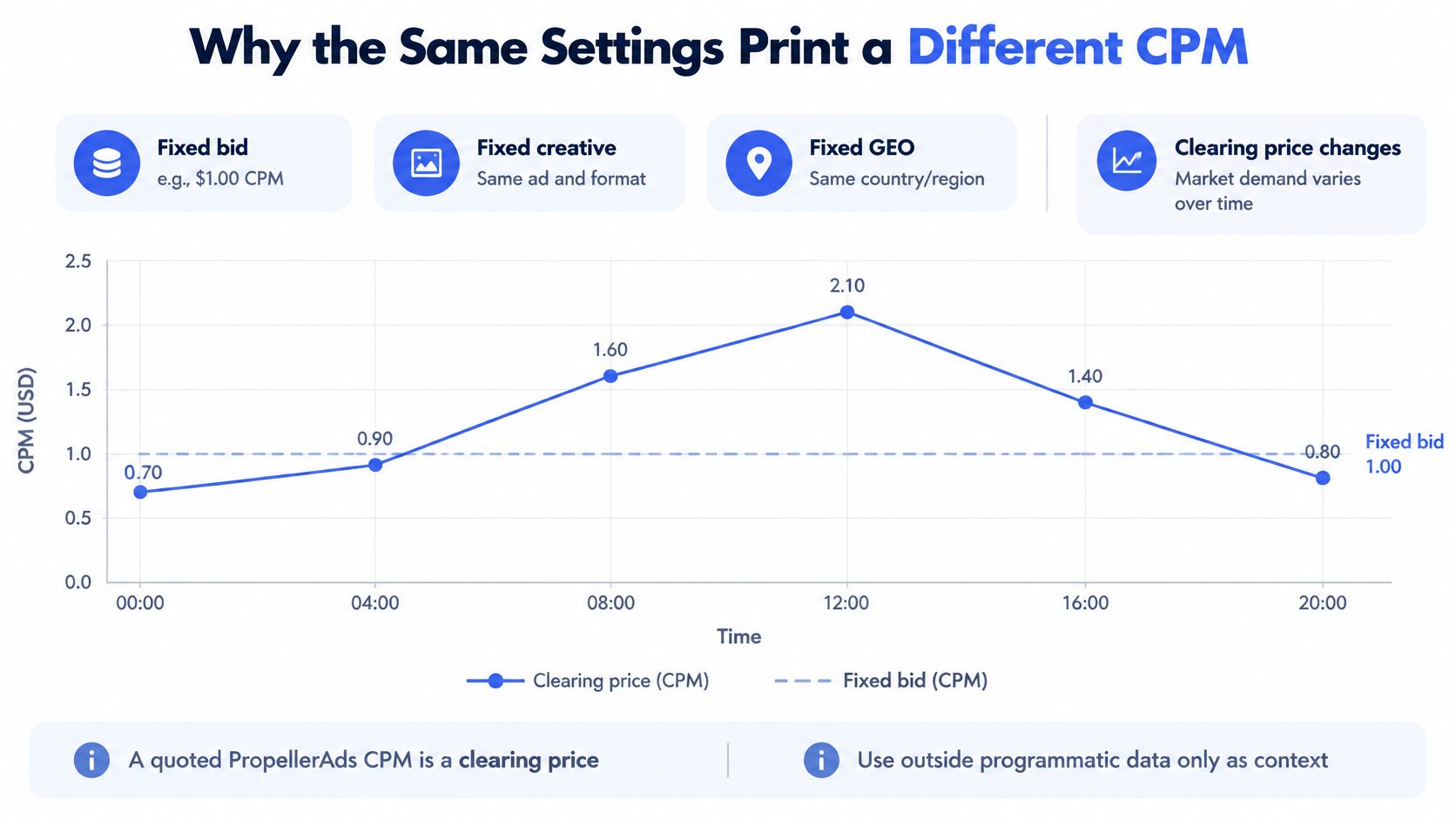
The same bid, creative, and GEO can clear at different CPMs because auction demand changes over time. Public market figures help explain that movement, but they are directional context, not a PropellerAds rate card.
What moved in the wider market
Databeat's December 2025 US programmatic trends recorded a 6.8% month-over-month rise in display CPM, a 1.9% rise in video CPM, and a 7.9% year-over-year increase in overall CPM. These movements show that demand can shift by format and time period. They do not predict the clearing price of a particular PropellerAds campaign. Supply, format mix, and competition determine local yield.
A fixed bid is not a fixed invoice. Log the traffic mix before deciding that the auction has changed.
How to separate season from mix
Compare daily prints with a seven-day rolling eCPM, then use the monthly view for budget decisions. A brief Q4 spike does not establish a new base rate; a January drop does not prove the campaign is broken.
If the traffic mix changes, isolate that effect before adjusting the bid. Keep format, country, and device cuts consistent across comparisons. Daily movement can flag a delivery issue, while the rolling view gives a steadier basis for bid decisions. Use the monthly view to judge budget-level changes, rather than letting one day reset the baseline.
Campaign Math From Deposit to Effective CPM
Self-serve forces an order. Mobidea's PropellerAds review describes setup as selecting a pricing model, entering the target URL, choosing countries or cities, and setting a bid. It also lists a $100 minimum deposit for credit-card funding and a $1,000 minimum for wire transfers. Card funding can isolate one GEO and one format. Wire funding tempts you to spread a large balance and then read a blended CPM that matches none of the rows.
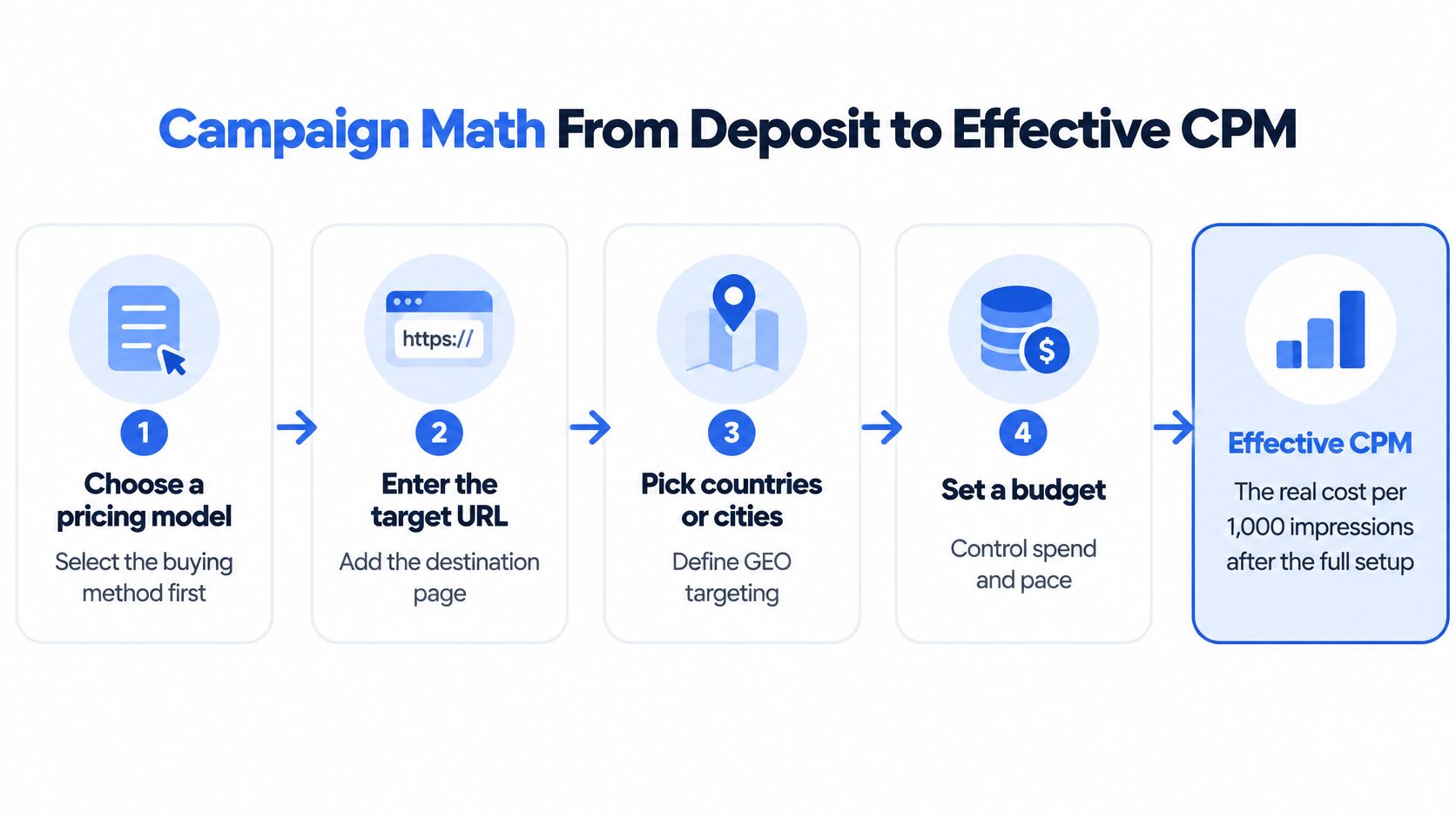
Fund, then name the cell
- Fund before you build. A card test can start near the card minimum. A wire test needs far more working capital, so do not launch five countries just to "use" the transfer.
- Choose the model in the campaign name. CPM, SmartCPM, CPC, CPA Goal, or a Smart CPA-style option. The invoice should say which promise you made.
- Enter one target URL with the tracker parameters you will reconcile. A second URL is a second test.
- Pick one country or city, then set the bid for that cut. GEO and bid are chosen at creation, so economics are country-level or city-level, not a network rate.
Say you run two separate $100 tests, not one blended pot.
- OnClick, cheaper GEO: 200,000 impressions. eCPM = 100 ÷ 200,000 × 1,000 = $0.50.
- Classic Push, Tier 1: 25,000 impressions. eCPM = 100 ÷ 25,000 × 1,000 = $4.00.
- Blended report: $200 and 225,000 impressions. eCPM = 200 ÷ 225,000 × 1,000 = $0.89.
That $0.89 sits near the popunder and conceals the $4 push cell. It flatters the expensive buy.
Reconcile before you believe it
Billed impressions × realised eCPM ÷ 1,000 should match spend, within rounding. If SmartCPM was on, compare average CPM with the cap so nobody pastes the cap into the cost column. If CPA Goal was on, ignore the pretty eCPM until cost per acquisition is on target. Name the campaign by model, format, and GEO so the charge ties back to the row you bought.
Cheap impressions still fail when the clicks are junk. Traffic quality insights from Securify are a useful check beside CPA, and the same split belongs in any read of what it costs to advertise online.
How to Optimize a PropellerAds CPM Test
Run one interpretable cell. PropellerAds' terms state that rates depend on the pricing model, impression frequency, ad placement, number of acquisitions, geographic targeting, and other campaign conditions. Self-serve advertisers must pre-fund the Advertiser Account, and the minimum deposit starts at $100 depending on the payment method. The nominal bid is only one input, and the test budget has to exist before delivery.
- Pre-fund, then stop. The deposit is in the account before the first impression, which protects you from launching a plan you cannot pay through.
- Write the model on the brief. Mark whether the number is a CPM, a SmartCPM cap, a CPC, or a CPA Goal, which protects the team from reporting a ceiling as a cost.
- Lock one format, one country or city, and one device. The first eCPM stays readable, which protects the comparison you will make on day three.
- Set frequency before launch. Frequency, placement, acquisitions, and geo are named rate drivers, which protects conversion rate from repeat impressions dressed up as reach.
- Spend past the noise, then compute eCPM from billed spend and delivered impressions, which protects you from a one-hour print.
- Line that eCPM up with CTR, conversion rate, and CPA. Kill or cap the cell when CPA misses even if CPM looks cheap, which protects ROAS from a flattering thousand.
- Add the next GEO or format as its own named campaign. That protects the original cell from becoming a blend the moment you "just add Brazil."
Three leaks that look like optimisation
Raising the bid because a Tier 1 CPM feels high next to a popunder average compares two products. Turning on CPA Goal and still optimising to CPM judges the diagnostic, not the goal. Reading a Q4 daily spike as a permanent price resets the base on seasonality.
The estimator is the pre-launch check. The invoice is the post-launch check.
Model spend by GEO, placement, frequency, and acquisition objective. Scale the cell whose CPA holds after the mix is stable, not the cell with the lowest CPM.
Decide Whether the CPM Is Worth Scaling
Scale only when three statements are true at once. The eCPM was computed from that campaign's spend and impressions. The cell is one format and one GEO, not a blend. CPA or ROAS still holds across a few days that are not a one-day auction spike.
Hold when SmartCPM is spending under the cap but conversion rate is still moving. Hold when a Q4 lift matches the wider market rather than a broken setup. Killing a learning cell because Tuesday cleared twenty percent higher than Monday throws away the only stable read you have.
Three actions you can check today
Scale when the week is one format, one country, one device, the billed amount reconciles to impressions times eCPM, and CPA is inside target on more than a single day.
Hold when the cap is not the average, the conversion rate has not settled, or the CPM move showed up in the wider auction while your mix stayed put.
Kill or rebuild when cheap OnClick clicks miss the CPA target, when a Tier 1 push CPM is being judged against an emerging-market popunder, or when spend will not reconcile. If the goal is a target acquisition cost, read CPA Goal and keep CPM as a diagnostic. If the goal is cheap reach, stay on CPM or SmartCPM and cap frequency so the second impression does not masquerade as new reach.
Export one week. Split by format, country, and device. Replace any borrowed average with the account's own eCPM. Fund the next test only for the row that survives that split.
If you are launching the Meta side of the same test matrix, Rapid Ads bulk-uploads creatives, locks naming conventions, and auto-disables Advantage+ changes that rewrite ads without notice, so the CPA you compare with a PropellerAds cell is not an artifact of Ads Manager drift. Media buyers use it to publish large creative sets across accounts without rebuilding each ad by hand. See how Rapid Ads fits the workflow before the next scale decision.