Most advice on costs to advertise online is too passive. It treats ad prices like weather: check the forecast, accept the increase, raise the budget, hope efficiency holds. That mindset breaks once you're buying media at scale.
The problem isn't that online ads are expensive in some abstract sense. It's that inefficient advertising gets punished harder every year. That matters because digital has become the centre of the market, not a side channel. Digital channels accounted for 72.7% of worldwide ad investment, global online ad spend exceeded US$790 billion in 2024, and total global ad spending was close to US$1.1 trillion, according to DataReportal's global advertising trends report. If you're managing budgets on Meta, Google, TikTok, or LinkedIn, you're not operating on the margin of media anymore. You're operating inside the main auction.
That changes how a serious media buyer should think.
Benchmarks still matter. You need them for planning, channel mix, and client conversations. But benchmarks don't tell you what part of your cost stack is fixed, what part is volatile, and what part is your fault. In practice, the winning operator isn't the one with the lowest quoted CPC. It's the one who controls targeting scope, creative fit, optimization event, landing-page continuity, and team execution well enough to turn auction prices into acceptable acquisition economics.
That's the useful lens for this topic. Not "what does it cost?" but which costs are controllable, which are not, and how do you push effective CPA down anyway?
Table of Contents
- Introduction
- Strategic Implications of Online Ad Pricing Models
- Digital Ad Cost Benchmarks for 2026
- The Five Levers That Directly Control Your Ad Costs
- How to Forecast and Budget for Ad Campaigns
- Advanced Tactics to Lower Your Effective CPA
- Conclusion: Mastering Cost Is Mastering Your Market
Introduction
Performance marketers hear the same line every quarter: costs are rising, so efficiency is getting squeezed. True, but incomplete. Rising costs don't kill accounts by themselves. Uncontrolled costs do.
A buyer who treats CPM, CPC, and CPA as fixed market facts usually ends up reacting too late. They widen targeting when performance drops, stack more spend behind weak creative, and blame seasonality for problems that started in the account structure. The platform takes that money happily.
The better view is simpler. Some costs are outside your control. Auction pressure, platform supply, competitor aggression, and seasonal demand all matter. But the largest day-to-day swings in account efficiency usually come from choices inside Ads Manager: the objective you optimize for, the audience logic you use, the creative you feed the system, the friction on the landing page, and the speed of your testing loop.
Practical rule: Don't ask whether costs to advertise online are high. Ask whether your campaign setup deserves the price you're paying.
That distinction changes how you budget and how you troubleshoot. It also stops you from overreacting to benchmark content that lists channel averages without explaining why one buyer pays them and another doesn't.
Strategic Implications of Online Ad Pricing Models
Most buyers know the definitions of CPC, CPM, and CPA. What matters in practice is that these aren't just reporting outputs. They're consequences of your optimization choice.
Optimization choice changes who enters your auction
Inside Meta Ads Manager, choosing a campaign objective and conversion event changes the pool of people Meta will prioritize. If you optimize for link clicks, you'll usually buy cheaper traffic than if you optimize for Purchase. That doesn't make it cheaper advertising. It often makes it cheaper delivery.
A click-optimized campaign tells Meta to find people likely to click. A Purchase-optimized campaign tells Meta to find people likely to complete the downstream action. Those are different users, different inventory pockets, and often different effective CPMs. The Purchase campaign may show a higher apparent cost at the impression or click layer, but a lower effective acquisition cost once post-click quality is included.
The same logic applies when teams optimize for Add to Cart too long. It can be useful during ramp-up, especially when signal volume is thin, but many accounts get stuck there. They celebrate lower top-line costs while inadvertently training the system toward a weaker proxy event.
When cheaper traffic is actually more expensive
A lot of budget often gets wasted. A buyer sees lower CPC from a broad traffic setup and assumes the account is improving. Then the landing page sees weaker sessions, lower intent, noisier attribution, and unstable blended performance.
A cleaner decision framework looks like this:
| Buying scenario | Metric that looks attractive | Metric that actually matters |
|---|---|---|
| New creative exploration | Lower CPM or CPC | Quality of downstream event rate |
| Prospecting for scale | Lower front-end cost | Stable cost per incremental purchase |
| Retargeting | Cheap conversions | Whether you're paying for conversions that would've happened anyway |
| Lead gen | Low CPL | Lead quality and sales acceptance |
| Search vs social mix | Lower click cost | Intent-adjusted acquisition cost |
Use CPM-led buying when your job is reach, message exposure, or creative signal collection. Use conversion-led buying when the business cares about revenue or qualified pipeline. Use click-led buying sparingly, mostly as a diagnostic tool or when the landing page event stream is too weak to support stable optimization.
Buyers don't get paid for winning cheap clicks. They get paid for buying outcomes the business can keep.
On Meta specifically, cost control often starts by resisting the temptation to optimize too high in the funnel just because the dashboard looks cleaner. If the account can support Purchase optimization, that's usually the most effective approach.
Digital Ad Cost Benchmarks for 2026
Benchmarks help with planning. They hurt performance when buyers treat them like targets instead of reference points.
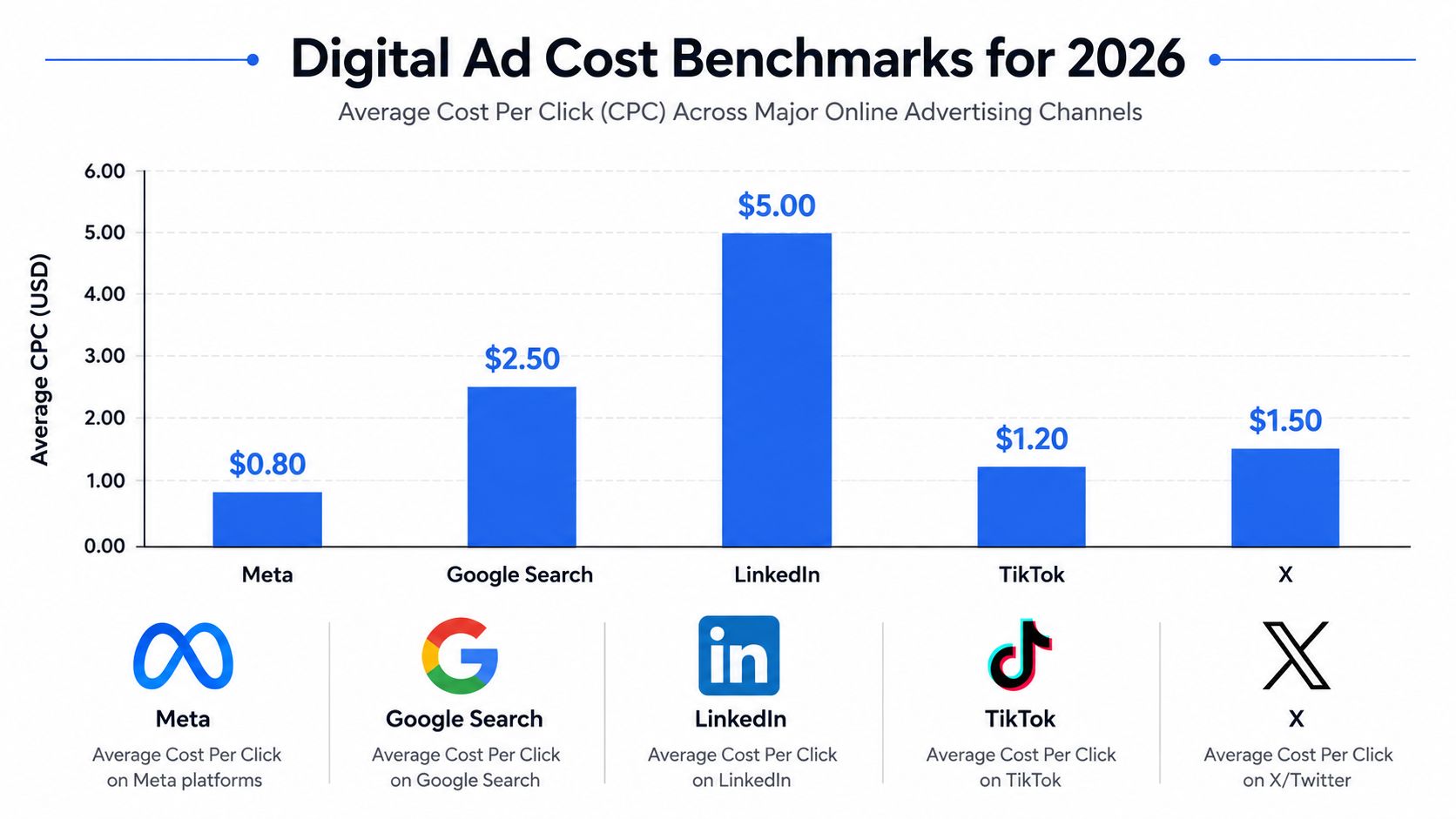
The useful question is not, "What does traffic cost on average?" It is, "Which parts of this price are set by the market, and which parts are penalties we are causing inside the account?" Platform-level pricing is only the starting point.
Cross-channel benchmark snapshot
Analysts at Aimers reported broad 2026 averages of roughly US$4.22 CPC on Google Ads, US$5.39 CPC on LinkedIn, US$1.03 CPC on Instagram, US$0.50 CPC on Facebook, US$9.16 CPM on TikTok, and about US$3.12 CPM on digital display.
Those numbers are directionally useful. They are not interchangeable buying economics.
A Google Search click is priced inside a demand-capture auction. A Facebook or Instagram click is usually priced inside an attention auction. LinkedIn charges a premium because inventory is narrower and audience filters are tighter. TikTok often buys cheap reach, but the creative burn rate and conversion path can make the effective acquisition cost look very different from the CPM.
| Platform | Reported benchmark | What is mostly market-driven | What the buyer can still influence |
|---|---|---|---|
| US$0.50 CPC | Large inventory supply, broad user base | Creative relevance, placement mix, conversion signal quality | |
| US$1.03 CPC | Visual-first competition, denser premium placements | Hook rate, format fit, audience overlap | |
| Google Ads | US$4.22 CPC | High intent, keyword competition | Match type discipline, query filtering, landing page quality |
| US$5.39 CPC | Narrow supply, expensive professional targeting | Audience construction, offer specificity, lead quality thresholds | |
| TikTok | US$9.16 CPM | Video inventory pricing, fast content turnover | Creative volume, first-frame strength, post-click path |
| Display | US$3.12 CPM | Broad awareness inventory, lower intent | Site quality controls, frequency, retargeting logic |
What buyers should actually take from these numbers
Use benchmarks to set guardrails, not goals. If Meta CPC is below platform average but purchase rate is weak, the account is not winning. It is buying low-quality traffic cheaply. If Google CPC is high but search terms convert profitably, the higher click price is doing its job.
This is the split that matters:
- Uncontrollable costs: seasonal auction pressure, channel-wide inventory scarcity, category competition, geo-level demand spikes
- Controllable costs: weak creative, poor offer-message match, bad placement fit, low-quality event signal, wasteful audience structure, conversion friction after the click
That distinction changes how a media buyer reads benchmark data. A higher CPM during Q4 is often market pressure. A high CPM on one ad set while similar ads in the same account clear cheaper is usually an account-level problem. A high CPC on branded search can be acceptable. A high CPC on broad non-brand terms with weak conversion rate usually signals poor traffic quality or loose query control.
Platform benchmarks by themselves miss the real cost stack
The sticker price of media is only one layer. Effective cost comes from the full chain: impression cost, click quality, landing page conversion rate, checkout completion, and incrementality. Buyers who stop at CPC usually end up scaling the wrong thing.
For DTC teams, that matters most on Meta and TikTok. Low front-end costs can hide expensive outcomes if the traffic is weak, the creative attracts curiosity clicks, or the site fails to convert mobile sessions efficiently. Search often shows the opposite pattern. You pay more upfront because the user arrives with clearer intent.
A practical rule is simple. Compare channels on cost per qualified outcome, not on click price alone. Benchmarks tell you what the market is charging to enter the auction. They do not tell you whether your setup deserves to pay less, or is forcing the platform to charge you more.
The Five Levers That Directly Control Your Ad Costs
Higher ad costs usually are not a platform tax you absorb. In a well-run account, a meaningful share of cost comes from setup choices inside your control. The job is to separate auction pressure from self-inflicted inefficiency, then fix the parts the platform is pricing against you.
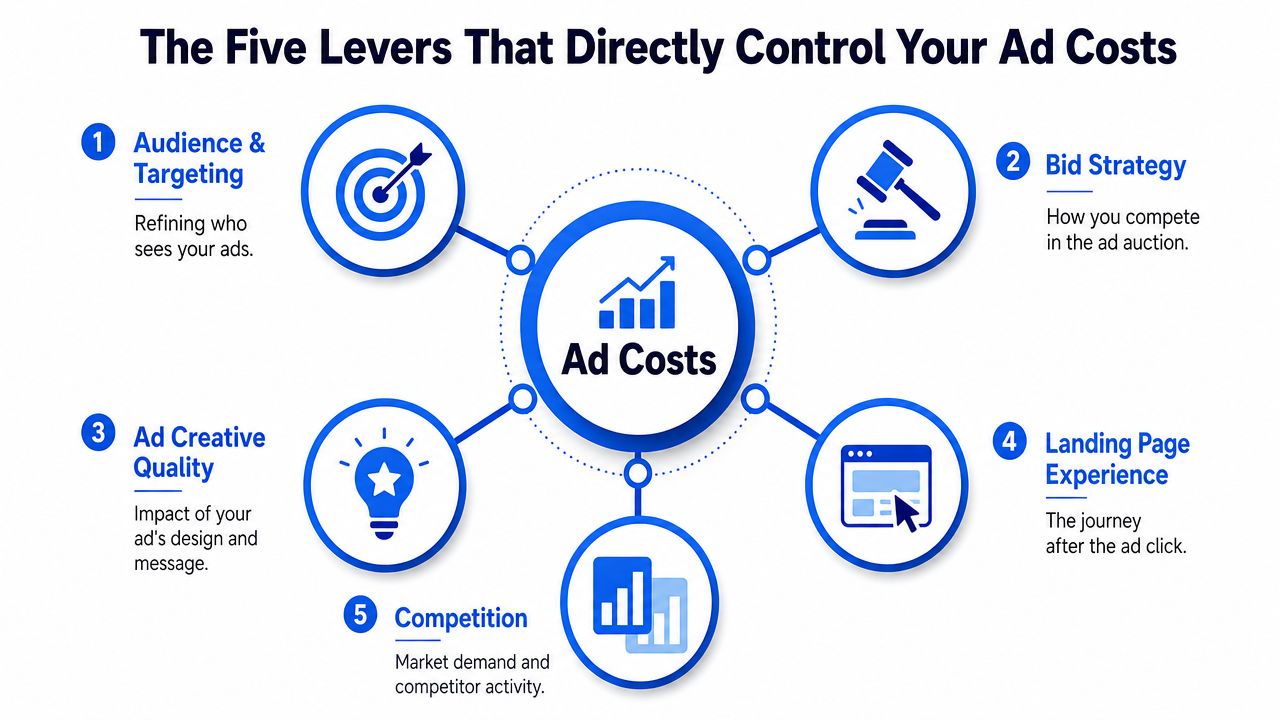
Audience and targeting
Audience structure controls two things at once. Who gets into the pool, and how much waste the system has to chew through before it finds buyers.
Broad can be efficient. It often is. But broad only works when the offer is clear, the creative pre-qualifies the user, and the account has enough conversion signal to teach the algorithm what a good customer looks like. If those pieces are weak, broad targeting turns into expensive exploration.
The opposite mistake is overbuilding the account. Stacked interests, tiny exclusions, and too many segmented ad sets reduce delivery, create overlap, and push spend into narrower inventory where CPMs and CPAs get worse.
A cleaner Meta workflow is to separate audiences by job:
- Broad prospecting for products with wide appeal and creative that does the filtering
- Customer-derived audiences when first-party seed quality is strong enough to justify a modeled expansion
- Retargeting with tight windows and careful exclusion logic
- Geo splits when one region distorts blended results or needs a different offer
If costs rise in one campaign and not another, start here. Audience design often explains whether the system is buying efficiently or paying a penalty to find the right user.
Bid strategy and optimization
Bid strategy sets the trade-off between volume and control. Lowest cost usually wins on delivery. Cost caps can protect CPA. Bid caps give tighter control but are easier to choke, especially if the cap reflects finance targets instead of auction reality.
The bigger lever is optimization event selection.
If the account is optimized to a weak proxy, the platform will get more of that proxy. Cheap landing page views, low-cost add-to-carts, or form opens can make the front-end numbers look healthy while purchase efficiency gets worse. Optimizing to the closest real business event often raises apparent costs up top and lowers effective CPA at the bottom. That is usually the right trade.
Inside Meta Ads Manager, check three things before changing bids: event volume, attribution lag, and learning stability. A cost cap set too close to the historical median on an event with low daily volume usually restricts delivery. In that situation, the bid strategy is not controlling cost. It is starving the system.
Ad creative quality
Creative is not a branding side project. It is one of the main price-setting inputs in paid social.
Strong creative improves cost in multiple ways. It earns attention fast, filters out low-intent clicks, improves click-through quality, and gives the algorithm better signals about who responds. Weak creative does the reverse. You pay for impressions that do not convert, then pay again through poorer downstream optimization.
The practical standard is simple. Every ad should answer three questions within seconds: what is the product, who is it for, and why act now?
That means testing specific variables, not vague concepts. Test the hook angle, the first frame, the offer structure, the proof type, the on-screen copy density, and the landing page handoff. Creative that wins in Stories may fail in Feed. UGC-style ads may beat polished brand spots for prospecting, then lose in retargeting where product detail matters more. Placement fit matters because the same message can perform very differently depending on format and user intent.
If the ad does not qualify the click before the click happens, the account pays for that confusion later.
Landing page experience
Media buyers who treat the landing page as someone else's problem usually end up overpaying for traffic. Post-click conversion rate is one of the fastest ways to change effective CPA without touching bids.
The failure pattern is familiar. The ad sells one angle. The landing page opens with a different message, loads slowly on mobile, hides the price or offer, and asks the user to do too much before trust is built. The platform reads that poor post-click behavior and adjusts accordingly.
Review landing pages like part of the media account. Check load speed on mobile networks, message match from ad to hero section, product page clarity, variant selection friction, cart behavior, checkout steps, and payment option visibility. Small fixes here often outperform another week of audience testing because they improve the economics of every click you already buy.
Competition
Competition is the least controllable lever, but it still has to be managed. Seasonal demand, category crowding, and aggressive bidding from larger advertisers can raise your costs even when the account is healthy. The mistake is reacting with brute force.
A better response is operational discipline. Tighten reporting windows during volatile periods. Reallocate spend toward creative and audience combinations that hold conversion quality, not just low CPC. Cut unnecessary segmentation so the system has room to find cheaper conversions. Split out geos, offers, or products that need different economics instead of forcing one blended campaign to absorb all the pressure.
This is also where senior buyers earn their keep. They know which costs are unavoidable and which ones are optional. Market pressure is unavoidable. Paying premium CPMs for weak creative, noisy audience structure, bad optimization signals, or a leaky landing page is optional.
Keep the distinction clear, and cost control gets a lot more practical.
How to Forecast and Budget for Ad Campaigns
Forecasting does not fail because media buyers lack spreadsheets. It fails because too many plans treat spend as the input and performance as a surprise.
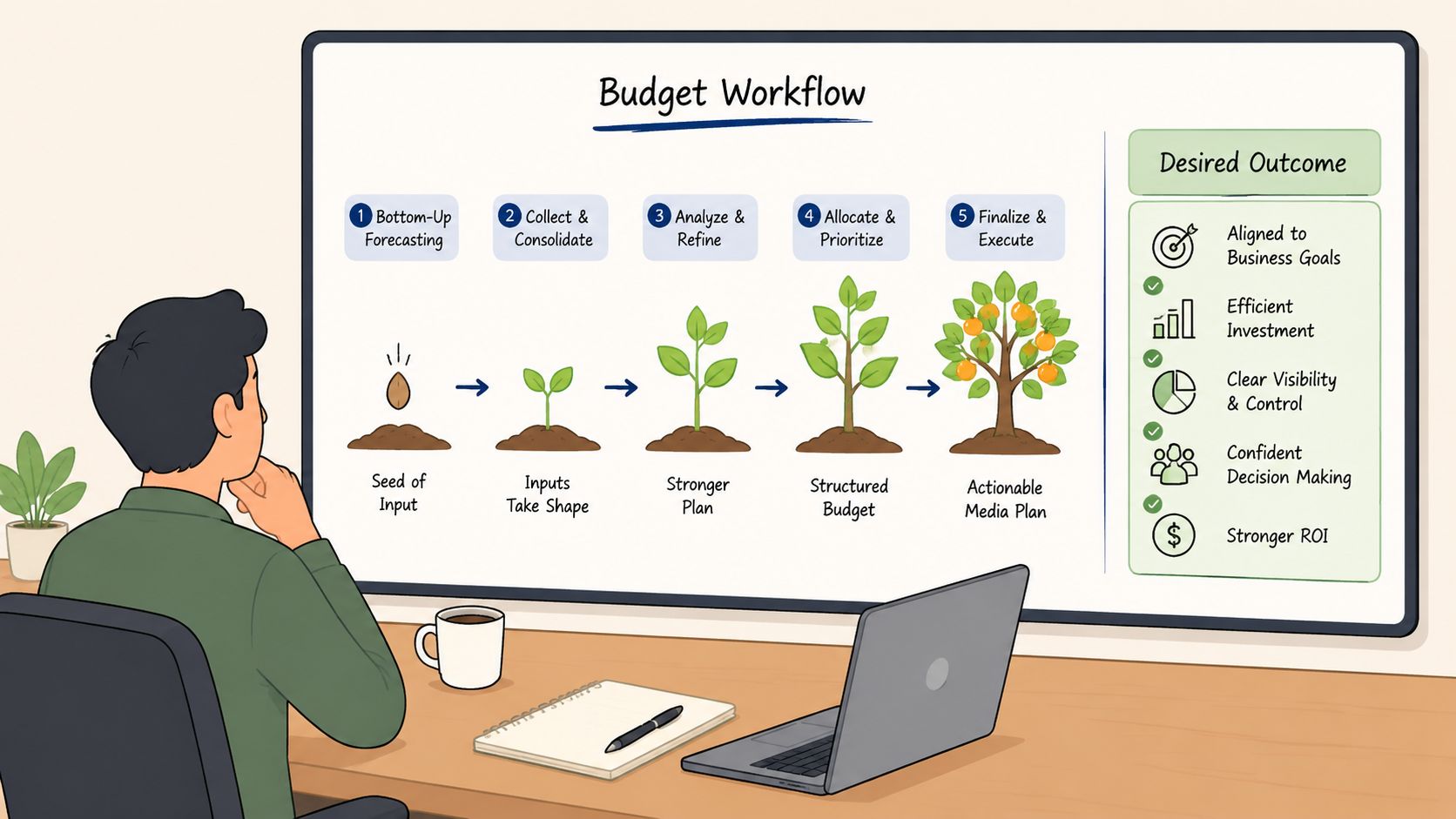
The practical way to budget is to split costs into two buckets. First, the costs you cannot control directly, such as auction pressure, seasonality, and category demand. Second, the costs you can control, such as conversion target selection, creative output, landing page conversion rate, offer structure, and how quickly you cut weak spend. Good forecasts separate those buckets so the team knows what needs monitoring versus what needs fixing.
Build the forecast from the business outcome backward
Start with the event the business values. In DTC, that is usually purchase. In lead gen, it is often a qualified lead or booked call, not a raw form fill.
Then work backward through the funnel using account data, not platform defaults. A usable forecast usually includes:
- Target output. Orders, qualified leads, or revenue contribution needed for the period.
- Efficiency guardrails. Target CPA, MER, contribution margin threshold, or payback window.
- Conversion assumptions. Site CVR, checkout completion rate, lead qualification rate, and AOV.
- Traffic assumptions. CPC or CPM ranges by campaign role, not one blended figure.
- Scaling assumptions. How performance changes if spend rises 20 percent, 50 percent, or more.
That last point gets missed often. The account that spends $500 a day efficiently may not hold the same economics at $2,000 a day if creative fatigue hits, frequency climbs, or the landing page cannot convert broader traffic.
For Meta, build this model by campaign role. Prospecting, retargeting, catalogue, and promo pushes should each carry their own assumptions. If all spend sits in one blended forecast, you lose the ability to explain variance and fix it quickly.
Use ranges and decision rules
A single CPA target looks clean in a deck and causes problems in practice. Costs move. Conversion rates move. Inventory quality changes week to week.
A better plan uses a base case, upside case, and stressed case. The point is not to predict the exact number. The point is to decide in advance what the team will do under each condition.
Here is the minimum standard for a budget model:
| Forecast component | What to include |
|---|---|
| Spend plan | Daily or weekly budget by campaign role |
| Traffic range | Expected CPC or CPM range based on recent account data |
| Funnel rates | Landing-page CVR, checkout completion, lead quality rate |
| Output range | Orders, qualified leads, revenue, blended CPA or MER |
| Response rules | Spend cut thresholds, scale triggers, creative refresh timing |
Response rules matter as much as the math. If prospecting CPA rises 25 percent above plan for three days, what happens? If CTR holds but CVR drops, does spend stay live while the CRO team fixes the page, or does the buyer cut budget and protect blended efficiency? Budgeting without these rules produces slow decisions, and slow decisions raise effective costs.
Budget the controllable costs with the media
Media spend is only part of the plan. Creative production, landing-page testing, and reporting time all affect the CPA you end up paying.
I budget those inputs with the campaign because they are cost-control tools, not overhead. If a brand plans to scale spend but funds only one new concept every two weeks, the forecast is already weak. If the landing page has known friction and no dev time is allocated, the forecast is overstating likely return.
A useful budget answers two questions at the same time. How much can the brand afford to spend on traffic, and how much does the team need to spend to keep that traffic efficient?
Example planning logic for a DTC account
A clean forecast can be simple. Suppose the brand needs a purchase CPA that supports margin. The buyer estimates traffic costs from recent account history, applies separate conversion assumptions for prospecting and retargeting, and then models what happens if CPMs rise during a promotion window.
If the stressed case still fits margin, the budget is viable. If it only works in the best case, the problem is not the spreadsheet. The problem is the operating plan.
That is the core discipline. Forecast the uncontrollable costs as ranges. Budget the controllable costs as active line items. Then manage the account against pre-set rules instead of reacting after the damage is already in the numbers.
Advanced Tactics to Lower Your Effective CPA
Cheap CPAs rarely come from finding some hidden audience. They come from controlling the parts of the system your team owns.
Auction pressure, seasonality, and category competition will move against you at times. You do not control that. You do control test speed, setup accuracy, creative routing, naming hygiene, and how quickly weak ads get replaced. Those inputs shape effective CPA more than another round of benchmark reading.
Testing velocity lowers CPA only if the tests are clean
Higher CPMs punish slow teams first. If the market gets more expensive, every extra day spent waiting on uploads, fixing names, or rebuilding the same ad structure across accounts increases the cost of learning.
Inside Meta, lower effective CPA usually comes from getting fast, reliable answers to a short list of questions:
- Hook fit: Which opening earns qualified attention from cold traffic?
- Format fit: Does the idea work better as 9:16 video, 1:1 static, carousel, or Flexible Ads?
- Offer fit: Does this audience respond better to discount framing, bundles, proof, or problem-solution messaging?
- Placement fit: Are Feed and Reels different enough to justify separate treatment?
That sounds basic. In practice, a lot of accounts fail here because the workflow is too manual to support enough creative throughput. The team ends up protecting average ads because replacing them takes too much effort.
Meta workflow mistakes raise costs in small increments
A lot of CPA inflation starts before delivery data is even useful.
I see the same issues repeatedly in scaled DTC accounts:
- Settings drift: Meta enhancements or default options change the ad that was approved in the test plan.
- Broken naming logic: Angle, creator, offer, and format are missing from the ad name, so post-launch analysis gets muddy.
- Cross-account inconsistency: Different markets use different conventions, which makes transfer learning weaker.
- Aspect ratio mismatch: Creative built for one placement gets pushed into another, and the test loses validity.
These are media buying issues, not admin issues. If the launched asset does not match the intended variable, the readout is contaminated. Then the buyer makes the next budget decision on bad inputs.
Clean experimentation produces cheaper decisions.
Build a launch process that protects signal quality
The practical fix is process discipline inside Ads Manager and around it.
Use a naming architecture that surfaces angle, offer, format, creator, audience, and market in the ad name. Split concept tests from offer tests and format tests so each batch answers one question. Standardize account settings across markets before launch, not after results come in. Publish enough creative volume each week that the account is not forced to rely on stale winners. Archive old ads aggressively so fatigue patterns and replacement decisions stay visible.
Strong teams distinguish themselves from busy teams. The busy team launches a lot of ads. The strong team launches ads in a way that makes the result interpretable.
Use tools when they remove friction from the system
For buyers managing heavy Meta output, workflow software can reduce effective CPA if it improves execution quality. Bulk creative uploads, multi-account launching, naming enforcement, UTM automation, and controls that prevent unwanted Advantage+ creative settings from being switched back on all protect test integrity.
The value is operational, not cosmetic. If a tool saves hours but introduces messy structures, it is not helping. If it lets the team launch faster while keeping variables clean, it improves the account's learning rate. That usually shows up later as lower blended CPA, fewer false positives, and less spend trapped in mediocre ads.
The pattern is consistent across strong accounts. Teams that control the controllable costs inside the workflow usually defend margin better than teams that spend all their time reacting to the uncontrollable ones.
Conclusion: Mastering Cost Is Mastering Your Market
The cost to advertise online isn't a fixed number waiting to be discovered. It's a moving output of auction pressure, targeting choices, creative quality, optimization logic, landing-page continuity, and team execution.
That's why generic benchmark articles only get you halfway there. You do need market reference points. You do need to know that different platforms price intent, audience precision, and inventory very differently. But efficient operators don't stop at reference points. They build systems that turn volatile auction inputs into stable acquisition outcomes.
A strong media buyer treats cost like a variable to manage, not a tax to endure. That means choosing the right optimization event, reading benchmarks with context, tightening the five controllable levers, budgeting with ranges instead of fantasy precision, and removing workflow drag that slows testing.
In a crowded auction, the edge usually goes to the team that learns faster and launches cleaner. That's what cost control really is. Not cheap traffic. Better decisions, repeated at speed.
If your team is launching Meta campaigns at scale, Rapid Ads is worth a look. It solves the workflow problems that push effective CPA up in practice: bulk creative uploads, multi-account management, enforced naming conventions, and keeping Advantage+ creative settings from unintended drifting during launch. For agencies, in-house growth teams, and high-volume media buyers, that kind of execution speed gives you more time for testing, analysis, and scaling the ads that deserve budget.