An ad set is Meta's middle management layer where audience, budget, placements, schedule, and bid controls are set, and every ad below inherits those delivery constraints. In practice, the strongest structures increasingly use fewer ad sets with broader audiences and more creative variation, rather than multiplying narrow segments.
You've probably seen the failure mode. A launch starts with dozens of audience splits, a large creative batch, separate retargeting logic, and carefully chosen placement controls. A few days later, delivery is uneven, several ad sets are learning limited, reporting is difficult to reconcile, and Meta has enabled or altered an Advantage+ setting you thought you had disabled. The issue often isn't the quality of the ads. It's the amount of signal each ad set receives and the number of competing structures you've created around it.
For performance marketers, ad sets in Facebook are no longer just filing cabinets between campaigns and ads. They're active delivery controllers. Their structure affects auction overlap, learning stability, creative distribution, budget control, and the amount of conversion data available to Meta's optimisation system.
Table of Contents
- Why Ad Set Structure Determines Your ROAS Stability
- Understanding Meta's Three-Tier Campaign Hierarchy
- Scaling Ad Set Workflows Without Losing Control
- Learning Phase Dynamics and Conversion Volume Requirements
- Naming Conventions and Bulk Import Workflows
- The Consolidation Strategy - Fewer Ad Sets, Better Performance
Why Ad Set Structure Determines Your ROAS Stability
A fragmented account can look complex while producing weak decision data. If you launch a large creative portfolio across many narrow ad sets, each segment competes for a limited pool of impressions and conversions. Meta may have plenty of total account activity, but each individual ad set can still lack the events required to make reliable delivery decisions.

Treat the ad set as the point where your campaign strategy becomes an auction configuration. The campaign establishes the objective and, with CBO, the budget framework. The ads provide the creative variables. The ad set determines who can see the ads, where delivery can occur, how much money is available, when delivery runs, and how Meta bids.
The daily operating sequence
Start with the business constraint, not the audience list. Decide whether the account needs one broad prospecting pool, a distinct retargeting pool, a geographic separation, or a genuinely different optimisation event. Every additional ad set should have a reason that changes delivery or measurement.
Then inspect the inherited settings. If three ads sit inside one ad set, they share its audience, placements, schedule, budget or budget allocation, and bidding controls. A creative winner can improve performance within that environment, but it can't escape the audience and auction conditions imposed above it.
Finally, separate structural problems from creative problems. If every ad in an ad set is volatile, the audience, budget, event, or auction conditions may be the constraint. If one ad is weak while others are stable, the issue is more likely creative. That distinction prevents unnecessary duplication of ad sets when the answer is a better creative portfolio.
Practical rule: Create a new ad set only when you need a materially different delivery environment, not because a label or minor interest variation feels cleaner.
This is also why creative production and ad set design now need to be planned together. A broad ad set can only benefit from creative diversity if the assets communicate distinct angles, formats, hooks, and offers. For teams refining their video portfolio, this resource on social media video ads that convert is useful because the creative input remains a core part of the broader delivery system.
ROAS stability comes from reducing unnecessary sources of volatility. That means fewer avoidable edits, enough budget and duration for the chosen objective, and an ad set structure that lets Meta compare meaningfully different ads inside a coherent auction pool. You're not giving up control. You're moving control to the variables that still matter operationally.
Understanding Meta's Three-Tier Campaign Hierarchy
Meta's structure has three levels: campaign, ad set, and ad. The campaign defines the marketing objective and, depending on the buying setup, the budget architecture. The ad set is the middle control layer. The ad is where the user-facing creative and copy live.
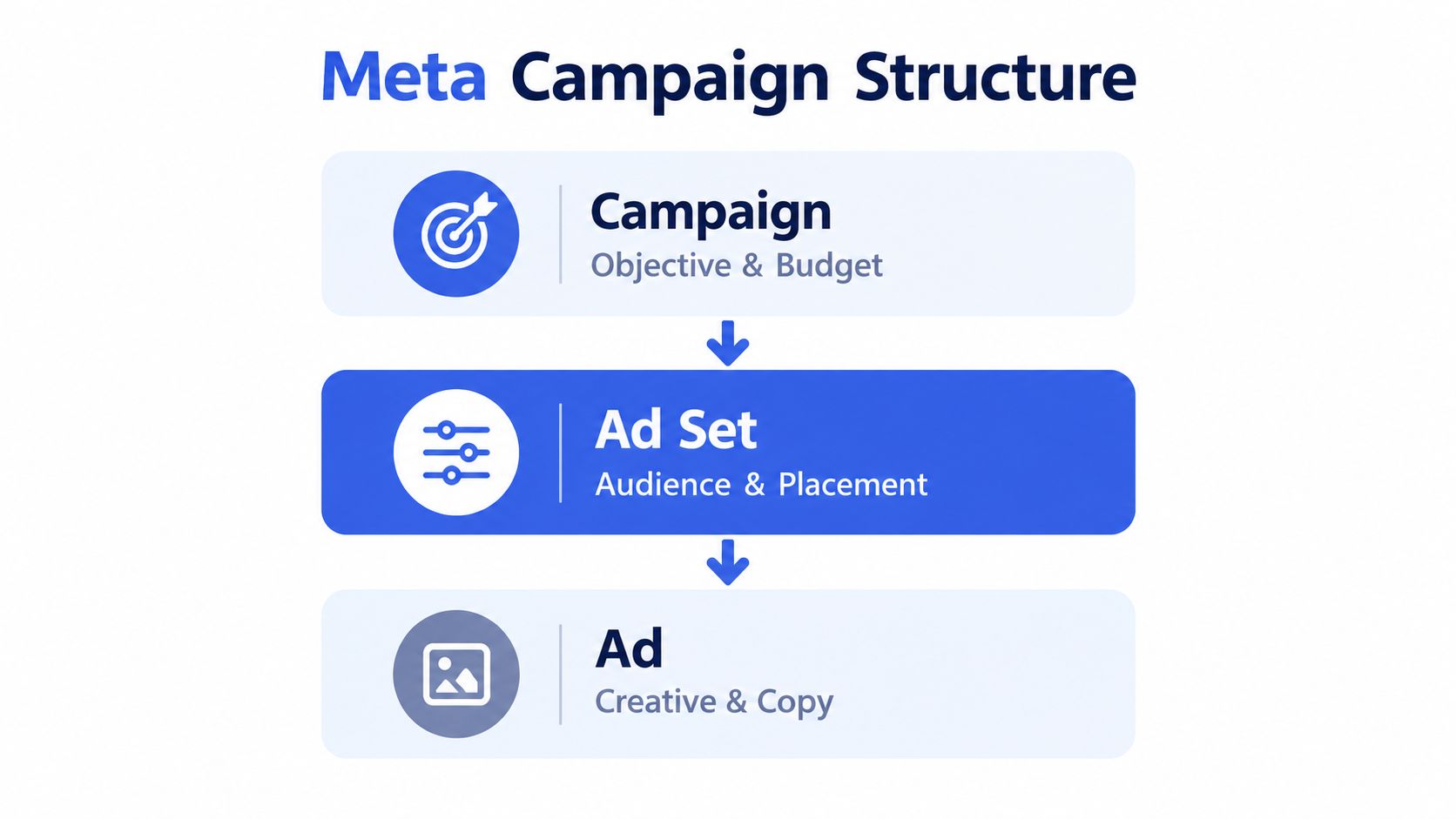
Meta describes ad sets as groups of ads that share settings, with ad set-level choices automatically applying to every ad in that set. The Meta ad set level overview makes the operational distinction clear. The ad set isn't merely a reporting label. It's where delivery constraints are defined.
| Level | Primary role | Operational consequence |
|---|---|---|
| Campaign | Objective and budget framework | Establishes the optimisation direction and budget context |
| Ad set | Audience, budget, schedule, placements, and bidding | Defines the auction pool and conditions shared by its ads |
| Ad | Creative, copy, format, and call to action | Supplies the message Meta tests within the ad set environment |
Suppose a campaign contains two ad sets, one broad prospecting pool and one retargeting pool. Each has three ads. Changing the prospecting ad set's location, placements, optimisation event, or cost control affects all three ads in that group. It also changes which impressions they can compete for, while leaving the retargeting environment untouched.
That's why ad set changes deserve more caution than ad edits. A new thumbnail changes one ad's creative input. A new audience definition changes the auction pool for every ad below the ad set. Meta's auction evaluates each eligible impression in real time against competing ads targeting the same people, so audience definition can influence overlap, delivery opportunities, and cost efficiency.
Where budget decisions fit
With ABO, the ad set receives its own budget and schedule. That gives the buyer direct allocation control, but it also means each ad set needs enough room to generate useful optimisation events. With CBO, Meta allocates campaign budget across eligible ad sets, but the ad sets still define the audiences, placements, and bidding conditions that shape where that budget can go.
Meta's guidance on auction and delivery performance connects effective delivery with the right objective, targeting, budget, duration, and creative. Those inputs interact. A technically correct objective won't rescue an ad set whose audience is too constrained or whose budget is spread across too many competing structures.
Use ad set reporting to answer operational questions, not just to rank CPA. Compare whether one audience is absorbing spend, whether placements are creating delivery differences, and whether creative variation is being evaluated inside comparable conditions. If the ad sets aren't comparable, the resulting performance table can create false confidence.
The hierarchy remains useful because each level answers a different question. Campaign, what are we optimising for? Ad set, under what delivery conditions? Ad, which message and asset should win?
Scaling Ad Set Workflows Without Losing Control
A small test can stay manageable in Ads Manager. A launch with many images, videos, copy variants, UTM parameters, placement formats, and markets creates a different operating problem. Repeated production work pulls attention away from media decisions, while small setup errors can later distort reporting.
The practical comparison is clear:
| Workflow area | Manual Ads Manager | Bulk workflow |
|---|---|---|
| Creative upload | Add assets repeatedly and verify each preview | Upload images, videos, and copy in a grouped batch |
| Ad set assignment | Sort assets manually | Apply predefined grouping logic |
| Naming | Type names one by one | Enforce a repeatable naming pattern |
| Placement formats | Check feed, Reels, and Stories compatibility manually | Route assets according to their aspect ratio |
| Settings control | Recheck Advantage+ and other defaults after edits | Apply defined defaults before publishing |
| Multi-account execution | Repeat the process account by account | Manage launches from a central workflow |
Bulk execution is useful only when the underlying structure is already defined. The workflow should preserve the connection between each creative, its ad set, placement logic, naming convention, and tracking parameters. Otherwise, faster publishing just produces a larger batch that requires manual reconstruction.
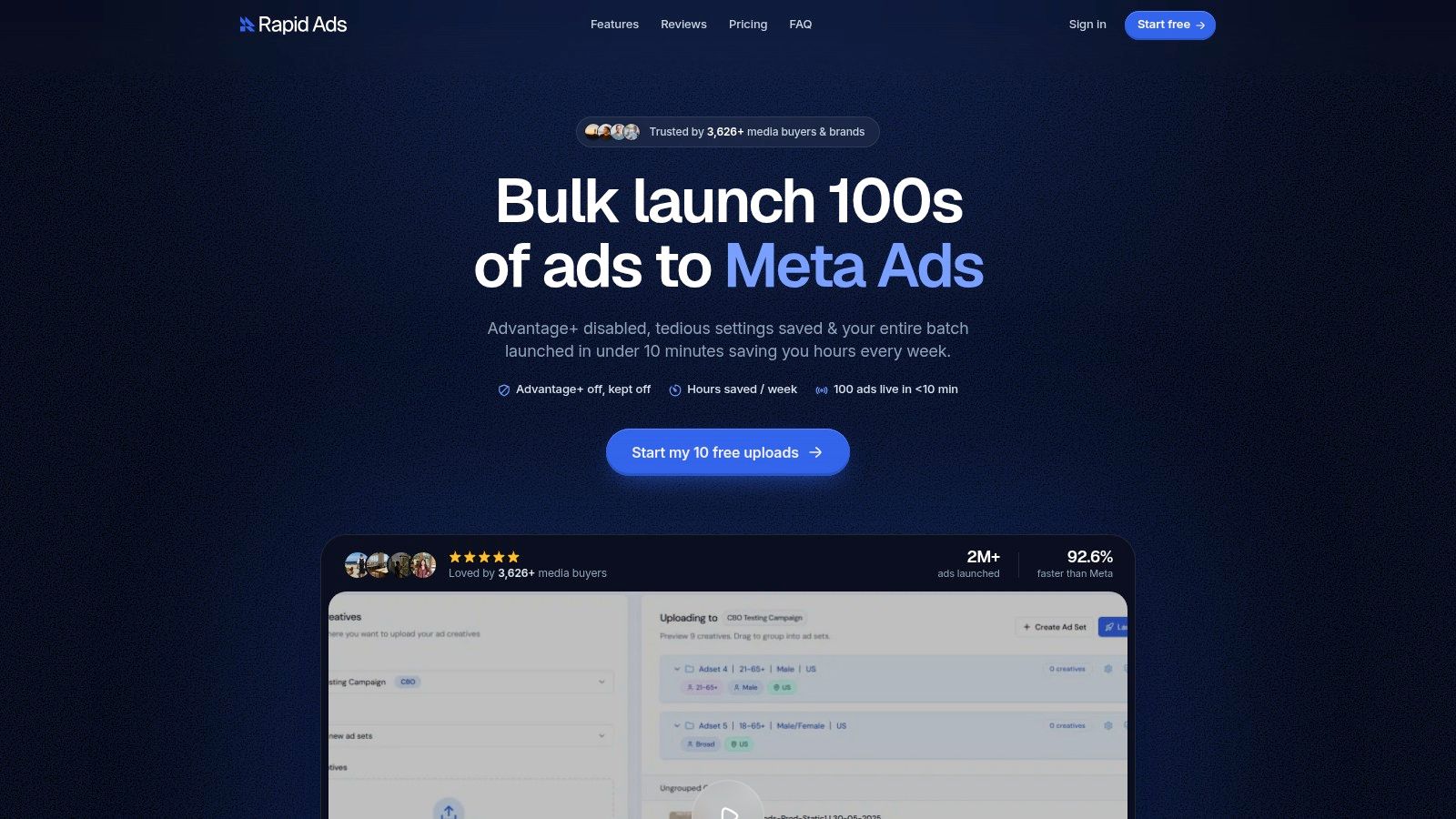
Rapid Ads is one option for this workflow. It lets teams drag and drop images, videos, and copy in bulk, group creatives into ad sets, apply naming conventions at ad and ad set level, attach UTM tags, and manage multiple ad accounts from one dashboard. Its aspect-ratio detection can route 1:1 and 9:16 assets into the intended ad set structure, which helps when a launch combines feed, Reels, and Stories creative.
Automation should accelerate a known structure, not conceal it. Before publishing, validate the campaign objective, ad set audience, budget model, optimisation event, placement rules, and naming template. A fast upload has limited value if analysts cannot interpret the resulting account.
A controlled publishing workflow
- Prepare the asset matrix. Map each creative to its concept, format, market, and intended ad set.
- Define the ad set template. Set the audience, placements, schedule, budget logic, bid controls, and optimisation event.
- Apply naming before upload. Identify what each asset represents before the ads go live.
- Validate a small sample. Check copy, URLs, tracking, placements, and Advantage+ settings before batch publishing.
- Publish and monitor structure first. Confirm that spend reaches the intended ad sets before judging creative winners.
The tool matters less than the controls around it. A sound bulk workflow removes repetitive clicks while making deviations visible before they affect delivery or reporting.
Learning Phase Dynamics and Conversion Volume Requirements
The learning phase is where Meta's delivery system gathers enough information to improve bidding and audience selection. An ad set can become learning limited when its audience is small, budget is low, bid or cost controls are restrictive, auction overlap is high, or too many ads run simultaneously. Meta lists these constraints in its learning phase guidance.
That creates a structural problem for granular accounts. You might have meaningful conversion volume at campaign level, but if it's divided across many ad sets, individual ad sets may not receive enough events to stabilise. Performance then swings between expensive delivery, underdelivery, and inconsistent CPA.
Why edits create instability
A buyer often reacts to volatility by editing the exact settings that need time to settle. Targeting changes, large budget changes, creative changes, optimisation-event changes, or bid-control changes can disrupt the current learning cycle. The result is a sequence of resets rather than a clean test.
Use a change hierarchy:
- Creative issue: Replace or add ads inside the existing structure when the audience and delivery environment remain valid.
- Budget issue: Adjust allocation deliberately, then avoid repeated small changes that make the account difficult to read.
- Audience issue: Consolidate or broaden where fragmentation is restricting delivery.
- Objective issue: Rebuild only when the campaign is optimising for the wrong business event.
Meta recommends combining ad sets and campaigns, expanding the audience, raising budget, or selecting a more frequent optimisation event when delivery is limited. Those options point to a broader principle: increase signal density before adding complexity.
Creative diversity gives a consolidated ad set more ways to find a response without forcing the buyer to create a new audience bucket for every message. Different hooks can appeal to different people inside the same broad pool. Different formats can also create more opportunities across placements, provided the assets are adapted rather than minor duplicates.
Frequent structural edits make performance harder to diagnose because you're changing the environment and the variable being tested at the same time.
A stable workflow therefore separates test design from account churn. Keep the ad set environment coherent, add meaningful creative variation, and use reporting to determine whether the limitation is audience reach, auction access, event frequency, or message quality.
Naming Conventions and Bulk Import Workflows
A naming system earns its place when a buyer can identify the delivery environment without opening every settings panel. Treat naming as measurement infrastructure, especially as consolidated structures make creative-level reporting more important than audience-level labels.
Use a fixed token order:
[Market]_[Objective]_[Audience]_[Placement]_[Bid]_[Test]
For example:
UK_Sales_Broad_AutoPlacements_CostCap_CreativeAngles
The tokens can change by account, but their order should remain stable. Keep campaign names focused on the objective and budget architecture. Use ad set names for delivery variables, and ad names for the creative concept, format, hook, version, and offer. This separation keeps reports readable when audience segmentation becomes broader and creative diversity carries more of the testing load.
Build the import template
Meta's import path supports creating ads from a CSV or spreadsheet-like file, as documented in Meta's bulk import workflow. Build the file around the fields that control delivery:
| Field | Purpose | Example Value |
|---|---|---|
| Name | Identifies the delivery environment | UK_Sales_Broad_AutoPlacements |
| Targeting | Defines the audience configuration | Broad prospecting |
| Placement | Specifies the placement approach | Advantage+ placements |
| Budget | Sets the ad set allocation where applicable | Campaign budget allocation |
Create one approved template and duplicate rows instead of rebuilding fields manually. Keep naming tokens consistent across markets so equivalent structures can be compared without translating a different system for each account. A practical bulk import workflow reference can support that template-building process.
Validate the file before upload:
- Confirm every ad set has a unique name where required.
- Check that the targeting description matches the actual configuration.
- Verify placement values against the account's available settings.
- Confirm budget fields match ABO or the selected campaign budget model.
- Inspect URLs and tracking parameters before publishing.
- Review age, gender, location, and exclusions where those controls are intentional.
- Upload a small validation batch before importing the full file.
A CSV standardises execution, but it can also replicate an error across every row. Treat the template as version-controlled operational infrastructure. When the account structure changes, update the template, record the change, and retire the previous version. That discipline protects reporting continuity while allowing broader ad sets and varied creative portfolios to scale without naming drift.
The Consolidation Strategy - Fewer Ad Sets, Better Performance
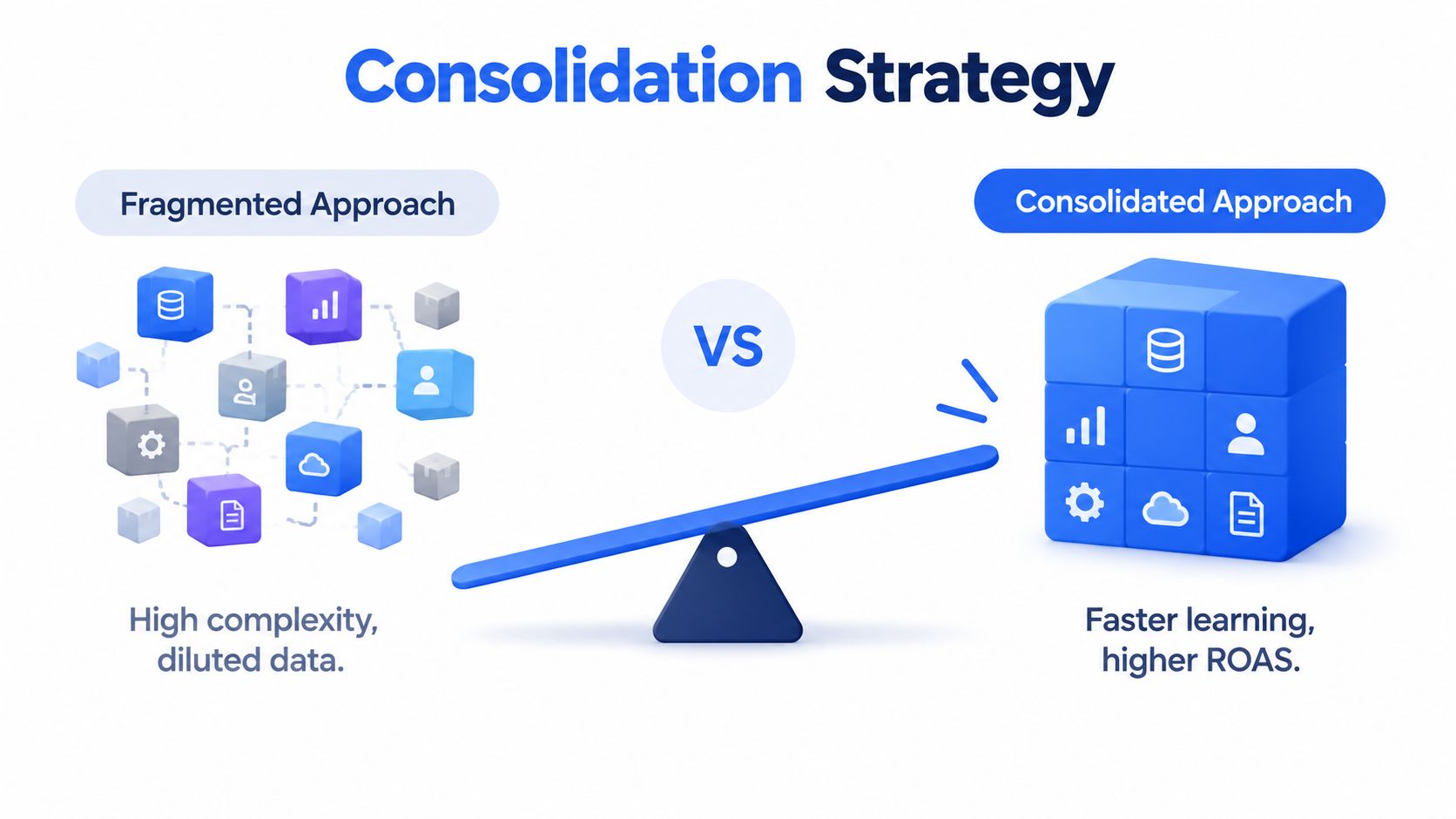
Granular segmentation used to feel like control. Separate ad sets for each interest, lookalike, age range, placement, and creative angle produced a tidy testing matrix. The problem is that tidy doesn't always mean efficient. Every split can reduce the data density available to the delivery system and create more auction overlap inside the account.
Recent guidance from the 19 rules of successful Meta advertising reflects the current direction toward simplification. The emphasis is on reducing unnecessary ad sets, avoiding minor targeting splits, and allowing Meta to optimise across broader audiences. The practical question is no longer, “How many audience segments can I build?” It's, “Which separations change the buying decision enough to justify dividing the signal?”
Replace audience slicing with creative range
A consolidated ad set should not contain a pile of near-identical ads. It should contain a deliberate portfolio:
- Problem-led angles: Different ways to frame the customer's pain or desired outcome.
- Proof-led assets: Demonstrations, comparisons, product use, or credible objections handled directly.
- Format variation: Feed, Reels, and Stories assets built for their environments.
- Message variation: Distinct hooks, opening frames, headlines, and calls to action.
- Offer variation: Different value propositions when the commercial test requires them.
The current practitioner guidance described in the brief points to portfolios ranging from 10 to 50 ads per ad set and concept families containing 16 to 20 assets. Those figures are not universal quotas. They illustrate the shift in the testing unit. Buyers are expanding the creative set while reducing the number of audience containers.
Dynamic Creative supports the same logic. At the ad set level, Meta can receive multiple images, videos, headlines, text options, and calls to action, then test combinations across audience segments. The Advantage+ Creative overview documents this setup. It's useful when the buyer wants Meta to explore combinations, but it doesn't replace creative strategy. Weak variations still produce weak inputs.
Decide what deserves separation
Consolidation works when the ad sets share the same business objective and can use the same delivery constraints. It's usually sensible to combine minor interest differences, similar prospecting audiences, and creative concepts that are being evaluated against the same conversion event.
Keep separation when the delivery environments are materially different:
| Consolidate when | Separate when |
|---|---|
| The optimisation event is the same | The optimisation event is different |
| The market and language are compatible | Markets require different economics or compliance |
| The placement strategy is shared | One group needs a distinct placement restriction |
| The offer and landing experience are the same | The offer, funnel, or product differs |
| The audience distinction is minor | The audience has a meaningful exclusion or lifecycle rule |
| The budget logic doesn't require isolation | A budget must be protected for a specific segment |
Advantage+ placements can distribute delivery across Facebook, Instagram, Audience Network, and Messenger. Meta's automation has also expanded around audience controls and placement suggestions, as outlined in this Advantage+ sales campaign guide. That makes placement-based ad set multiplication less attractive when the campaign can use a coherent creative portfolio across environments.
There's a caveat. Consolidation isn't an excuse to remove every control or ignore business constraints. If one audience has a different value model, legal requirement, funnel stage, or exclusion rule, isolating it can preserve decision quality. The right test is whether separation protects a meaningful operational distinction.
The strongest structure often looks simpler in Ads Manager and more refined in the creative library. Fewer ad sets create denser signals. More differentiated creative gives the system room to find message-market fit. Reporting becomes easier because performance differences are less likely to reflect accidental budget starvation or audience fragmentation.
Decision test: If deleting an ad set would only remove a label, consolidate it. If deleting it would change the economics, eligibility, or optimisation conditions, keep it separate.
That's the operating model for scaling ad sets in Facebook now. Use the middle layer to define distinctly different delivery environments, then let creative diversity do more of the testing work inside each environment.
Rapid Ads supports the consolidated workflow by grouping bulk-uploaded creative into ad sets, applying ad set settings, enforcing naming conventions, and handling mixed-format assets for Meta launches. If your team is spending more time sorting, renaming, and rebuilding ad sets than analysing performance, visit Rapid Ads and evaluate whether its bulk workflow fits your account structure.