Consumers reported $794 million in losses from scams that started on Facebook in 2025, according to the Federal Trade Commission. That measures consumer harm, not invalid traffic in your campaigns. But it reframes Facebook ad fraud as more than bots clicking ads: advertiser identity, destinations, conversion endpoints, and payment flows all need scrutiny.
For a media buyer, the useful question isn't whether fraud exists. It's which measurement stopped representing a real customer action, and whether you can isolate that failure before increasing budget.
Table of Contents
- Four Facebook Ad Fraud Types and Where They Show Up
- Signals That Separate Fraud From Normal Volatility
- How to Triage Suspicious Spend in Six Steps
- Prevention Controls That Protect Spend and Attribution
- Escalation Path for Compromised and Reseller-Linked Accounts
- Why Meta's Removal Numbers Do Not Guarantee Clean Delivery
- Decide Whether This Account Is Clean Enough to Scale
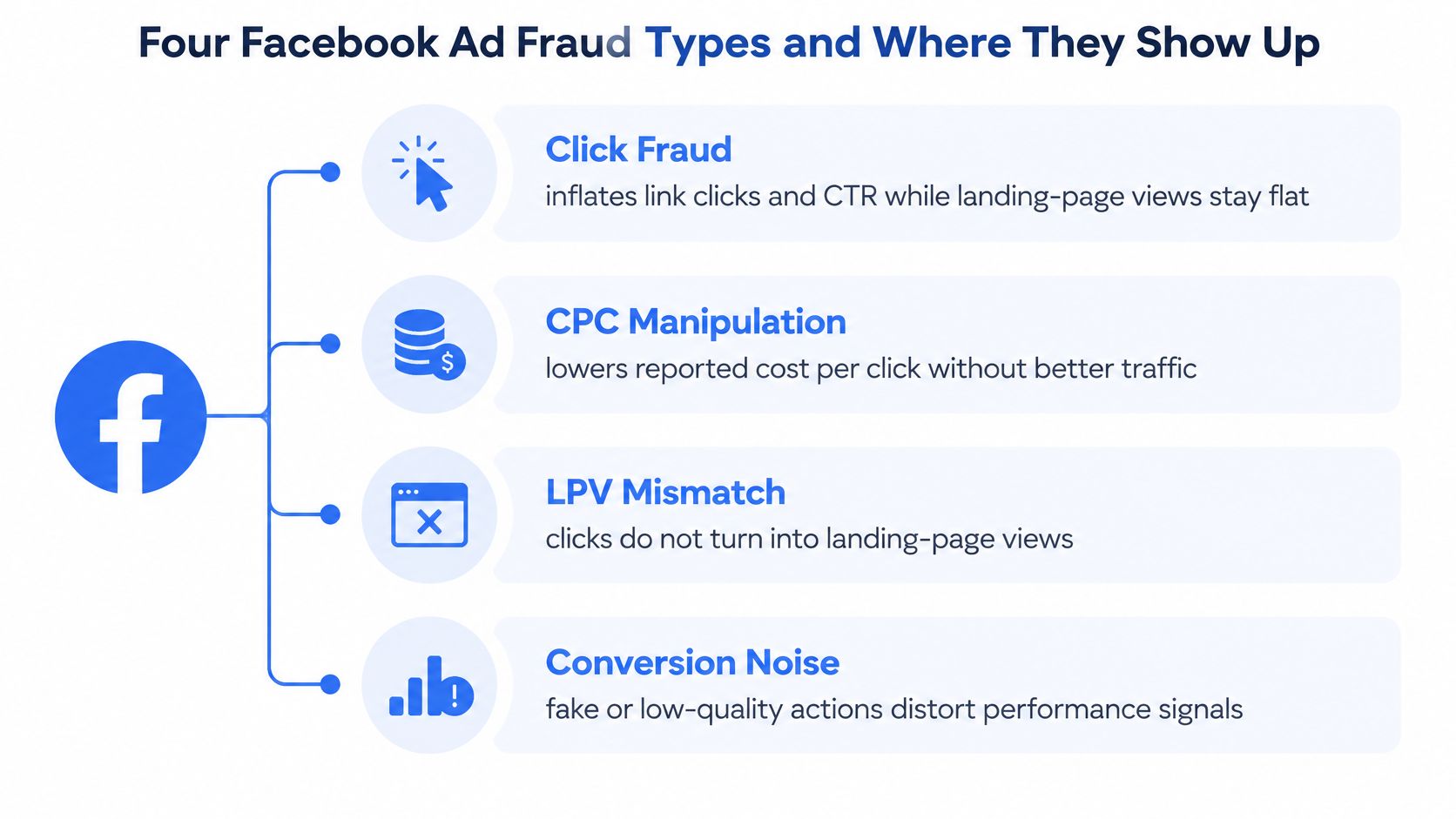
Four Facebook Ad Fraud Types and Where They Show Up
A rising link CTR with flat landing-page views is a reason to investigate, not celebrate cheaper traffic. Click inflation lowers reported CPC without improving acquisition. It doesn't automatically lower purchase CPA, because that requires either more purchases or contaminated conversion reporting.
The practical taxonomy separates traffic manipulation from conversion fabrication and attribution theft.
Facebook ad fraud types, distorted metrics and first checks
| Fraud type | Where it shows up | Metric it distorts | First check |
|---|---|---|---|
| Click fraud | Ad sets with high link clicks and few landing views | CTR, CPC, cost per landing view | Click-to-landing-view ratio by placement |
| Fake installs and fake form fills | App install and lead campaigns | Cost per install, cost per lead | Event timing and CRM-qualified rate |
| Impression fraud | Placements with unusual reach and frequency | CPM, reach, frequency | Placement and publisher breakdown |
| Attribution fraud | Conversions credited to paid when other sources drove them | ROAS and CPA by source | Comparison with server-side conversions and UTM source |
Fake installs and submissions require a different response from suspicious clicks. Check app activation, contactability, and completed transactions rather than accepting the event count as proof of acquisition.
Impression fraud involves non-human or hidden delivery. Unusual reach or frequency alone can't establish it, and Ads Manager doesn't expose enough evidence to prove every impression was viewable by a person. Attribution fraud instead concerns who receives credit: injected clicks or stacked tracking can attach paid-source credit to an outcome another channel produced.
The visual groups the symptoms you'll encounter, rather than treating each symptom as a separately proven fraud mechanism.
Treat clicks as unverified traffic
A cross-platform study covering Facebook, Google, Yahoo, and LinkedIn over seven days estimated that 88–98% of observed clicks came from automated programs, with more than 10% of those bots classified as advanced systems capable of mimicking human behavior, according to the document hosted by the House Energy and Commerce Committee. Those observations aren't a current Meta-wide invalid-click rate.
Join click timestamps, session continuity, device signals, interaction patterns, and downstream outcomes. IP blocks and user-agent filters alone aren't sufficient evidence.
Practical rule: Treat a click as unverified until you can connect it to a session, then judge that session by its outcome.
Keep creative-production costs separate from media-quality analysis. For creator-led campaigns, Nereo pricing for creators provides a separate budgeting reference, not a traffic-verification mechanism.
When CTR rises while CPA holds flat, investigate click fraud before attribution fraud, especially if landing views don't follow. A genuine creative improvement remains possible until the session evidence says otherwise.
Signals That Separate Fraud From Normal Volatility
A 2024 health-research recruitment campaign recorded 16,962 impressions and 401 clicks, yet one day generated 717 survey entries against only 34 ad clicks, according to the published health-research case. The researchers interpreted that discrepancy as strong evidence of automated activity.
The important failure wasn't necessarily the ad-click counter. Someone could attack the survey endpoint directly while Ads Manager continued showing plausible delivery.
Fraud signals, where to read them and what each pattern means
| Signal | Where to read it | Healthy pattern | Suspicious pattern |
|---|---|---|---|
| Click-to-landing-view ratio | Ads Manager outbound clicks against landing page views | Landing views track clicks within a stable band | Clicks rise while landing views stay flat |
| Form submission timing | Form tool or server logs | Completion times spread across human ranges | Many completions within seconds of page load |
| Device and IP concentration | Server logs | Varied devices and networks across the day | Repeated devices or the same IP block across campaigns |
| Geographic fit | Ads Manager country breakdown against CRM location | Delivery matches the served markets | Traffic from markets you don't serve |
| Placement concentration | Ads Manager placement breakdown | Spend spreads across placements with conversions | One placement takes most spend with no qualified outcomes |
| CRM-qualified rate | CRM by campaign and date | Qualified rate holds against the prior baseline | Submissions rise while qualified rate falls |
Read the ratios in the right direction
Use landing-page views divided by outbound clicks as the landing-view rate. Label it explicitly so nobody mistakes a rising clicks-per-view ratio for an improvement.
Compare the same destination, device mix, attribution setting, and reporting dates. The Meta Ads reporting workflow helps organize those comparisons without treating every dashboard discrepancy as invalid traffic.
There isn't a defensible universal cutoff for a healthy landing-view rate. A slow page, consent restrictions, and interrupted redirects can all reduce recorded views.
Creative fatigue usually presents a different hypothesis: weaker response to the same offer or creative, rather than unexplained submissions without matching sessions. An attribution-window change can alter reported CPA without changing the underlying customer population. Shared office networks can also explain concentrated IP activity, while autofill can explain fast legitimate submissions.
A single abnormal metric is a diagnostic lead, not a fraud verdict.
Use two independent signals on the same campaign and date range as an operational triage threshold, not a scientifically validated fraud classifier. A falling landing-view rate plus uncontactable leads warrants intervention; two reports derived from the same broken tracking event don't constitute independent evidence.
How to Triage Suspicious Spend in Six Steps
Start by limiting additional exposure without destroying the evidence. Don't duplicate the flagged campaign, replace every creative, and reset tracking before you've captured what happened.
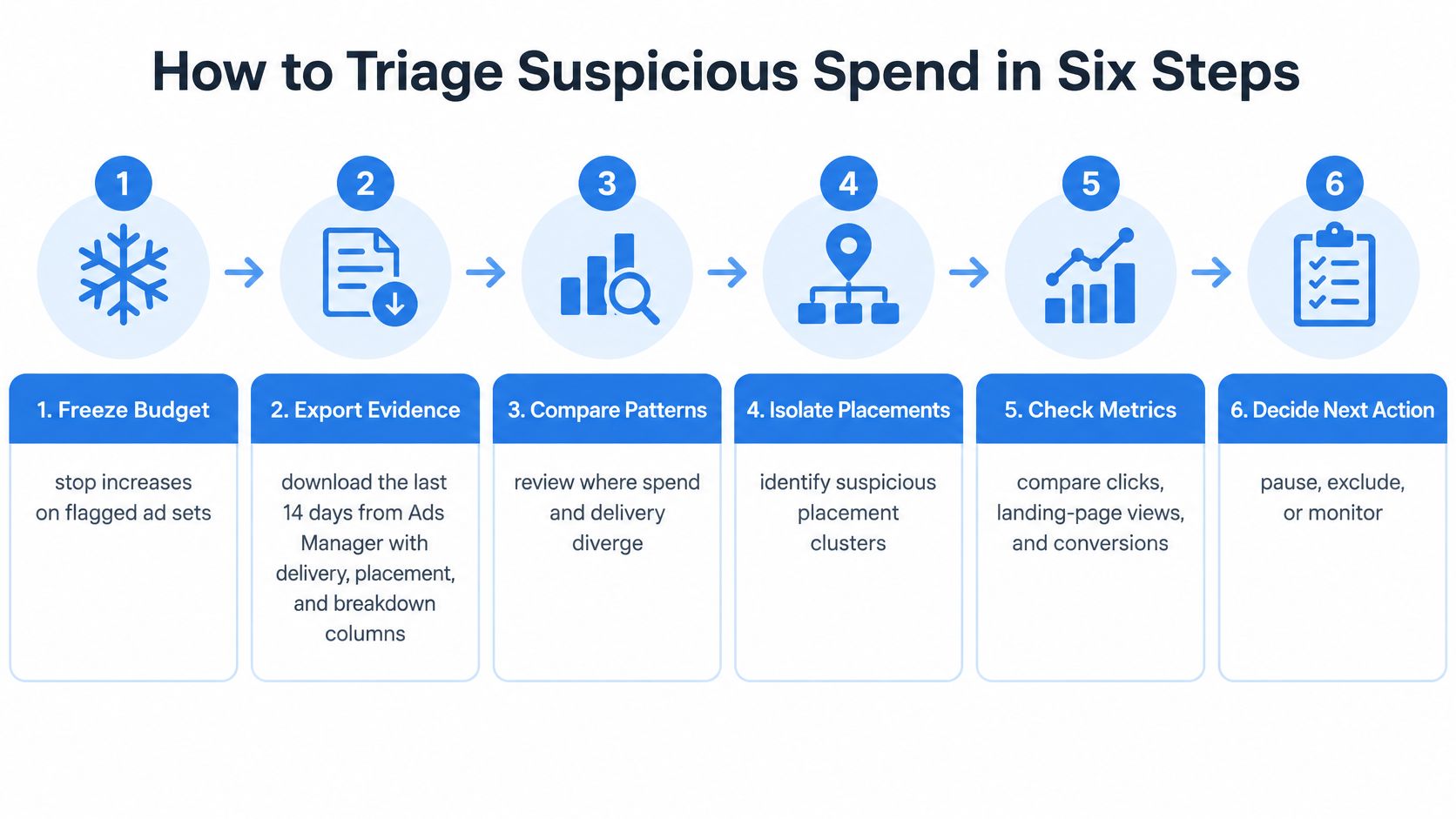
The workflow below separates delivery problems from unauthorized activity.
Preserve, reconcile, isolate
Freeze increases and export delivery. Use the last 14 days as an investigation window, exporting campaign, ad set, and ad IDs alongside spend, impressions, outbound clicks, landing-page views, results, and separate placement and country breakdowns. This preserves a comparison point before anyone changes delivery.
Inspect change history and billing. Match budget jumps, payment-method changes, new admins, and campaign edits to internal approvals in the same window. An authorized configuration change can imitate suspicious delivery, while an unexplained edit may identify the compromise.
Reconcile outcomes with sessions. Join the export to server logs and CRM records using captured click identifiers or UTM parameters, retaining campaign and ad IDs where available. Record unmatched conversions separately rather than pretending every legitimate customer will retain a click identifier.
Compare placement and geography clusters. Contrast the flagged period with the pre-anomaly baseline and mark combinations producing high clicks but almost no landing views or qualified outcomes. Aggregate account averages can hide a localized failure.
Verify the live destination. Check the final URL, redirect chain, mobile rendering, form endpoint, and page version against the approved destination. Use Facebook Pixel Helper checks to inspect browser events, but don't mistake a firing pixel for proof of a legitimate conversion.
Save the evidence bundle. Preserve screenshots, exports, change logs, page captures, timestamps, and the reporting time zone before further edits. A support reviewer needs a reproducible sequence, not disconnected screenshots.
Make the containment decision
Pause clusters that fail reconciliation, destination checks, or the placement comparison without a credible technical explanation. Set an account spending limit appropriate to the remaining investigation budget, and record who can authorize its removal.
For CBO campaigns, remember that pausing an ad set can redistribute budget to the remaining ad sets. Check the surviving delivery rather than assuming the campaign's exposure has fallen proportionally.
Escalate as an account compromise only when permissions, billing, or change history indicate unauthorized access. Poor traffic quality requires containment and validation, but it doesn't by itself prove someone controls the account.
Prevention Controls That Protect Spend and Attribution
Access and financial controls come first. In Business Settings, give each person or partner only the permissions needed for their work, and remove departing partners the day their engagement ends. Review partner access as well as individual users.
Set an account spending limit and assign someone to review payment methods and billing notifications. A cap is a backstop, not a fraud detector, and it can interrupt legitimate campaigns if nobody owns the reset decision.
Prevention controls, where to set them and what they reduce
| Control | Where to set it | Risk it reduces | Owner |
|---|---|---|---|
| Lowest-necessary roles for each partner | Business Settings, People and Partners | Unauthorized edits and access drift | Account owner |
| Spend limits and payment method review | Business Settings, Payments or Billing & payments | Unexplained spend before anyone notices | Account owner |
| Enforced naming convention | Ad and ad set names | Anomalies that can't be traced to an entity | Media buyer |
| UTM tags on every destination | Ad URL parameters | Attribution claims that can't be checked | Media buyer |
| Server-side conversion events | Events Manager with server integration | Invalid submissions entering the event pipeline unchecked | Analytics lead |
| Validated optimization event | Ad set conversion event selection | Fraudulent conversions feeding delivery | Media buyer |
| Landing-page monitoring | Scheduled content and redirect checks | Destination edits going unnoticed | Operations team |
Make every launch traceable
Encode market, audience, and creative ID in ad and ad set names. Preserve entity IDs in exports because names can change; names help humans investigate, while IDs keep joins stable.
Apply UTM parameters to every destination and verify that redirects preserve them. Don't use the presence of a UTM as proof of causality: it identifies the tagged route, not whether the ad caused the sale.
Rapid Ads addresses a specific operational failure here: bulk launches can retain naming conventions across large batches, while its auto-disable for Advantage+ creative enhancements keeps those settings disabled instead of allowing silent setting drift on manually uploaded creatives. That's launch consistency, not a fraud-detection claim.
Monitor destination content and redirects against approved versions. An unexpected page change should have an owner, an approval record, and a rollback path.
Validate before you optimize
Server-side doesn't mean verified. Sending a fabricated form submission through Conversions API merely gives the fabricated action another delivery route.
Deduplicate browser and server events, then distinguish raw submissions from contactable, qualified leads. For purchases, reconcile the event with completed payment and order records rather than relying on a thank-you-page visit.
Optimization safeguard: Feed the delivery system the business outcome you trust, not simply the easiest event to collect.
Validated events may arrive later and in smaller volumes than raw submissions. Accept that trade-off deliberately: the control many accounts lack isn't more tracking, but an optimization event that excludes known-invalid outcomes.
Escalation Path for Compromised and Reseller-Linked Accounts
Unauthorized access needs a security response, not another audience test. Assign an incident owner immediately, with a separate buyer responsible for stopping delivery and a finance contact responsible for reconciling charges.
Contain access and preserve the claim
The account owner secures access. Revoke suspicious admins, terminate unfamiliar sessions, change the owner's password, and enable two-factor authentication on the owner login. Check business integrations as well as people, without removing legitimate dependencies blindly.
The buyer stops delivery. Pause active ads on affected accounts and record spend from the first anomaly onward. Separate confirmed unauthorized charges from spend that's merely under investigation.
The analyst exports the evidence. Package change history, billing events, placement breakdowns, landing-page captures, and server logs with a consistent timeline. Keep originals in restricted storage.
The incident owner files with Meta. Submit the bundle through the Business Help Centre and retain the case reference, submission time, affected account IDs, and requested remedy. Don't assume a report guarantees reimbursement.
The integration owner notifies connected providers. Users must notify Rapid Ads promptly of any unauthorized account use by contacting support@rapid-ads.com. Include relevant account identifiers and the incident timeline, never passwords or recovery codes.
The agency owner resolves reseller provenance. Request ownership records, payment records, and the current permissions list from the reseller. An unresolved ownership chain should block relaunch.
Treat reseller enforcement figures narrowly
Meta reported removing more than 46 million advertisements through reseller channels and proactively detecting and disabling more than 99% of violating ad accounts associated with those resellers, according to Fortune's reporting. That denominator covers accounts identified as violating policy, not every reseller-linked account or every fraudulent action.
For the login-security review, browser verification from MANDATE provides context on account-takeover controls. It doesn't replace Meta's permissions audit or prove that an ad-account session was authorized.
When restoring legitimate collaboration, use a documented Facebook ad account access-sharing process rather than shared credentials. Give each response task a named owner and completion status so nobody assumes another team has stopped the spend.
Why Meta's Removal Numbers Do Not Guarantee Clean Delivery
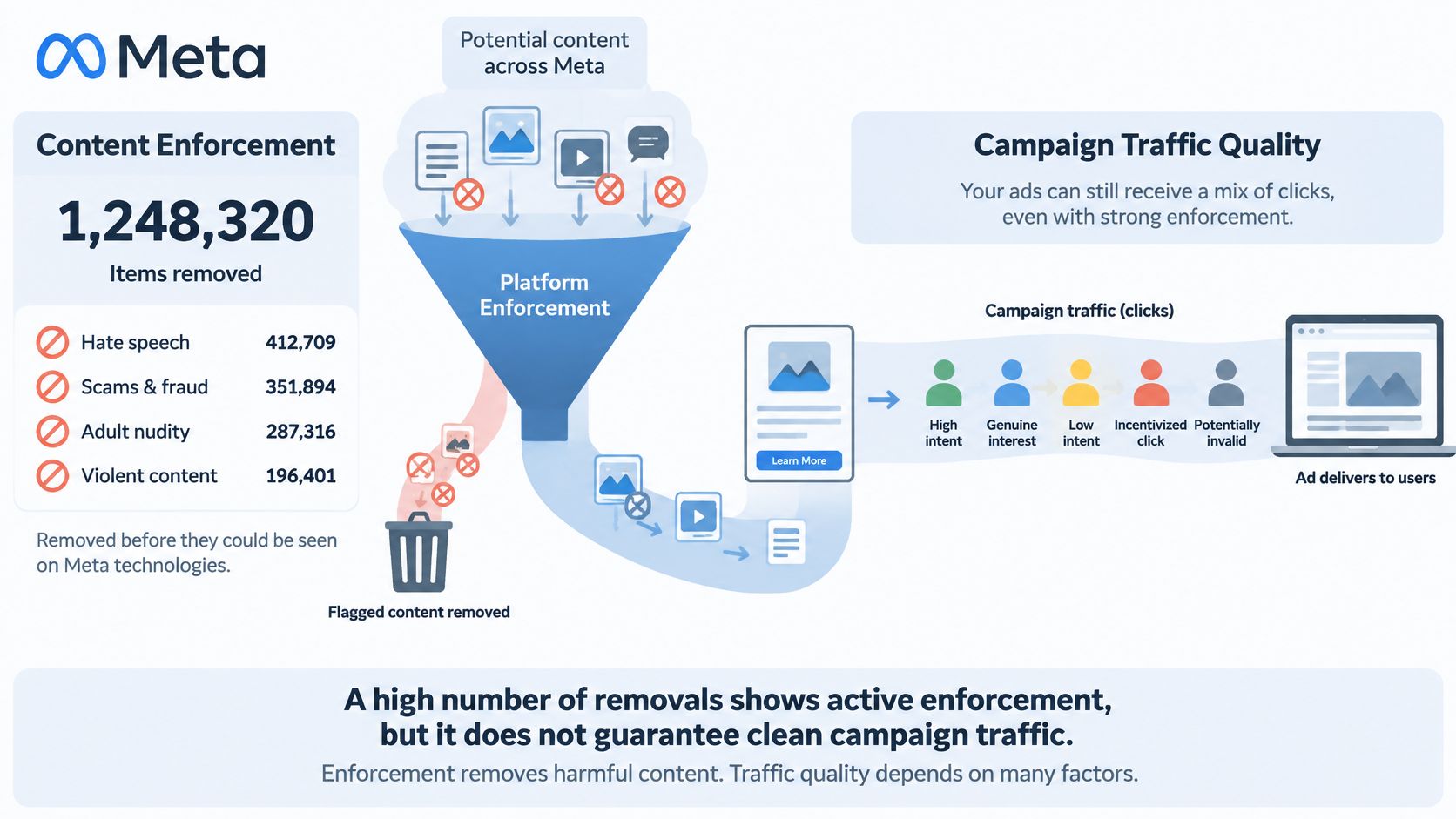
Platform-wide removals measure enforcement activity, not whether a specific campaign received invalid clicks or low-quality traffic. Reported internal documents described an enforcement model that required automated systems to be at least 95% certain of fraud before banning an advertiser. They also cited estimates of approximately 15 billion high-risk scam-ad impressions daily and about $7 billion in annualized revenue, according to Rappler's reporting.
These are reported estimates and practices, not an independently audited account of every current enforcement decision. An advertiser remaining active after review is not evidence that its traffic is clean.
Content enforcement and campaign traffic quality measure different things.
Different denominators answer different questions
Meta reported removing 3.4 billion fake Facebook accounts in 2025, 99% proactively, and 159 million scam ads, 92% before user reports, in its scam-protection guide. Those totals describe enforcement actions. They do not show the invalid-click rate for your campaigns or the share of visitors who reached your site and became qualified leads.
A separate estimate concerned Meta's revenue, not campaign-level delivery. Internal documents reviewed by Reuters estimated about 10.1% of Meta's 2024 revenue, roughly $16 billion, would come from scam and prohibited-goods advertising. Meta described the estimate as rough and overly inclusive, as summarized by Norton. A May 2025 internal safety estimate put Meta platforms' involvement at approximately one-third of successful scams in the United States, according to Yahoo Finance's account.
These figures have different denominators and outcomes. They cannot be converted into a probability that a particular ad account, click, or conversion is fraudulent.
An enforcement total can rise while a campaign's traffic quality remains uncertain. The campaign-level test is whether Ads Manager delivery aligns with destination behavior and qualified outcomes, not whether Meta reports removing a large volume of accounts or ads.
Score the response you control
- Prevented spend: Estimate the exposure avoided using the documented pre-pause spending pace. Mark it as a counterfactual, not a recovered amount.
- Time to disruption: Record the hours between the first observable anomaly and containment.
- Repeat offenders: Track recurring unauthorized actors or linked assets, rather than counting replacement ad names as separate incidents.
- Refund recovery: Record amounts requested, approved, and received separately.
- Outcome recovery: Check whether placement exposure and CRM-qualified rates returned to their acceptable operating ranges.
Removal counts provide context. Spending records and qualified outcomes show whether your own controls worked.
Decide Whether This Account Is Clean Enough to Scale
Make the scale decision go or no-go, with a dated record and an accountable approver. A better platform ROAS isn't sufficient if the underlying acquisition evidence remains unresolved.
Apply an operational pass-fail test
Use the following windows as a practical review protocol, not published universal fraud thresholds.
- Qualified outcomes pass: Compare the last 7 days of CRM-qualified rate with the account's prior 28-day baseline. Scale only if the recent rate sits inside the baseline range, using a consistent qualification definition and comparable cohorts.
- Access and billing pass: Inspect the same 14-day investigation window for unexplained admins, payment-method edits, or budget jumps. Any change without a matching internal ticket is a no-go.
- Delivery signals pass: Require the landing-view rate and placement concentration that triggered investigation to return inside their pre-anomaly bands.
- Optimization passes: Confirm the ad set still uses the validated lead or purchase event, with known-invalid events excluded where technically possible.
- Ownership passes: Complete compromise escalation and resolve reseller ownership gaps before approving another increase.
A sparse CRM cohort may not support a meaningful comparison. In that case, keep the cap while collecting enough verified outcomes rather than interpreting statistical uncertainty as clearance.
Separate provenance from performance
For an unfamiliar advertiser or reseller, you can check a company's ad start dates through AdvertiserLeads as a provenance cross-check. Public advertising history doesn't authenticate account ownership or establish traffic quality.
We're an Official Meta marketing partner. Data obtained through Login with Facebook is used exclusively to help users upload ad creatives to Meta Ads and isn't used for any other purpose; neither fact substitutes for an account-level scale decision.
If a test fails, retain the cap and repeat reconciliation, cluster analysis, and destination verification. Run this test on your largest account this week, record go or no-go for each account, and include estimated prevented spend since the first anomaly.
Rapid Ads offers bulk creative uploads, enforced naming conventions, and controls for unwanted Advantage+ creative enhancements, helping teams keep launches consistent and anomalies traceable. Visit Rapid Ads to standardize your launch workflow before your next approved budget increase.