Nielsen found that creative can account for up to 89% of digital advertising impact when the execution is strong, while targeting, reach, and recency remain unchanged. (Nielsen's analysis) That should change how performance marketers diagnose weak ROAS. If the audience, bid strategy, landing page, and delivery are already credible, the next serious variable to investigate is the ad itself.
Creative advertising isn't decoration applied after media planning. It's the disciplined production of messages, formats, hooks, and visual assets designed to win attention and create purchase intent in a specific environment. For Meta buyers, that means treating creative as a measurable operating system, not as a single polished video handed to a campaign manager.
Table of Contents
- What Creative Advertising Is
- The Two Pillars of High-Performance Creatives
- Platform-Native vs. Repurposed Creative
- Managing Advantage+ Creative Enhancements
- Scaling Creative Workflows with Flexible Ads
- The AI Paradox in Modern Advertising
- Building Your Creative Scaling Strategy
What Creative Advertising Is
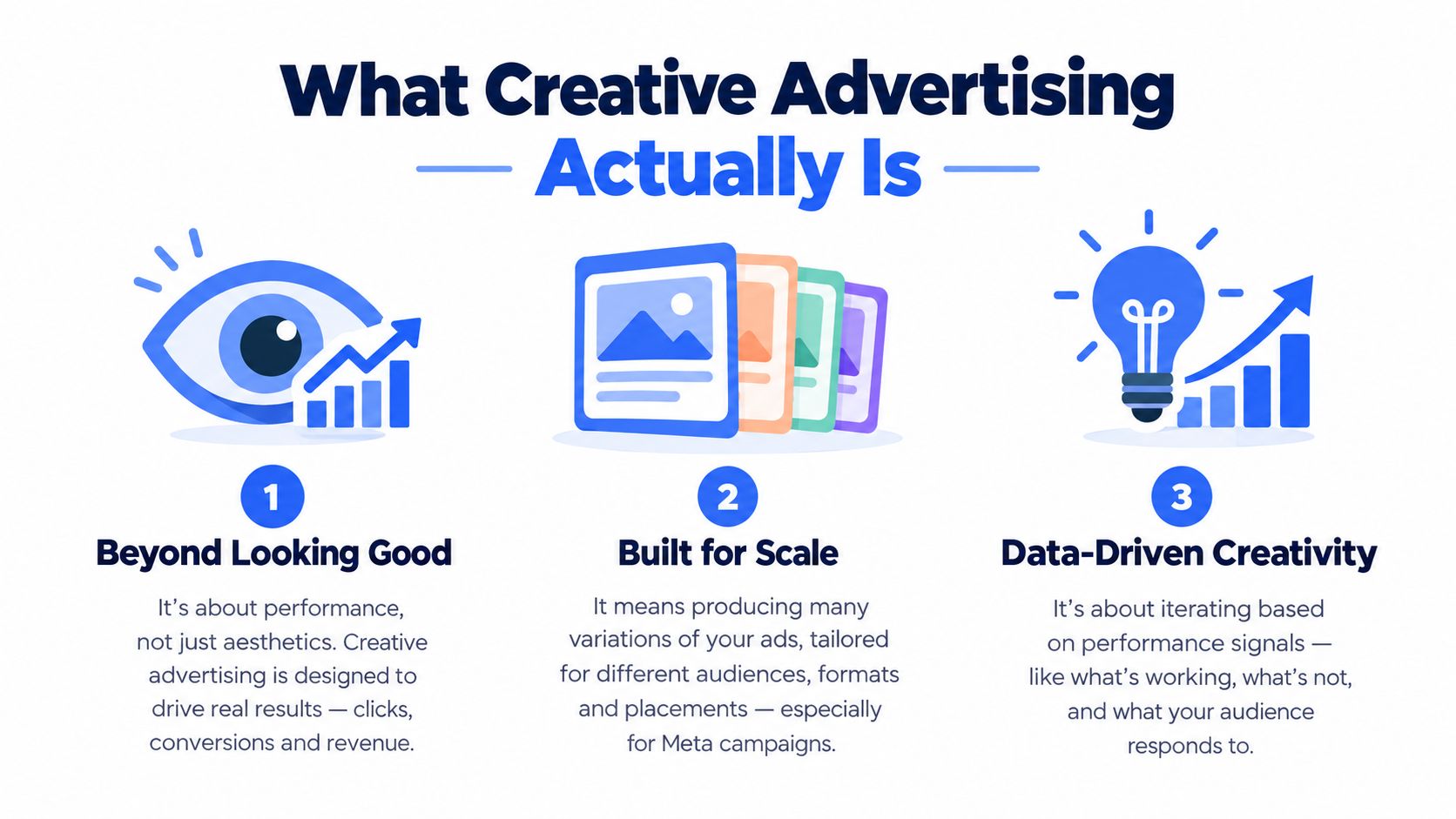
Creative advertising turns a commercial proposition into platform-native assets that earn attention and move people toward action. The operative term is process. One ad can provide a signal, while a repeatable system creates controlled variation across promises, formats, visual cues, and audience contexts. That variation gives media buyers something measurable to compare instead of relying on taste.
A 2006 Nielsen study found that 65% of a brand's advertising sales lift came from creative. A later Nielsen review reported that strong creative could contribute up to 80% of sales impact in traditional TV and 89% in digital advertising. These findings do not separate creative from the offer, product, media plan, or measurement. They establish creative as a performance variable that deserves the same testing discipline as targeting and bidding.
The performance definition
A useful Meta creative performs three jobs:
- Stop the scroll: The opening frame, line, or movement interrupts habitual feed behaviour.
- Signal relevance: The viewer quickly recognises the problem, identity, or desired outcome.
- Create a reason to act: The offer feels credible and worth investigating now.
A high-CTR ad is therefore not automatically strong creative. A sensational hook may generate curiosity clicks but poor conversion quality. A product demonstration may attract fewer inexpensive clicks while bringing in buyers with stronger intent. Judge the asset against its funnel role and the downstream metric it is meant to improve.
Format is part of the creative decision. A 9:16 Reel, a 1:1 carousel card, a creator-led testimonial, and a static comparison chart change how the same message is seen, read, and remembered. Marketers aligning brand consistency with paid distribution can use this practical guide to social media branding and ads. Performance teams still need to adapt the brand system to each placement, because a design that works in a feed may fail in a short-form video environment.
For a practical workflow, label each asset by its buyer, problem, promise, format, and intended funnel outcome. That structure makes test results easier to interpret and helps the team produce the next variation with a clear reason.
Practical rule: Treat every creative as a hypothesis about a buyer, a problem, and a promise. If you cannot state the hypothesis clearly, you will not know what the result teaches you.
The Two Pillars of High-Performance Creatives
The strongest creative usually balances originality with appropriateness. Originality earns the initial mental space. Appropriateness helps the viewer understand why the ad matters, who it's for, and what the brand can credibly deliver.
A 2020 meta-analysis synthesised 93 datasets from 67 papers and found positive effects of creative advertising on ad and brand reactions. Its central finding is more useful than the usual advice to “be more disruptive”: originality mainly works through affect transfer, while appropriateness works through signalling. (The meta-analysis in the Journal of Marketing)
Originality earns attention
Originality can come from an unexpected visual, a sharp contrast, an unusual opening line, or a familiar category presented through a new point of view. It doesn't require absurdity. A direct-response ad can be original because it names a frustration competitors avoid, demonstrates a product in an unfamiliar setting, or uses a format that feels native to the audience rather than to the brand's internal presentation deck.
The failure mode is novelty without direction. A strange image may produce thumb-stops and comments, but if the viewer can't connect it to the product, the attention transfers to the entertainment rather than the offer. Creative buyers should separate attention signals from commercial signals in reporting instead of allowing a high CTR to settle the argument.
Appropriateness turns attention into meaning
Appropriateness means the creative fits the audience, product, situation, and brand promise. A finance ad needs different proof from a beauty ad. A prospect comparing expensive software needs more explanation than an impulse buyer responding to a simple visual benefit. The same joke, colour palette, or testimonial structure can work in one segment and feel completely misplaced in another.
The meta-analysis found that the effects of originality and appropriateness become stronger for high-involvement products and for unfamiliar brands on ad reactions. That gives media buyers a practical testing priority:
| If the problem is... | Test first... | Avoid... |
|---|---|---|
| Low thumb-stop rate | A new first frame, hook, or visual contrast | Rewriting the entire ad without isolating the opening |
| High clicks, weak conversion | Clearer product relevance and proof | Adding more spectacle |
| Low brand recognition | Stronger brand cues and repeated promise | Optimising only for cheap traffic |
| Weak response from a narrow segment | Identity-led language and context | Generic lifestyle imagery |
Good creative doesn't choose between originality and relevance. It uses originality to open the door, then uses appropriateness to explain why the viewer should walk through it.
Platform-Native vs. Repurposed Creative
A repurposed asset starts with the wrong question: “How can we make this existing ad fit Meta?” A platform-native asset starts with a better one: “What does this placement allow us to do that the original format couldn't?”
The difference matters because feed, Stories, Reels, and carousel environments impose different viewing conditions. Meta recommends 9:16 for Stories, Status, and Reels because users hold phones vertically, while carousel images are recommended at 1:1 or 4:5. Meta also recommends a consistent 1:1 ratio for all videos in a carousel, which prevents mixed assets from producing an uneven browsing experience. (Meta's placement guidance)
A side-by-side operating view
| Platform-native creative | Repurposed creative |
|---|---|
| Opens with the message in the first frame | Often begins with a logo, title card, or slow introduction |
| Uses vertical composition for vertical placements | Crops a landscape master and loses important context |
| Builds captions and proof into mobile viewing | Assumes sound, attention, or a larger screen |
| Matches the pacing of feed behaviour | Preserves broadcast pacing that feels slow in-feed |
| Generates placement-specific hypotheses | Treats every placement as a distribution outlet |
Kantar's global Creative Effectiveness Awards work tested over 13,000 ads across 75 markets, and its analysis of award-winning campaigns found 97% of 65 campaigns tested in 2022 and 2023 scored in the top 33% of Kantar's effectiveness database. Kantar also reported that creative quality contributes nearly 50% of media impact, rising to as much as 55% when cross-channel synergy is included. (Kantar's creative effectiveness analysis)
The trade-off is production effort. Repurposing is faster at the start, but it often creates weak learning because the asset contains several problems at once: poor crop, wrong pacing, indistinct hook, and unclear CTA. Native production requires more deliberate planning, yet each variation gives the algorithm a cleaner opportunity to match message and format to a buyer.
A strong creative system doesn't resize one ad. It translates one proposition into several placement-specific experiences.
Repurposing still has a role when the source material contains a strong demonstration, credible customer proof, or distinctive brand footage. Build from the useful idea, not from the original edit. Teams that need a repeatable way to break long-form material into channel-ready components can review these content repurposing workflows and tools, then apply a stricter Meta test plan to each resulting asset.
Managing Advantage+ Creative Enhancements
Meta's Advantage+ creative enhancements can alter the presentation of an ad after you've uploaded it. That may help in some delivery contexts, but it also introduces a testing variable you didn't necessarily approve. At scale, silent setting drift makes performance analysis harder because the asset you intended to test may not be the asset users consistently receive.
Meta says some enhancements may be on by default and documents how to turn them off after publication. (Meta's Advantage+ creative help documentation) The operational point is simple: don't assume the setting you chose during build remains the setting attached to every published ad.
The audit workflow
Use Ads Manager as the source of truth:
- Open the Ads tab. Filter to the campaign, account, market, or naming pattern you want to inspect.
- Select the relevant ads. Include active, scheduled, and recently edited ads if you're checking for drift.
- Click Edit. Open the Advantage+ creative section and inspect the enhancement state.
- Disable the enhancements where required. Save the change, then confirm the published configuration rather than relying on the initial build screen.
- Record the decision. Add the setting to your launch checklist or naming convention so another buyer doesn't accidentally reintroduce it.
For bulk operations, Meta says buyers can select multiple ads in the Ads tab, open Edit, choose Advantage+ creative, apply the same on or off settings across the selection, then save or publish. (Meta's bulk-edit workflow)
Preserve the test variable
Run controlled tests with enhancements consistently enabled or disabled across the comparison set. Don't compare a manually controlled asset against an automatically modified one and then attribute the result to the hook, offer, or audience. Keep the ad copy, destination, budget logic, and naming structure stable enough that the creative difference remains interpretable.
A useful audit cadence follows every major launch, bulk edit, and duplication event. It also belongs in account maintenance, because the operational risk isn't limited to initial publication. If your team manages multiple accounts, assign ownership for the check and store the result alongside the launch record.
Scaling Creative Workflows with Flexible Ads
Manual uploading becomes a performance problem when a campaign needs many hooks, aspect ratios, copy variants, and market adaptations. The media buyer can spend the day clicking through Ads Manager, or build a production line that keeps the human attention on hypotheses and evaluation.
Meta's Flexible Ads workflow operates at ad level and allows up to 10 images and videos in one ad. Meta limits the format to campaigns using the traffic, engagement, sales, and app promotion objectives, so it isn't a universal replacement for standard ad setup. (Meta's Flexible Ads documentation)
A practical batch workflow
Start with a matrix rather than a pile of files. Separate the variables before upload:
- Message: problem-led, outcome-led, comparison, objection handling.
- Format: static, UGC-style video, product demonstration, carousel.
- Placement: 1:1 or 4:5 feed assets, 9:16 Stories and Reels assets.
- Proof: review, demonstration, founder explanation, feature evidence.
- Audience context: cold prospect, engaged viewer, cart abandoner, existing customer.
Then enforce naming at the point of creation. A useful convention can include market, audience, angle, format, hook identifier, and iteration status. Clean names make breakdowns possible when dozens or hundreds of ads are live across accounts. Without them, reporting turns into manual detective work and winning patterns remain buried inside platform labels.
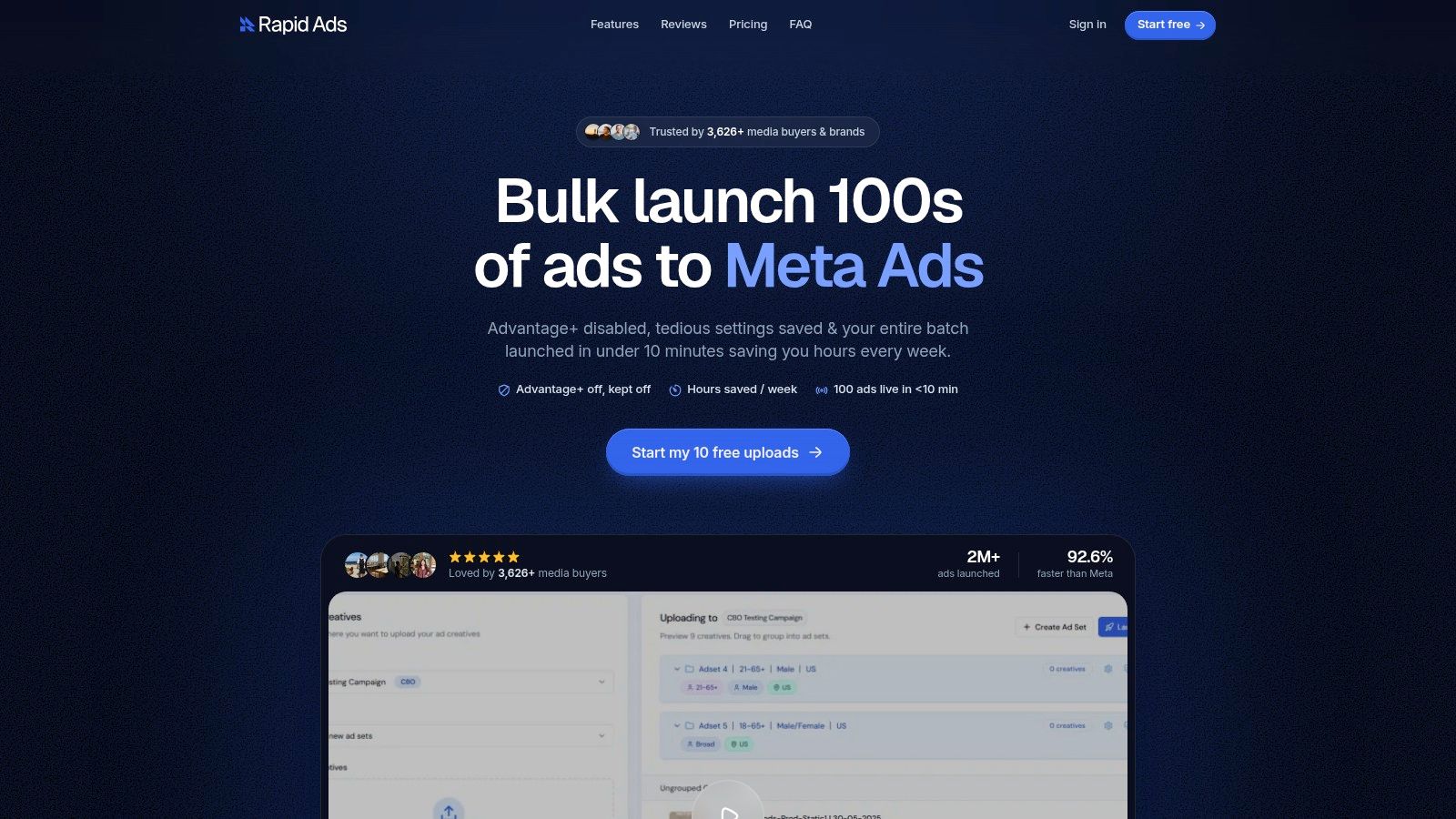
A tool such as Rapid Ads can support this workflow by bulk uploading images, videos, and copy, applying naming conventions, detecting 1:1 and 9:16 assets, and setting up Meta Flexible Ads in the same batch. It can also help teams manage multiple ad accounts without treating each account as an isolated upload project.
The key is not automation for its own sake. Automation should remove repetitive configuration, while the buyer retains control over the creative brief, test design, exclusions, and interpretation of results.
Scale the number of valid questions, not the number of random ads.
Flexible Ads can be useful when you want Meta to dynamically test a defined asset pool within one ad. Standard individual ads remain preferable when you need strict delivery control, clean creative-level comparisons, or a precise holdout. Use both formats deliberately instead of assuming one structure fits every learning objective.
Give each batch a review gate before publishing. Check aspect ratio, copy mapping, destination URLs, UTMs, enhancement settings, naming, and objective compatibility. Only then should the system move assets into live campaigns.
The AI Paradox in Modern Advertising
AI makes it easier to generate concepts, images, scripts, variations, and rough edits. That solves a production constraint, but it creates a new creative constraint: feeds can fill with assets that are technically polished and emotionally interchangeable.
Motion's survey found that 86% of DTC advertisers planned to increase AI use for research and ideation in 2025, while 79% expected to expand AI in creative production. (Adobe's 2025 Creative Trends research) The figures describe planned adoption, not guaranteed performance. More AI in the workflow doesn't automatically create more distinction in the market.

Use machines for throughput, humans for judgement
AI is valuable for expanding a testable idea. It can help turn one customer objection into several scripts, produce rough visual directions, classify comments, or identify recurring language in sales calls. It's much less reliable at deciding whether a message feels believable to a particular community, whether a joke crosses a line, or whether a visual reinforces the brand's actual identity.
Recent industry coverage highlights authenticity, human connection, immersive experiences, humour, retrofuturism, handmade aesthetics, and community storytelling as responses to AI fatigue and distrust. That points to a practical division of labour:
- Use AI for exploration: Generate routes, not final answers.
- Use customer language for grounding: Build hooks from real objections, reviews, and conversations.
- Use humans for selection: Reject generic work even when it looks finished.
- Use performance data for iteration: Keep the emotional idea, then refine the weakest execution.
A human-feeling ad doesn't need to look crude. It needs a specific point of view, recognisable stakes, and evidence that someone understands the buyer's situation. The strongest synthetic asset can still fail if it removes the texture that makes the product believable.
For teams testing automated workflows, marketers can browse ShipTeaser content generation as part of the wider production toolkit. The same rule applies regardless of software: generate broadly, approve narrowly, and keep the final creative accountable to the customer rather than to the tool.
Building Your Creative Scaling Strategy
A scalable creative strategy has four connected layers. Insight defines the buyer's problem. Execution turns that problem into platform-native assets. Operations gets those assets live with consistent settings and naming. Measurement decides which ideas deserve another iteration.
Start by auditing the current bottleneck. If the account has plenty of impressions but weak attention, inspect the first frame and opening line. If clicks are healthy but CPA is deteriorating, review promise alignment, proof, landing-page continuity, and audience quality. If performance varies wildly by placement, stop forcing one asset across every surface and rebuild the formats that are structurally wrong.
The operating checklist
Use this sequence before the next creative batch:
- Write the commercial hypothesis. Identify the audience tension, desired outcome, offer, and proof.
- Create distinct angles. Separate identity, pain, comparison, demonstration, objection, and outcome rather than making superficial colour changes.
- Build for the placement. Produce 9:16 assets for vertical environments and appropriate feed or carousel ratios instead of relying on crops.
- Choose the test structure. Use individual ads for strict comparisons and Flexible Ads when a defined group of assets should be dynamically tested.
- Standardise settings. Audit Advantage+ creative enhancements and document whether they're enabled or disabled.
- Enforce naming and tracking. Map every asset to a clear angle, format, audience, market, and iteration identifier.
- Review quality before launch. Check the hook, brand signal, offer clarity, proof, caption readability, destination, UTM, and mobile preview.
- Read results by role. Use attention metrics to diagnose the opening, conversion metrics to assess the promise, and blended business outcomes to decide what scales.
The creative review shouldn't end at launch. Keep a record of why each batch exists and what the next decision will be. That prevents teams from replacing winners based on fatigue anxiety or scaling weak ads merely because they have attractive CTRs.
Process discipline is a creative advantage. It lets you produce more meaningful variations, preserve clean comparisons, and spend strategy time where manual setup used to consume it.
AI can increase throughput, Flexible Ads can expand delivery options, and bulk tools can reduce repetitive work. None of them replaces judgement. The buyer still has to decide which customer truth is worth amplifying, which execution earns trust, and which result is strong enough to justify more budget.
Rapid Ads is built for the operational side of this system, with bulk uploads, naming conventions, aspect-ratio routing, Flexible Ads support, multi-account management, and Advantage+ auto-disable controls for Meta campaigns. If manual setup is limiting how many valid creative tests you can launch, visit Rapid Ads and evaluate whether its workflow fits your next batch.