The most popular advice in Meta advertising is also the least useful at scale: produce more variations. More hooks, more statics, more UGC cuts, more headlines, more formats. Then let the algorithm find the winner.
That approach creates activity, not necessarily learning. If every new ad changes the hook, footage, offer, format, copy, and landing-page promise at the same time, you won't know why performance moved. You may find a temporary winner, but you won't build a repeatable creative system that survives fatigue, new markets, or larger budgets.
A serious ad creative strategy treats every asset as part of an experiment. It defines the hypothesis, isolates the variable, controls delivery conditions, protects the intended rendering, and follows the result beyond CTR into qualified revenue and contribution margin. Volume matters, but only after your operating system can turn volume into interpretable evidence.
Table of Contents
- Defining Ad Creative Strategy for Performance Marketers
- Building an Attention and Memory Framework
- Structuring Creative Hypotheses and Testing Matrices
- Aligning Formats with Funnel Stages and Placements
- Scaling Production Without Sacrificing Learning Quality
- Measuring True Impact Beyond Platform Metrics
- Operationalizing the Workflow for High-Volume Launches
Defining Ad Creative Strategy for Performance Marketers
Most media buyers still treat creative as a production queue. The team asks for ten new ads, the editor delivers ten files, and the buyer launches them into a campaign already shaped by audience, budget, placement, and automation settings. When performance falls, the response is usually another production request.
That isn't a strategy. It's a replacement cycle.
A useful ad creative strategy starts before anyone opens Premiere, Figma, or CapCut. It identifies the commercial problem, the audience tension, the message to test, and the evidence required to promote or reject the idea. The finished ad is an output of that system, not the system itself.
Nielsen's cross-market research found that creative quality can account for up to 89% of sales impact in digital advertising, making it a more foundational driver than reach or targeting, according to its research on advertising effectiveness. That doesn't mean targeting and distribution are irrelevant. It means media efficiency can't rescue an asset that fails to communicate a relevant promise clearly.
Why variation volume fails
Launching a large batch of superficial edits creates several problems:
- Variable contamination: Changing the hook, offer, footage, and CTA together prevents causal interpretation.
- Spend fragmentation: Too many ads compete for insufficient evidence, particularly when the account distributes spend unevenly.
- False winners: An ad can receive delivery because of early auction conditions rather than because its concept is stronger.
- Weak learning transfer: A winning visual may tell you nothing about the winning promise, objection, or emotional appeal.
Meta's 2025 analysis examined over 1.1 million creatives and found that, in gaming, 2% of creatives accounted for 53% of total ad spend, as reported in this industry summary of Meta's creative analysis. The concentration is a warning against assuming that a large upload automatically creates a broad, balanced test.
Practical rule: Scale the number of hypotheses before scaling the number of files.
A strong operating system might test a problem-led hook against a demonstration-led hook while keeping the body, offer, audience, placement, and landing page constant. Once the stronger concept is clear, the team can test executions inside that concept. This creates compounding knowledge. The next brief becomes sharper because it inherits a proven insight instead of starting from a blank page.
Building an Attention and Memory Framework
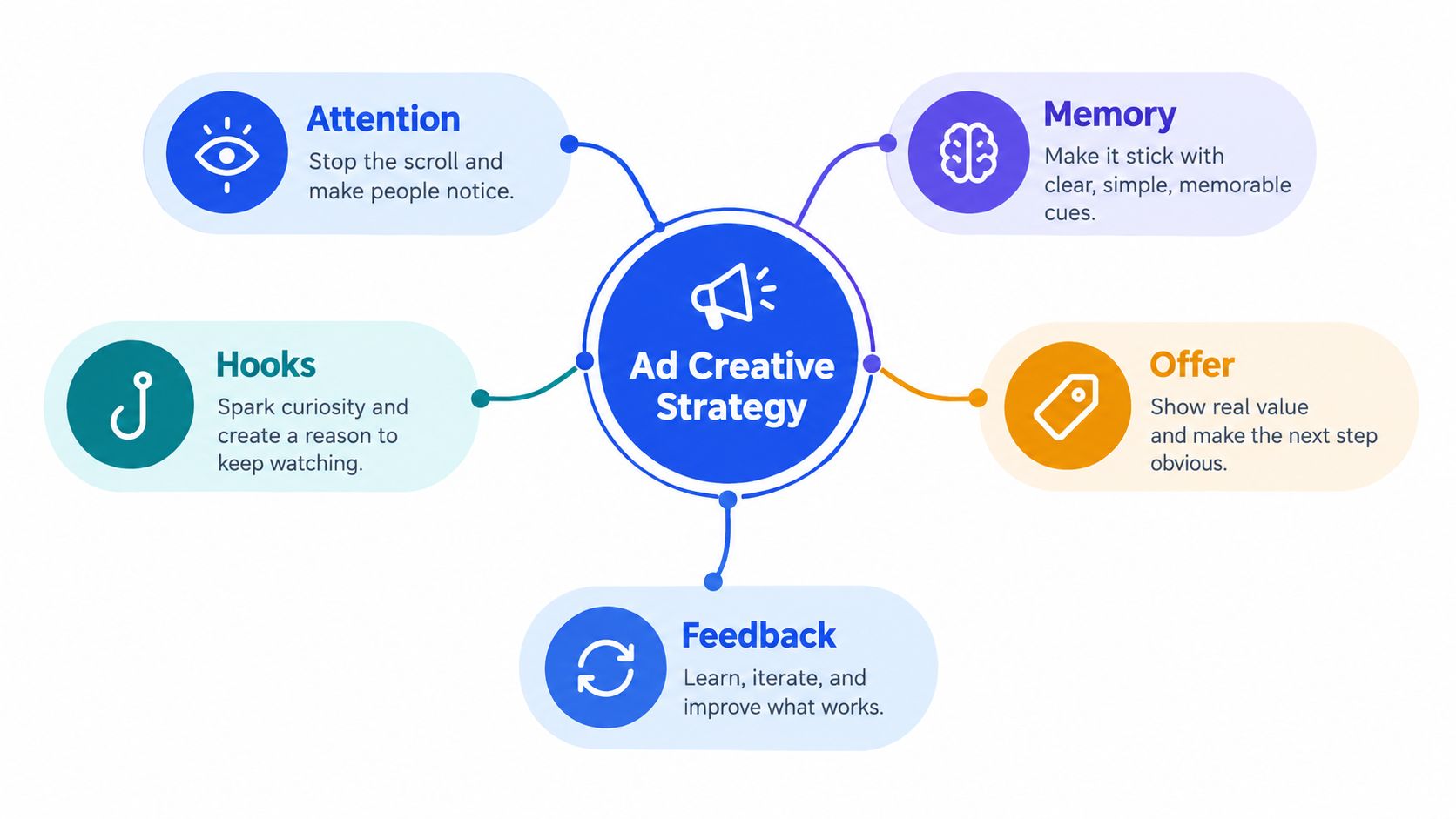
An ad has to earn attention before it can communicate, but attention alone isn't a business outcome. A high CTR may reflect curiosity, ambiguity, or an aggressive promise that attracts people who aren't qualified to buy. The post-click experience then exposes the mismatch through weak conversion quality, poor retention, or low sales acceptance.
Lumen, Brand Metrics, and Havas found a relationship between attention quantity and downstream brand outcomes. Their attention research supports treating the opening visual, first frame, motion pattern, and message hierarchy as measurable variables rather than purely aesthetic decisions.
Diagnose attention before response
Separate the creative review into two stages.
Stage one is attention. Check early video retention, the three-second or six-second view rate where relevant, first-frame comprehension, scroll-stop behaviour, and whether the product appears quickly enough to explain the ad's premise.
Stage two is response. Check CTR, landing-page view rate, qualified conversion rate, CPA, revenue, and contribution margin. An asset that fails at stage one needs a stronger opening. An asset that earns attention but produces weak qualified conversions may have a promise, offer, audience, or post-click continuity problem.
System1 analysed short-form video advertising and found that the most entertaining ads achieved 54% more six-second video views and 40% more positive sentiment. Its analysis also found that neutral emotional responses were 27% less effective at driving conversions, according to its short-form advertising analysis. The operational lesson isn't to make every ad funny. It's to design for an immediate premise and a positive, relevant payoff rather than optimising only for completion rate.
A useful creative brief specifies:
- Opening mechanism: Demonstration, creator statement, problem framing, visual contrast, or product reveal.
- Brand signal: Logo, packaging, distinctive colour, product shape, or verbal cue that appears early enough to be remembered.
- Reason to believe: Proof, use case, mechanism, testimonial, or comparison.
- Action bridge: A clear connection between the promise and the next click.
The Nielsen Brand Lift Report found that brand recall accounted for 38.7% of total brand lift across emerging digital environments, while baseline awareness accounted for 37.5%, as documented in its 2023 Brand Lift Report. This is why an ad shouldn't merely win the auction. It should leave a retrievable association between the brand, the product, and the benefit.
Structuring Creative Hypotheses and Testing Matrices
A testing matrix turns creative production into controlled experimentation. The key is to isolate one meaningful variable while holding the surrounding conditions steady enough for the result to be useful.
Start with the commercial question, not the format. For example: does the audience respond more strongly to the time saved by the product, or to the risk avoided by using it? That question can generate two hooks, while the body, product footage, offer, audience, placement, budget structure, and landing page remain fixed.
A repeatable testing sequence
- Define the control. Select the current strongest asset or the clearest baseline execution. Document its hook, body, offer, format, CTA, audience, placement, and destination.
- Choose one variable. Test the opening premise first. Don't change the offer and video length in the same comparison.
- Write the prediction. State what you expect and why. “A demonstration-led opening will improve qualified conversion rate because it makes product utility clear before the click” is more useful than “new hook.”
- Build the variants. Keep the body and offer consistent while changing only the chosen mechanism.
- Set the evidence rule. Decide in advance what counts as a signal, what requires more delivery, and what triggers a pause. Avoid declaring a winner after a few cheap clicks.
- Promote learning, not just ads. Record the winning mechanism in a creative taxonomy, such as problem framing, creator proof, comparison, urgency, or product demonstration.
The matrix should become a working document for creative, media buying, and analytics. It prevents the editor from making arbitrary changes and gives the buyer a clean explanation for why a variant exists.
| Variable Isolated | Control Element | Test Variant | Primary Metric |
|---|---|---|---|
| Opening hook | Same body, offer, audience, and placement | Problem framing versus product demonstration | Qualified conversion rate |
| Visual proof | Same hook and script | Creator testimonial versus product close-up | Cost per qualified conversion |
| Offer structure | Same footage and message | Core offer versus bundle framing | Contribution margin |
| Message hierarchy | Same asset and CTA | Benefit-first headline versus mechanism-first headline | Revenue efficiency |
Use a staged matrix
The first pass should validate concepts, not micro-edits. Test the fundamental reason someone should care. The second pass isolates execution, such as creator style, opening frame, visual sequence, or on-screen copy. The final pass validates whether the concept survives different placements, audiences, and markets.
This structure avoids the common mistake of changing hooks, footage, offers, formats, and copy simultaneously. It also gives your production team a backlog of meaningful work. Instead of asking for “more ads,” you can request “three executions of the demonstration concept using the same offer and body.”
Aligning Formats with Funnel Stages and Placements
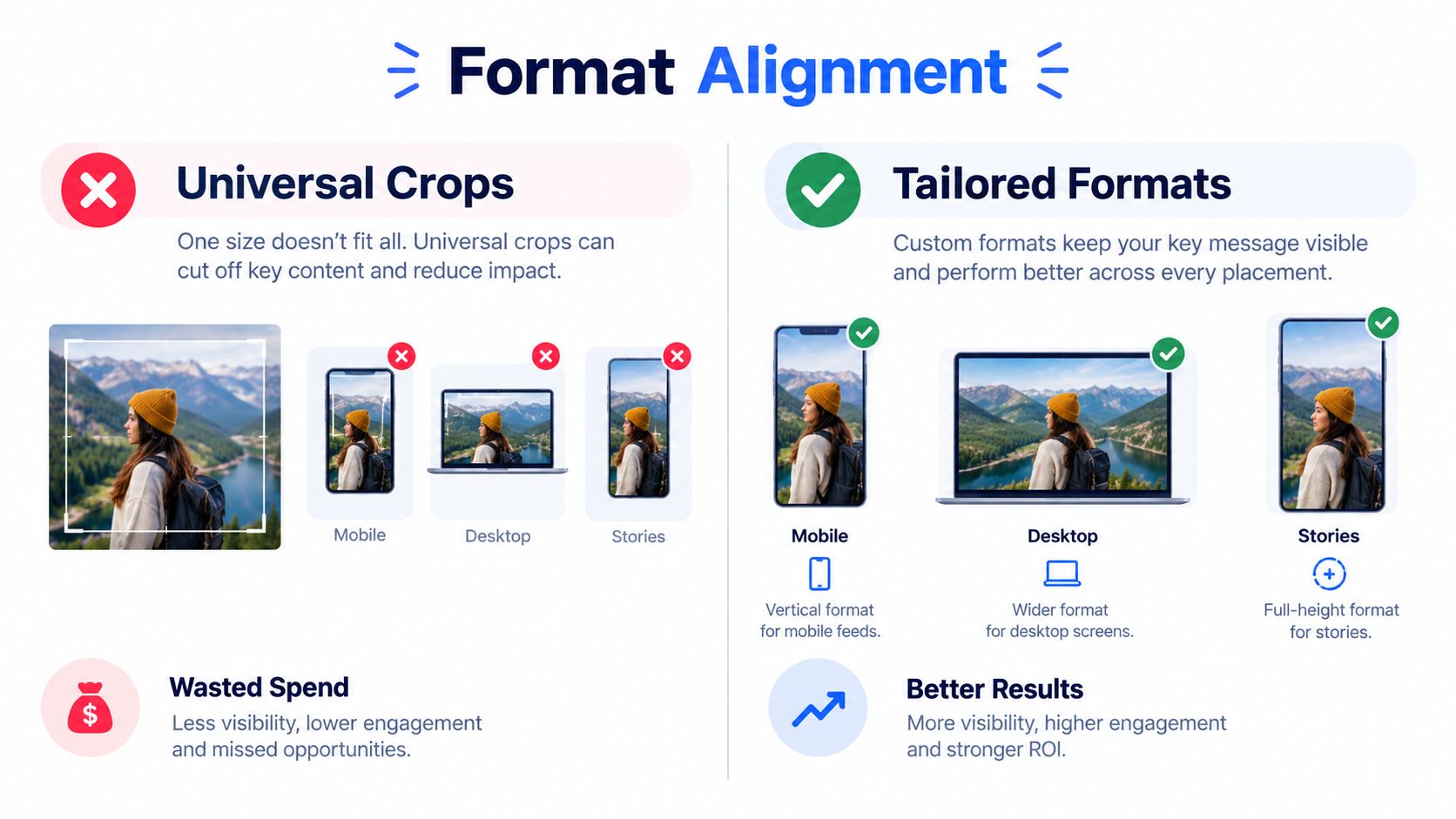
A universal crop is convenient for production, but convenience often transfers the cost to the viewer. Text gets pushed into unsafe areas, product framing becomes cramped, and a strong first frame loses its hierarchy when Meta adapts it for another placement.
Meta's placement guidance recommends 4:5 for Facebook Feed and 9:16 for Stories and Reels, where vertical composition supports the full-screen experience, according to its placement specifications. Feed placements support both square and portrait-feed formats, while Stories and Reels need a deliberately vertical asset when composition matters.
Deterministic assets versus automated adaptation
| Approach | What it does well | Main risk | Use it when |
|---|---|---|---|
| Native placement customisation | Reduces manual asset preparation and can broaden delivery | Cropping or adaptation may change the intended composition | The creative is visually resilient |
| Separate 4:5 and 9:16 assets | Preserves hierarchy, framing, and copy placement | Requires more production and QA | Product visibility and text position are critical |
| Advantage+ creative enhancements | Lets Meta generate or adapt versions based on predicted interaction | The final rendering may differ from the approved master | You can review previews and accept variation |
| Strictly controlled uploads | Gives the brand a deterministic output | May reduce automation flexibility and increase setup work | Legal, brand, or design constraints are strict |
The choice should follow the asset's sensitivity. A simple product image with generous negative space may tolerate adaptation. A testimonial with subtitles, a before-and-after composition, or a product demonstration that depends on sequence usually needs placement-specific control.
Meta's placement asset customisation can replace media, change the crop, and save a variation for a placement group or an individual placement. Its supported ratios include 1.91:1, 16:9, 1:1, 4:5, and 9:16, as described in its Crop workflow documentation.
Build the routing logic into production
Name assets by placement before uploading, for example HOOK_DEMO_BODY_A_OFFER_CORE_FEED_4x5 and HOOK_DEMO_BODY_A_OFFER_CORE_REELS_9x16. Keep the script and offer identical when you want a clean format comparison. If you change the framing and the edit at the same time, you won't know whether the result came from aspect ratio or creative execution.
Check the master asset, the placement preview, and the active Advantage+ enhancements. Meta notes that enhancements vary by format, placement, and catalogue usage, so a technically correct upload can still render differently after automation is applied.
Scaling Production Without Sacrificing Learning Quality
High-volume production creates a paradox. More assets give the account more ways to discover a winner, but unstructured volume can dilute spend and make the results harder to interpret. The answer isn't to stop producing. It's to stage production so each layer answers a different question.
Use three production gates
Concept validation comes first. Create a limited set of distinct ideas based on different customer tensions, benefits, objections, or proof mechanisms. Keep the media environment as stable as practical so the account can compare concepts rather than a mixture of unrelated changes.
Execution isolation follows. Once a concept earns enough evidence, vary the creator, opening frame, edit rhythm, headline treatment, or proof style while preserving the concept's core promise. This tells you whether the idea is durable or whether one execution carried the result.
Market and placement validation comes last. Adapt the strongest concept to Feed, Stories, Reels, and relevant markets without assuming that a winning execution transfers unchanged. Translation, cultural context, creator credibility, and product framing can all change the response.
WARC's 2025 measurement guidance recommends keeping human-led hypothesis testing alongside AI generation so major campaign assets produce interpretable experiments rather than only more volume, as reported in this coverage of the WARC measurement report.
Governance is part of creative performance
A naming convention should identify the dimensions that matter to analysis:
MARKET_FUNNEL_CONCEPT_HOOK_BODY_OFFER_FORMAT_PLACEMENT_VERSION
A useful convention makes the result searchable without opening every preview. Apply the same logic to ad sets, campaign names, UTMs, creative folders, and reporting exports. If your analytics team can't connect a creative ID to its concept and destination, the production effort won't create reusable knowledge.
Keep a hypothesis register with:
- Business question: What decision is the test intended to inform?
- Isolated variable: Which element changes?
- Controls: Which elements remain constant?
- Decision rule: What evidence supports promotion, revision, or rejection?
- Learning record: What should the next brief preserve or avoid?
AI can accelerate ideation, resizing, and copy combinations. It can't decide whether a test isolates the right variable or whether a cheap click represents profitable demand. Human governance protects the quality of the evidence.
The best creative library isn't the largest one. It's the one where every winning asset teaches the team something reusable.
Measuring True Impact Beyond Platform Metrics
Platform metrics are diagnostic signals, not a complete economic verdict. CTR can reveal that a promise attracts attention, but it can't tell you whether the promise attracts the right buyer. Thumb-stop rate can identify a strong opening, but it can't establish that the customer will retain, repurchase, or generate an acceptable contribution margin.
The measurement hierarchy should move from shallow creative signals to business value.
Start with diagnostic metrics
Use early retention and attention measures to understand whether the asset earns processing time. Review the first frame, the opening claim, the product reveal, six-second views for short-form video, and engagement quality. These metrics help explain why an ad may be failing before you blame the landing page or bid strategy.
The Lumen and Havas analysis supports separating an attention stage from a response stage. If attention is weak, revise the opening mechanism. If attention is strong but qualified conversion is weak, investigate the offer, audience intent, product experience, or post-click continuity instead of making another cosmetic edit to the first frame.
Then follow the customer downstream
A practical reporting stack looks like this:
- Platform attention: Early retention, video views, thumb-stop signals, CTR, and CPC.
- Site quality: Landing-page views, engaged sessions, form completion, checkout progression, and purchase quality.
- Commercial outcome: Qualified conversion rate, revenue, blended CAC, contribution margin, refund behaviour, and cohort value.
- Incrementality: Holdouts, geo or audience experiments, and marketing-mix analysis where the account has enough data and channel complexity to support it.
The winning ad in Ads Manager may not be the winning ad for finance. A sensational claim can lower CPC while increasing rejected leads. A broad promise can generate conversions inside Meta's attribution window while producing weak repeat behaviour. A platform-reported lift can also reflect attribution overlap rather than incremental demand.
Connect every creative variable to economics
Store the creative concept, hook, format, offer, and placement alongside order and lead data. Use UTMs that preserve those dimensions without creating unreadable strings. Review cohorts by acquisition creative, not just by campaign, so you can identify whether the ad attracts customers with acceptable revenue and margin.
For budget decisions, blended CAC and contribution margin matter more than a single platform ROAS view. Incrementality tests and marketing-mix analysis can help when channel attribution becomes unreliable, while creative-level reporting explains which message deserves further production.
Measurement rule: Use attention metrics to diagnose the asset, qualified revenue to judge the asset, and incrementality to decide how aggressively to fund it.
This prevents a common failure mode: scaling the ad with the cheapest click instead of the ad that creates profitable, durable demand.
Operationalizing the Workflow for High-Volume Launches
The final risk is execution drift. A carefully designed matrix can lose its value when an operator uploads the wrong crop, leaves an enhancement active, misnames an ad, or attaches copy to the wrong creative combination.
Use a launch workflow that treats Ads Manager configuration as part of the experiment.
A controlled bulk-launch process
- Freeze the matrix. Confirm the concept, isolated variable, controls, placements, formats, destinations, and naming pattern.
- Prepare the asset folders. Separate Feed and Reels or Stories files, keep approved copy with the relevant concept, and include version identifiers.
- Create the campaign structure. Decide which tests belong in the same ad set and which need separate delivery conditions. Don't mix very different hypotheses under one label.
- Apply names and UTMs before publishing. The ad name should expose the hypothesis. The UTM should preserve the creative identifier and destination.
- Review automation settings. Check Advantage+ creative, placement customisation, catalogue behaviour, and any enhancement that may alter the approved rendering.
- Preview every placement group. Look for cropped faces, hidden product details, subtitle collisions, overwritten text, and a missing brand cue.
- Publish in batches and reconcile. Compare the intended matrix with the live campaign structure before drawing performance conclusions.
Meta warns that Advantage+ creative can automatically optimise images and videos into versions that alter the original framing. Its guidance on automated creative enhancements makes the trade-off clear: broader adaptation can support delivery, but deterministic rendering requires stricter control and QA.

Rapid Ads is one workflow option for teams that need to bulk upload images, videos, copy, and creative combinations, enforce ad and ad-set naming conventions, route aspect-ratio assets, attach UTMs, and auto-disable unwanted Advantage+ creative enhancements across launches. The value goes beyond faster publishing. It reduces the chance that a carefully controlled testing matrix gets corrupted by manual setup or silent setting changes.
If your Meta account is losing hours to one-by-one uploads, inconsistent names, placement sorting, or Advantage+ settings that revert, test the workflow with Rapid Ads. Use it to publish structured creative matrices across accounts while keeping the operational details aligned with the hypotheses your team is trying to measure.