Is Motion slowing your Meta Ads at scale, or are you really paying for the wrong kind of workflow? For media buyers, the bottleneck usually isn't another dashboard, it's getting from insight to launch without breaking naming conventions, losing control of Advantage+, or wasting time on bulk uploads and multi-account hygiene. That's why the best motion app alternatives in 2026 aren't just calendar-like tools. They split into creative intelligence platforms, workflow suites, and execution layers built for teams that live inside Ads Manager.
The category has widened fast. By 2026, alternatives were no longer just about scheduling. Market guides grouped them into AI schedulers, task planners, and all-in-one project platforms, while G2's alternatives coverage also stretched into booking, automation, and business-ops software, including tools like Zapier, Acuity Scheduling, YouCanBookMe, Doodle, SuiteDash, and Thryv alongside scheduling names such as Reclaim.ai and Calendly (Morgen's 2026 Motion alternatives guide). For paid social teams, that expansion matters because the core pain isn't planning in a vacuum, it's coordinating creative, launches, and client work across accounts.
The strongest buying signal in the category is price segmentation. In 2026, FlowSavvy sat around a free tier plus roughly $6/month annually or $8/month monthly, Reclaim.ai around a free plan plus paid tiers near $10/user/month and $15/user/month, Sunsama around $20/month, and Morgen around $15/month annually or $30/month monthly (FlowSavvy's Motion alternatives pricing roundup). Review depth also showed real market maturity, with Calendly at 4.7/5 from 2,643 reviews, Reclaim.ai at 4.8/5 from 141 reviews, Zapier at 4.5/5 from 2,079 reviews, and SuiteDash at 4.8/5 from 618 reviews in G2 data (G2 Motion alternatives). That's enough volume to compare tools on fit, not hype.
Table of Contents
- 1. Foreplay
- 2. Superads
- 3. Smartly.io
- 4. Vidmob
- 5. CreativeX
- 6. Madgicx
- 7. Segwise
- 8. Atria
- 9. Singular Creative IQ
- 10. Triple Whale Creative Cockpit
- Top 10 Motion App Alternatives, Feature & Pricing Comparison
- Next Steps Choose Your Workflow and Migrate Smoothly
1. Foreplay
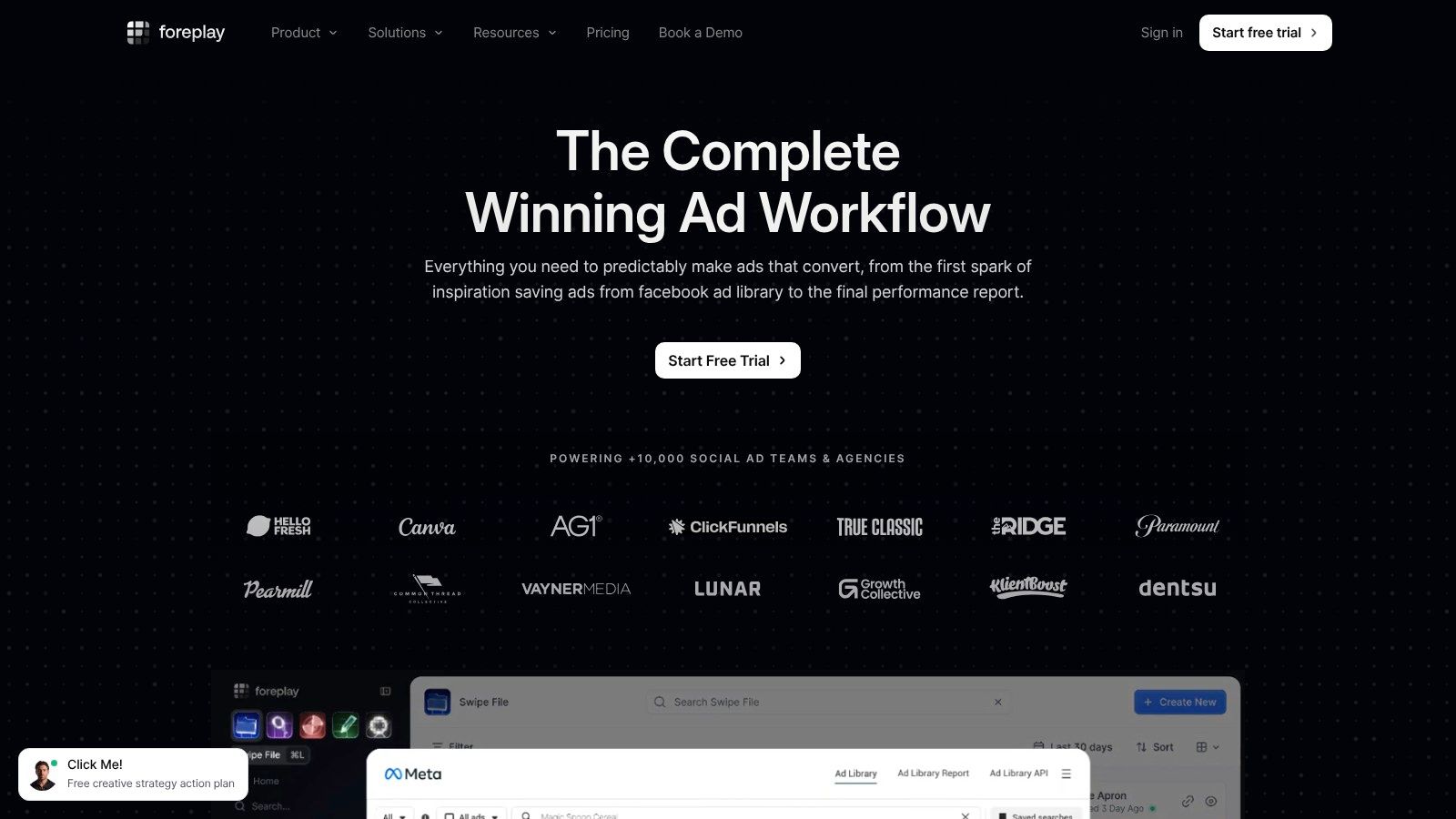
Foreplay is the clearest fit if your Meta Ads process starts with competitor research, not your own reporting. The product's website positions it around ad discovery, swipe files, briefs, storyboards, and competitor tracking, which makes it a better match for agencies that need to move from market observation to creative direction quickly (Foreplay). That matters because a lot of Motion-style buyers don't need another planner; they need a system for finding winning angles before they brief production.
Why it maps to Meta Ads work
Foreplay's Lens layer, Spyder competitor tracking, and discovery search across 100M+ ads create an upstream research loop that helps teams build better creative hypotheses before they touch Ads Manager. The Chrome extension and API or MCP connector are especially relevant for senior media buyers who want retrieval workflows they can query through ChatGPT or Claude instead of manually hunting through tabs. Its value is strongest when your team is running multiple brands or client accounts and needs a repeatable swipe-file process.
The limitation is structural. Foreplay is strongest on inspiration, reporting, and competitive context, but it's not the same thing as a bulk-launch or naming-enforcement system. If your operational bottleneck is pushing 200 creatives into Meta with clean UTM structure, Foreplay doesn't solve that directly.
Practical rule: use Foreplay when the question is “what should we make next,” not “how do we ship it without creating naming chaos.”
What to watch before you buy
- Plan gating: lower tiers can limit Lens branding, so shared reporting may need a higher plan.
- Workflow fit: it's an all-in-one research-to-insight tool, but not a replacement for execution software.
- Team use case: it's strongest for agencies and DTC teams that need a creative library tied to market monitoring.
For Meta Ads teams, the verdict is simple. Foreplay is a research engine, not a launch engine, and that distinction matters when your CBOs, ABOs, and creative refresh cycles are moving fast.
2. Superads
Superads is the cleaner pick if you want a dashboard-first creative analytics layer without dragging in a heavyweight enterprise stack. Its positioning is cross-platform, with reporting across Meta, TikTok, LinkedIn, and Google, plus AI tagging, fatigue alerts, and competitor tracking (Superads). For agency owners, that breadth is useful because it makes the reporting layer portable across clients who don't all live on the same channel mix.
Why it stands out for reporting
Superads is built for teams that need fast analysis and easy sharing. Auto-tagging by hook, format, product, and angle reduces manual cleanup, and cross-platform boards make it easier to compare creative themes across channels instead of looking at each account in isolation. Its stated free start option also lowers the barrier for teams testing whether their current reporting pain is really a tooling problem or a process problem.
The tradeoff is depth. Superads is more about reporting and analytics than element-level causal analysis, so if you need to know why a specific frame, CTA, or scene won, you may hit the ceiling quickly. That makes it a stronger choice for media buyers who want a sharp overview than for creative strategists running deep forensic analysis.
When Superads beats a Motion-style workflow
- Fast onboarding: it's lighter than an enterprise suite.
- Shareability: the UX is built for dashboards people can read.
- Cross-channel sanity: useful when Meta is just one part of a broader media mix.
If your main pain is that motion app alternatives should give you better visibility without another complex system to maintain, Superads fits. It won't replace launch tooling, and it won't enforce your naming conventions inside Ads Manager. But it does give you a practical creative reporting surface that many teams can adopt quickly.
3. Smartly.io
Smartly.io belongs in a different tier. It's the option for teams that don't just want better creative analysis, they want creative production, DCO, and cross-channel automation in one enterprise platform (Smartly.io). If your organization is already coordinating Meta, Google, TikTok, Snapchat, and other placements at scale, the platform's scope makes more sense than a narrower analytics tool.
Enterprise execution is the point
The most relevant feature here is the loop between Creative Insights, Creative Predictive Potential, and campaign automation. That means the platform is not only reporting on performance after launch, it's also trying to inform what should go live before spend scales. For large teams, that matters because the cost of creative mistakes multiplies fast when every iteration must be propagated across channels and formats.
Smartly.io is also one of the few tools in this list that makes sense if your media team and creative team are tightly coupled. The platform is less about isolated reporting and more about coordinating the production-execution cycle across a broad operating environment.
Where it fits in a Meta Ads stack
Use Smartly.io if you need:
- Cross-channel automation across major networks.
- Dynamic creative optimization and product feed use cases.
- Enterprise support for multi-team workflows.
- A platform that treats creative operations as a system, not a side feature.
The drawback is obvious. This is an enterprise buying motion, not a quick self-serve trial. For smaller agencies or DTC teams, it's probably too much platform and too much process. But for performance teams running global campaigns, it's one of the few alternatives that can sit above the launch layer rather than beside it.
4. Vidmob
Vidmob is the strongest fit when the question is not “what ad won,” but “which creative element drove the outcome?” It uses computer vision and AI to tag creative elements frame by frame, then ties that analysis to results through analytics and services (Vidmob). That makes it especially relevant for enterprise advertisers that need a deeper read on video, motion, audio, and visual structure.
Why media buyers should care
For Meta-heavy teams, its primary value is the granularity. Many analytics tools can tell you an ad is outperforming. Fewer can break down the creative into the building blocks that explain the result. Vidmob's approach is designed for those higher-stakes decisions, where a minor shift in opening frame, branding treatment, or pacing can change outcomes across accounts.
It also comes with a studio and managed-service layer, which makes it more than software. That's useful if your internal team can't fully support creative tagging and analysis in-house, but it also means the buying process is closer to a strategic engagement than a lightweight tool install.
Best fit and tradeoffs
- Best fit: large brands, complex paid social teams, and agencies with enterprise clients.
- Strength: deeper creative intelligence than dashboard-only alternatives.
- Tradeoff: sales-led, scoped, and built for enterprise budgets.
Vidmob isn't the fastest path to bulk uploading or naming consistency in Ads Manager. It's the path for teams that want a more rigorous model of creative intelligence, then have the operational muscle to act on it. If you're already running multi-account workflows and need more than surface-level attribution, it's one of the more defensible choices in the market.
5. CreativeX
CreativeX is about governance, not just analysis. It helps global advertisers standardize creative quality, enforce brand and platform best practices, and connect creative quality to performance over time (CreativeX). That makes it a strong option for organizations where the main problem is inconsistency across regions, brands, or teams.
Where CreativeX is different
Most tools in this list are trying to help you discover winning ads faster. CreativeX is trying to make sure the ads you ship meet an internal standard before they go live. For large advertisers, that's a real operational problem. Different teams often build creative in different ways, and without governance the account structure becomes messy fast.
That governance angle matters for Meta Ads scaling because bad structure compounds. If naming conventions drift, creative quality varies wildly, and platform best practices aren't enforced, your reporting gets harder to trust. CreativeX is built to reduce that chaos, even if it doesn't go as deep on element-level experimentation as some creative intelligence specialists.
Best use case
CreativeX fits best when you need:
- Standardized creative governance across brands and regions.
- Reporting on adherence to platform and brand best practices.
- A process that can scale across global teams.
Its downside is also clear. If your main requirement is granular testing, ad-level iteration, or fast launch execution, CreativeX may feel too governance-heavy. For enterprise orgs, though, that's often the point. They need consistency before they need another dashboard.
6. Madgicx
Madgicx is the Meta-first option in this group. It positions itself as an Ecom Ad Cloud with automation, analytics, creative insights, and AI ad generation, which makes it a practical choice for teams that live inside Meta and don't need deep cross-channel execution (Madgicx). If you're scaling ecommerce spend inside Meta, that specialization is a feature, not a limitation.
Why it's operationally useful
Madgicx's creative insights go beyond native Ads Manager, which matters because Ads Manager can tell you what's happening without helping you interpret patterns in a useful way. The platform's ad-type performance and testing-pattern analysis helps media buyers spot fatigue and structural issues earlier than native reporting alone.
Its modular approach also matters. The platform includes automation agents and add-ons such as server-to-server tracking and AI Ad Library or Generator features, so teams can adopt the pieces they need rather than buying a monolith. That's useful for agencies that want to standardize Meta workflows without pushing clients into a full enterprise suite.
Practical rule: if Meta is your main channel and you need both campaign automation and creative visibility, start here before you jump into a broader stack.
Where it loses ground
Madgicx is primarily Meta-focused, so cross-channel teams may outgrow it. Its pricing also varies by spend and feature set, which means you need to evaluate it in-app rather than rely on a single public number. That's normal for this category, but it makes side-by-side procurement harder.
For buyers comparing motion app alternatives against workflow pain, Madgicx makes sense when your problem is inside Meta itself, not across a broader media mix. It helps with the work around the ads, but not the whole media-ops universe.
7. Segwise
Segwise is one of the most analytically serious tools in the set. It automatically tags video, audio, on-screen text, and image elements across networks, then links those elements to outcomes through MMP integrations like AppsFlyer, Adjust, Branch, and Singular (Segwise). For app marketers, gaming teams, and DTC operators with enough volume, that kind of element-level intelligence is the difference between guesswork and actual creative diagnostics.
Why it matters for performance teams
The strongest part of Segwise is that it doesn't stop at dashboards. It tries to answer the harder question of why it worked, which is exactly what many Motion alternatives avoid. If you're managing creative across Meta, Google, TikTok, and app channels, the platform gives you a way to tie asset attributes to downstream performance instead of treating each ad as a black box.
That's especially valuable for teams working with ROAS and LTV data from MMPs, where the reporting chain is only useful if the creative labels are consistent and the integrations are wired correctly. In other words, Segwise rewards mature operations. It's not the tool you buy before your taxonomy exists.
Best fit and tradeoffs
- Best fit: teams with enough creative volume to justify deep tagging.
- Strength: cross-network, element-level analysis.
- Tradeoff: onboarding and setup matter, because the tool depends on connected data sources.
Segwise is probably too much platform for small teams without a clear weekly review cadence. But for larger advertisers who are already running disciplined creative testing, it offers the kind of causal visibility most dashboards can't match. If your bottleneck is not producing data but making sense of it, Segwise deserves serious consideration.
8. Atria
Atria sits closer to the insight-to-launch handoff than most tools here. It blends analytics, creative grading, competitor research, and rapid ad production for Meta and TikTok, with Raya AI acting as a strategist that grades ads and prescribes next iterations (Atria). That makes it attractive for teams that want prescriptive guidance, not just a report archive.
Why it's useful for iteration speed
Atria's structure is compelling because it compresses the workflow. Instead of forcing teams to jump from research tool to insight tool to launch tool, it tries to keep the loop tighter. That's valuable for performance marketers because a good creative insight that sits unlaunched is wasted time.
Its competitor research and swipe-file style discovery also matter. Many teams don't need a full enterprise research platform, they just need a cleaner way to decide what to test next and get the first iteration moving. Atria positions itself well there, especially for smaller teams or operators who want faster decisions with fewer moving parts.
Where it's best
- Meta and TikTok only at present.
- Strong for what to test next workflows.
- Useful if you want a more modern UX and a free-start experience.
The downside is scope. If your media mix is broader than Meta and TikTok, Atria is less obviously central. Still, if your main demand is directional creative guidance with fast execution, it's one of the sharper alternatives on the list. It's closer to a creative operating assistant than a generic planner.
9. Singular Creative IQ
Singular's Creative IQ is designed for teams that want creative reporting tied directly to cost and attribution. It includes a Creative Gallery, AI visual and audio tagging, Creative Explore reporting, asset clustering, and ROAS analysis that sits on top of attribution data (Singular Creative IQ). That makes it especially relevant for mobile and cross-channel advertisers who care about how creative performance maps to business outcomes.
Why it changes the analysis layer
Creative-only dashboards can be useful, but they're incomplete if your attribution stack lives elsewhere. Singular solves that by putting creative analysis on top of cost and attribution rather than treating it as a separate silo. That's a more useful model for performance teams that need to answer both creative and commercial questions at the same time.
The platform's maturity also matters. Established reporting workflows and help docs reduce the learning friction that often comes with more specialized tooling. For teams already operating with attribution discipline, that means less time reconciling outputs and more time acting on them.
Best use case
Singular Creative IQ is strongest for:
- Mobile-first teams.
- Cross-channel advertisers.
- Buyers who want creative views joined to attribution and ROAS.
Its downsides are familiar for this tier of software. It's sales-led, requires setup, and isn't built for quick self-serve experimentation. But if your stack already depends on attribution rigor, it's a more coherent alternative than a standalone creative reporting layer.
10. Triple Whale Creative Cockpit
Triple Whale's Creative Cockpit is the best match for DTC teams already using Triple Whale as their source of truth. It lets you view and compare ad assets alongside KPIs, while the broader platform ties those views into ecommerce analytics and attribution (Triple Whale Creative Cockpit). That combination matters when creative analysis is only useful if it feeds directly into business reporting.
Why it works for ecommerce operators
The platform's creative layer isn't isolated. It sits inside a stack that already serves attribution and store-level analytics, which makes review meetings cleaner. Instead of jumping between tools to decide whether an ad is worth another day of spend, teams can keep the creative conversation close to their ecommerce numbers.
The Creative Studio also helps with quick edits, enhancements, and remixes, which is useful for fast-moving DTC teams that don't want to bounce between a design queue and a reporting dashboard. That said, the creative functionality is part of a broader product philosophy, so the fit is best for teams already bought into the Triple Whale ecosystem.
Best fit and limits
- Best fit: ecommerce and DTC teams that already use Triple Whale.
- Strength: creative analytics plus broader attribution in one place.
- Tradeoff: it's opinionated, and some creative features sit behind plan tiers or add-ons.
If you need a pure Motion replacement, Triple Whale is not that. If you need creative insight wrapped into an ecommerce operating system, it's compelling. That distinction decides whether it belongs in your shortlist.
Top 10 Motion App Alternatives, Feature & Pricing Comparison
| Tool | ✨ Core features | ★ UX / Quality | 💰 Pricing & value | 👥 Target audience | 🏆 Key strength |
|---|---|---|---|---|---|
| Foreplay | ✨ Competitor discovery, swipe files, Lens analytics, Spyder tracking | ★★★★, polished research→brief flow | 💰 Tiered; not ad‑spend priced, some features gated | 👥 Agencies, DTC teams | 🏆 End‑to‑end research→brief→report workflow |
| Superads | ✨ Auto-tagging, cross‑platform dashboards, fatigue alerts | ★★★★, fast onboarding, shareable reports | 💰 Free start; paid tiers (public ranges limited) | 👥 Reporting teams, SMEs wanting quick insights | 🏆 Low‑friction creative reporting & benchmarks |
| Smartly.io | ✨ DCO, cross‑channel automation, predictive forecasting | ★★★★★, enterprise UX & support | 💰 Enterprise/sales‑led (no public pricing) | 👥 Large brands & agencies at scale | 🏆 Deep creative + media execution loop |
| Vidmob | ✨ Frame‑by‑frame computer‑vision tagging, studio + services | ★★★★★, mature enterprise platform | 💰 Enterprise/sales‑led; scoped projects | 👥 Large brands needing production + intelligence | 🏆 Combines creative analytics with production services |
| CreativeX | ✨ Creative quality scoring, governance, compliance reporting | ★★★★, enterprise governance focus | 💰 Enterprise/sales‑led (no public list) | 👥 Global advertisers, brand teams | 🏆 Standardizes creative quality & brand governance |
| Madgicx | ✨ Meta‑first automation, creative insights, AI ad gen | ★★★★, practical, modular UX | 💰 Spend/feature‑based; try‑before‑buy addons | 👥 Meta‑centric ecommerce teams | 🏆 Automation + fatigue/creative insights for Meta |
| Segwise | ✨ Multimodal AI tagging, MMP linking, element‑level signals | ★★★★, deep analytics; setup required | 💰 Enterprise‑leaning; requires connected data | 👥 Gaming, apps, DTC teams needing causal insight | 🏆 Element‑level "why it worked" + outcome linking |
| Atria | ✨ Raya AI strategist, swipe‑file discovery, launch workflows | ★★★★, modern UX, prescriptive guidance | 💰 Free start credits; tiered plans | 👥 Meta & TikTok teams wanting rapid launch | 🏆 Insight→action loop with prescriptive next steps |
| Singular (Creative IQ) | ✨ Creative gallery, AI tagging, attribution‑joined analytics | ★★★★★, established reporting & docs | 💰 Enterprise/sales‑led; integrated attribution value | 👥 Mobile/app & cross‑channel teams | 🏆 Creative analytics tied directly to ROAS |
| Triple Whale (Creative Cockpit) | ✨ Asset‑level KPI views, Creative Studio, ecommerce integration | ★★★★, productized DTC workflows | 💰 Tiered; creative features in tiers/add‑ons | 👥 Ecommerce DTC teams using Triple Whale | 🏆 Creative analytics + ecommerce attribution in one place |
Next Steps Choose Your Workflow and Migrate Smoothly
The right motion app alternatives depend on where your Meta Ads workflow breaks. If you need upstream research, Foreplay is the strongest swipe-file and competitor-intelligence fit. If you want fast creative reporting across channels, Superads is cleaner. If you need deep element-level analysis, Segwise, Vidmob, and Singular Creative IQ go further than simple dashboards. If your team is a DTC operation already living in ecommerce attribution, Triple Whale Creative Cockpit stays closer to the commercial truth. And if you're running Meta-first creative automation, Madgicx is the more operationally specific choice.
The important part is not picking the shiniest interface. It's matching the tool to the failure point in your operating rhythm. A research tool won't fix launch chaos. A governance platform won't solve swipe-file discovery. An analytics suite won't enforce naming conventions inside Ads Manager. Once you separate those jobs, the shortlist gets much smaller and much more useful.
Migration should follow the same logic. Start by deciding which layer Motion was covering for you, reporting, tagging, or recommendations. Then lock your taxonomy before you switch. If your hook labels, offer framing, format tags, and creator buckets are messy now, the new tool will just import the mess faster. After that, rebuild the weekly review cadence so your team keeps making decisions on a fixed rhythm instead of reacting ad hoc.
For Meta teams in particular, launch discipline matters as much as analysis. Bulk uploads, consistent naming, and clean UTM handling are what make the analytics side trustworthy. If you're evaluating a new insight platform, make sure your execution layer can support it with clean account management, consistent creative naming, and fast batch deployment. Otherwise, you'll end up with better charts and the same launch bottlenecks.
If your real problem is not insight but shipping, pair your analytics choice with a purpose-built execution layer and stop forcing one tool to do both jobs. Build the stack around your actual bottleneck, then test it on one campaign wave before you roll it out account-wide. That's the fastest way to protect ROAS, reduce launch errors, and stop losing hours to manual Meta Ads Manager work.
A CTA for Rapid Ads.