Clear, concise copy wins because people scan before they commit to reading. A 2023 Nielsen readability finding reports that 45% of readers scan online content for key phrases or short paragraphs, while only 20% read every word (ZipDo's copywriting statistics roundup). On Meta, that behavior turns every opening line into a media-buying decision. If the benefit isn't obvious immediately, the impression keeps moving and your CPA pays for the missed opportunity.
Effective ad copy isn't a collection of clever hooks. It's a closed-loop system: research, message selection, funnel fit, placement adaptation, controlled testing, and operational execution. The writing matters, but so do the character limits, the landing-page match, the naming convention, and the ability to launch enough disciplined variations without losing the original angle.
Table of Contents
- Why Most Meta Ad Copy Underperforms
- Choosing the Right Copy Framework for the Funnel Stage
- Structuring Headline, Primary Text, and CTA That Survive the Truncation
- Adapting Copy for Feed, Reels, Stories, and Marketplace
- Testing, Refreshing, and Iterating Without Burning Budget
- Scaling Production Without Losing Creative Intent
Why Most Meta Ad Copy Underperforms
Weak Meta ads usually fail before the auction provides useful feedback. The advertiser writes for the brand, product team, or internal brief instead of the person already scrolling past the placement. A polished sentence can still lose if it does not identify a relevant problem quickly.
The opening often looks like this:
“We're excited to announce our new platform for modern businesses.”
It may be accurate, but it makes the reader do the work. A stronger version names the problem and gives the audience a reason to continue:
“Still rebuilding the same Meta campaigns by hand?”
The second line also qualifies the impression. A media buyer with that problem will recognize it immediately. Someone without it can keep scrolling, which is preferable to paying for an unqualified click.
The four expensive failure modes
Brand-first framing explains what the company built instead of what the buyer gets. “AI-powered creative management” describes a category. “Launch hundreds of ad variations without rebuilding every campaign” describes an operational benefit. The second version gives the reader a reason to care and gives the buyer a clearer angle to test.
Identical primary text across placements treats Feed, Reels, Stories, and Marketplace as if they display copy in the same way. Feed can support more context, while Reels and Stories demand an opening that survives fast viewing and limited visible text. Placement adaptation is part of performance, not a cosmetic rewrite.
Generic CTAs describe a click without explaining its value. “Learn more” fits almost any campaign. “See the available sizes” sets the right expectation for an ecommerce shopper. “Get your quote” matches a local lead campaign because it reflects the conversion event and the next step.
Buried benefits put setup before the reason to care. If the offer saves time, reduces risk, or removes a costly workflow problem, state that outcome early. Proof, mechanics, and objections can follow once the reader has a reason to continue.
A quick diagnostic is to remove the brand name and product category from the ad. Can a reader still identify the audience, the problem, and the post-click action? If not, the copy is probably vague, regardless of how polished it sounds.
Why scan behavior changes the writing brief
The writing brief is fast comprehension, not an arbitrary preference for short copy. Longer copy can work when the first line is specific, paragraphs are easy to scan, and each sentence advances one argument. Short copy fails when it replaces a clear promise with a slogan.
A cited 2023 Convince & Convert study reports that 60% of consumers consider clear, concise copy the most important factor in a brand's content (the same ZipDo source set). Apply that finding during editing. Remove words that do not strengthen the pain, promise, proof, objection handling, or next step.
The operational test matters too. Research audience language before drafting, store the original angle with each variant, and name ads so the hook, offer, placement, and iteration remain visible in reporting. Disable Advantage+ enhancements when they alter the intended copy or presentation. A winning hook that cannot be identified, reproduced, adapted, and bulk-launched without losing its meaning is not a scalable asset. It is a one-off.
Choosing the Right Copy Framework for the Funnel Stage
AIDA, PAS, and FAB are useful because they impose sequencing. They aren't interchangeable templates to apply based on personal taste.
AIDA, Attention, Interest, Desire, Action, suits colder audiences when the ad needs to create curiosity, explain the relevance, and then earn the click. PAS, Problem, Agitate, Solution, is stronger when the audience already feels the pain but hasn't committed to a particular solution. FAB, Features, Advantages, Benefits, works well for warm users comparing products or resolving a final objection.
| Framework | Best Funnel Stage | When It Wins on Meta | Sample Hook (Primary Text Opener) | Common Failure Mode |
|---|---|---|---|---|
| AIDA | Cold prospecting | The audience needs a short path from curiosity to desire | “Your ad workflow shouldn't require rebuilding every campaign.” | Spending too long on interest before stating the offer |
| PAS | Cold to warm | The problem is familiar and costly enough to earn attention | “Still losing hours to manual ad launches?” | Agitating the pain without presenting a credible solution |
| FAB | Retargeting and consideration | Buyers are comparing concrete differences | “Bulk-import copy, preserve naming, and launch from one workspace.” | Leading with features without translating them into outcomes |
SaaS example
For a cold SaaS audience, AIDA might read:
AIDA: “Your ad workflow shouldn't require rebuilding every campaign. Organize copy, assets, and ad sets in one launch process. Spend less time on repetitive setup and more time on testing. See how the workflow works.”
PAS makes the pain more direct:
PAS: “Still losing hours to manual Meta launches? Repeated uploads and inconsistent names make performance harder to read. Use a structured bulk workflow to launch cleanly and keep testing organized. See the process.”
For a warm audience, FAB is more appropriate:
FAB: “Bulk-import primary text, headlines, and descriptions. Apply consistent naming and preserve your creative rules. Launch the next testing batch without recreating every field. Review the workflow.”
Ecommerce example
Cold ecommerce copy using AIDA:
AIDA: “Your daily routine shouldn't need five complicated steps. Discover a simpler way to care for dry skin, see how the routine works, and choose the set that fits your needs. Shop the collection.”
Problem-aware PAS:
PAS: “Still layering products that leave your skin feeling tight? More steps don't always create a better routine. Start with a focused set designed for a simpler daily application. Shop the routine.”
Warm FAB:
FAB: “A lightweight formula, a simple application, and a routine designed for daily use. Get the benefit of a consistent skincare step without adding unnecessary complexity. Choose your set.”
Local service example
AIDA can introduce the service to a broad audience:
AIDA: “A small leak can become a disruptive repair. Our local team helps homeowners identify the issue, understand the work, and book the next step. Request an assessment.”
PAS works when the problem is urgent:
PAS: “Dealing with a leak that keeps coming back? Temporary fixes can leave the underlying problem untouched. Book a professional assessment and get a clear repair plan. Get a quote.”
FAB suits a retargeting audience comparing providers:
FAB: “Clear repair recommendations, appointment scheduling, and a local service team. Know what needs fixing before the work begins. Get your quote.”
For better opening-line practice, founder video hook strategies are useful when the creative features a founder or spokesperson. The principle carries over to paid copy: lead with a tension the viewer recognizes, not with a polished company introduction.
Routing rule: Match the framework to awareness level, not personal preference. Choose the structure that lets your strongest proof point lead the primary text.
Structuring Headline, Primary Text, and CTA That Survive the Truncation
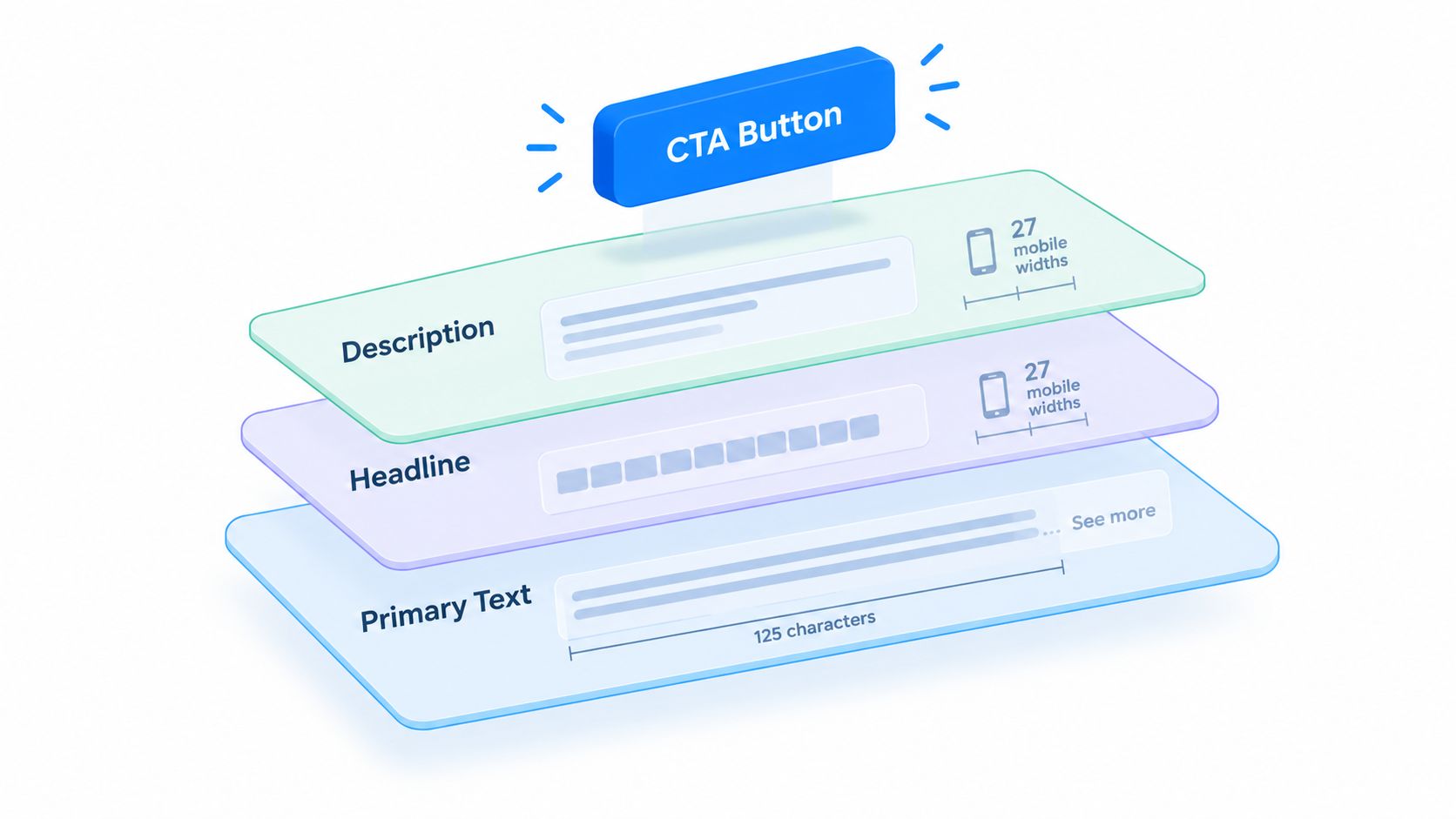
Meta ads give each copy field a distinct job: primary text earns the read, the headline reinforces the promise, the description supplies support, and the button signals the conversion action. Treating every field as another place to repeat the same slogan wastes the limited space and weakens the path to conversion.
Meta's Ads Guide recommends approximately 50 to 150 characters of primary text for many Feed placements, while Feed ads often truncate around 125 characters before the “See more” expansion (Tinuiti's Meta ad specifications). Write the visible opening as the complete sales argument. The continuation can handle proof, objections, and qualification, but the ad should still make sense if the reader never expands it.
Primary text
Job: Stop the scroll and state the audience-relevant benefit.
Weak:
“Our platform offers a range of powerful tools designed to help modern advertising teams improve their campaign management.”
Stronger:
“Still rebuilding Meta campaigns one ad at a time?”
The second line uses the audience's language and creates recognition quickly. Follow it with the specific outcome:
“Launch approved copy in bulk while keeping naming rules intact.”
That sequence gives the reader a problem, a result, and a reason to continue. If credible proof exists, place it directly after the promise instead of hiding it near the end. A cited benchmark reports that ads combining a strong hook, benefits, proof with numbers, and an explicit CTA can achieve 2 to 3 times higher conversion rates, although results depend on the account and testing conditions (Facebook ad copy guidance).
Keep the first line tied to the audience and campaign stage. A cold prospect may need the problem named. A retargeting audience may respond better to proof, a product detail, or a reason to act now. Do not spend the opening on company history.
Headline
Job: Compress the central benefit into a short reinforcement line.
Weak:
“A smarter way to manage your advertising workflow”
Stronger:
“Launch Ads in Bulk”
The stronger version gives the click a clear purpose. Remove hedge words such as “designed to,” “can help,” and “a better way to.” They consume characters without adding conviction. The headline should reinforce the primary text, not restate the brand slogan.
For scaled production, keep the headline tied to the ad's intent. A naming convention such as Funnel_Angle_Offer_Audience_Variant makes it easier to identify which promise is running when bulk-launching multiple ads. Disable Advantage+ enhancements when an automated variation could alter the intended wording, qualification, or offer. Creative control matters when a small wording change changes who clicks.
Description
Job: Handle a secondary proof point, objection, or offer detail.
Weak:
“Find out more about our flexible campaign management solution”
Stronger:
“Preserve naming and copy rules”
Description visibility varies by placement, so it should not carry the only important claim. Put the main promise in primary text or the headline, then use the description to support the decision. A proof point, implementation detail, or qualification often works better here than another abstract benefit.
CTA button
Job: Name the conversion action without creating a mismatch.
| Campaign objective | Button label | Copy should promise |
|---|---|---|
| Ecommerce purchase | Shop Now | A product, collection, or offer to browse |
| Education or consideration | Learn More | A guide, product explanation, or comparison |
| SaaS lead or trial | Sign Up | Registration, access, or trial activation |
| Local lead generation | Get Quote | A quote request or pricing assessment |
“Learn More” is appropriate when the next step is education. It becomes weak when the campaign optimizes for a direct purchase and the copy avoids naming the product or offer. The button, ad, and landing page should complete the same sentence. If the ad says “Get your quote,” the destination should present the quote form without making visitors search for it.
A practical truncation map
For Feed, place the hook and core offer before the visible cutoff, then add proof and objection handling in the continuation. Desktop may show more primary text, but mobile should set the writing constraint because the first impression determines whether the reader expands the ad.
Reels compresses copy more aggressively. Placement guidance reports that Facebook Reels can truncate primary text at about 40 characters, while Stories and Marketplace commonly allow more room but display copy differently from Feed (Meta placement format guidance). Make the strongest claim understandable without “See more.”
Use this field allocation:
- Primary text: pain or desired outcome first.
- Headline: one concrete promise.
- Description: proof, objection handling, or offer detail.
- CTA: the action the campaign optimizes for.
Adapting Copy for Feed, Reels, Stories, and Marketplace
One Meta campaign can place ads across surfaces with radically different reading conditions. Treating the same paragraph as universal copy is an avoidable source of message loss.
Feed gives the writer enough room for a short narrative, especially when the audience is warm. The first 125 characters still need to carry the hook because the reader may never expand the text. PAS is useful here when the problem is recognizable, while AIDA can work when the creative and offer need more context.
Reels is closer to a spoken caption and visual overlay than a conventional text placement. The copy should support the video's first movement or spoken line rather than repeat it. Use a short overlay that communicates one tension or outcome, then let the primary text provide only the necessary context.
Stories have less usable space because interface controls and stickers compete with the message. Put the key benefit near the beginning, keep the copy visually separated from the creative's busiest areas, and make the CTA obvious. Don't make the viewer decode whether the sticker, button, or text is the next step.
Marketplace sits beside a product card and purchase context. Brand storytelling has less work to do there. Lead with the product benefit, condition, use case, or differentiator that helps the shopper compare.
| Placement | Hook Length | Truncation Point | Best Framework | CTA Shape |
|---|---|---|---|---|
| Feed | Short problem or benefit statement | Often around 125 characters | PAS or AIDA | Benefit-led action |
| Reels | Very short spoken or visual hook | About 40 characters in the cited guidance | Direct hook or compressed PAS | Fast, explicit action |
| Stories | Short front-loaded benefit | Compressed by placement UI | Direct offer or PAS | Sticker-compatible action |
| Marketplace | Product benefit and differentiator | Varies by surface and card layout | FAB or comparison-led copy | Product or quote action |
The routing rule is simple: Feed earns attention with a readable argument, Reels earns it with compression, Stories earns it with immediate clarity, and Marketplace earns it with useful comparison language.
Don't write one “master” ad and hope Meta's placement system handles the adaptation. Maintain a placement-specific version of the hook, then keep the promise consistent across the landing page and creative.
Testing, Refreshing, and Iterating Without Burning Budget
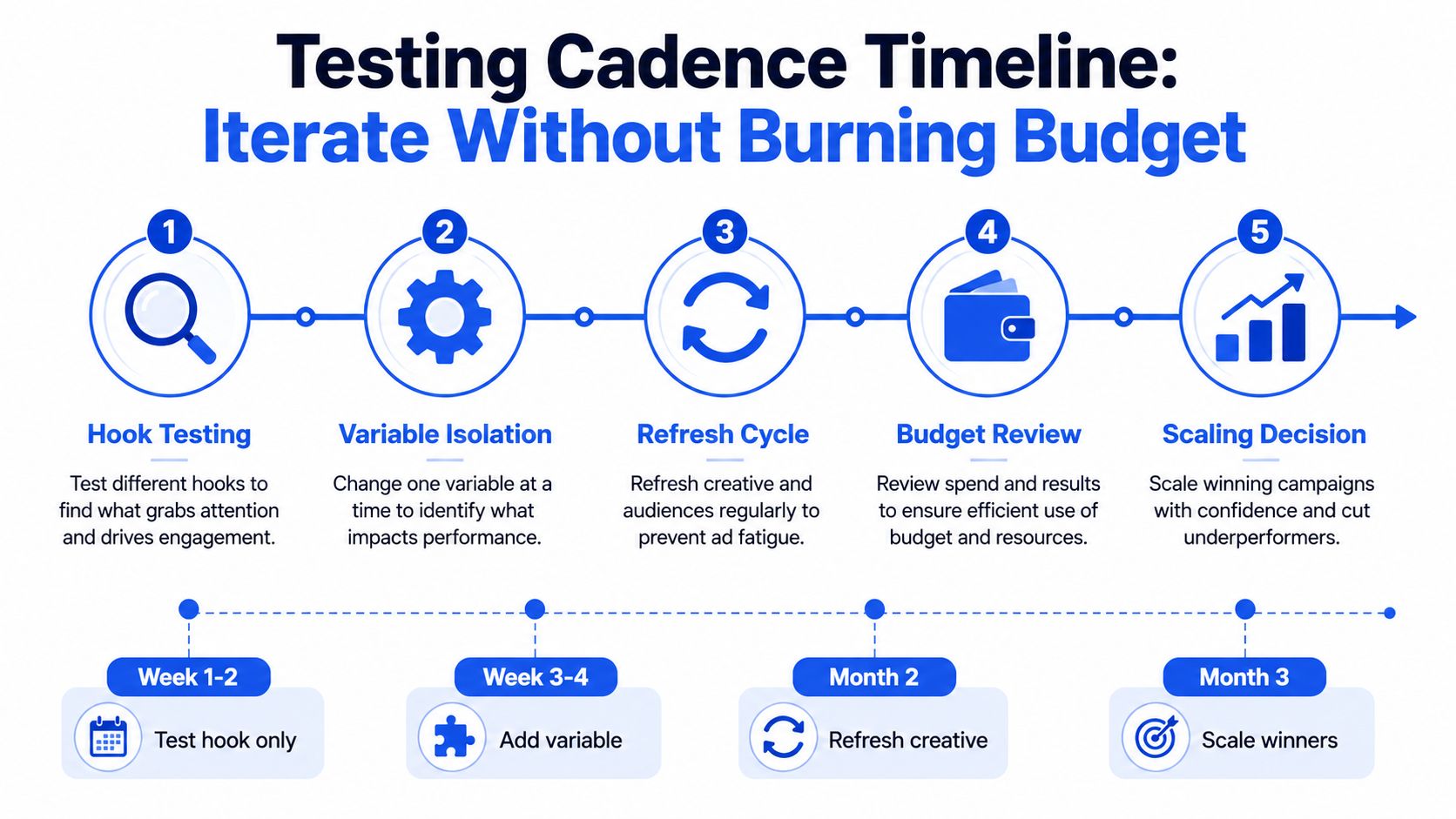
Testing copy should isolate a decision, not create a pile of random variations. The aim is to learn why an ad wins, then apply that learning without weakening the original promise.
Start with one variable. Test the hook before changing the angle, and test the angle before changing the framework. Keep a champion ad live as the control while each challenger tests one hypothesis. Changing the hook, offer, body structure, and CTA together only proves that the ad changed. It does not show which decision improved performance.
A controlled testing rhythm
Use a repeatable review cycle:
- Early review: Check delivery, policy issues, spend distribution, and whether the first line is cut in the intended placement.
- Weekly review: Compare hook strength, CTR, conversion rate, CPA, frequency, and placement performance against the champion.
- Fortnightly review: Decide whether to promote a challenger, revise the angle, or build a variation from the strongest element.
- Monthly review: Retire fatigued patterns, refresh the creative library, and record the winning insight in the account taxonomy.
A hook rate below 25% is a practical warning sign for video-led placements. Pair that diagnostic with stop guessing on ad creative, which frames testing as a decision system rather than a sequence of subjective creative opinions. For other placements, inspect declining CTR alongside frequency and CPA. No single metric should act as an automatic kill rule.
Review the setup before blaming the copy. Advantage+ enhancements can alter text combinations or presentation, so disable them when the test depends on a specific hook, sentence order, or CTA pairing. Otherwise, the platform may serve a modified version and blur the result. Keep the approved copy, creative intent, and test hypothesis in the launch record.
What should trigger a refresh
Refresh when repeated exposure weakens the response. Useful signals include a falling hook rate on Reels, sustained CTR decline in Feed, rising prospecting frequency, or CPA drifting upward across a rolling comparison window. Set thresholds from the account's baseline and conversion volume, not from a universal rule copied from another advertiser.
Record fatigue instead of deleting the ad. A convention such as PROSPECTING_PAINS_PAS_V2026-10-04 identifies the audience, angle, framework, and iteration date before anyone opens Ads Manager. Marking a retired pattern as fatigued prevents the team from recycling the same exhausted hook and preserves the history needed for later analysis.
A worked iteration
Suppose the control opens with:
“Manage all your Meta ads in one place.”
The first challenger changes only the hook:
“Still rebuilding every Meta ad by hand?”
If attention and downstream conversion quality improve, keep the hook and test the angle:
“Launch your next testing batch without repeating every upload.”
If that angle produces stronger conversion efficiency, preserve it and test the framework. A PAS version can name the operational pain first. A FAB version can emphasize bulk import, naming control, and placement routing for a warmer audience.
The useful conclusion is narrower than “version three won.” A specific audience responded better to a specific pain-led promise, expressed through a particular structure. Feed that insight into the next batch, while keeping the champion available for comparison.
The following video helps teams turn the testing rhythm into a repeatable production habit.
Scaling Production Without Losing Creative Intent
At scale, copy is an operational asset. A strong line that exists only in a document isn't useful until the team can identify it, adapt it, validate it, launch it, and connect its result to a clear hypothesis.
Start with naming. Encode the fields that matter in one predictable pattern:
{audience}_{angle}_{framework}_v{date}
A name such as RETARGETING_OBJECTION_FAB_V2026-10-04 tells the buyer what the ad is trying to do before they open Ads Manager. Add a separate status convention for controls, challengers, and fatigue. Keep the same logic at ad set level so reporting remains readable across markets and accounts.
Build the copy as a structured asset pool
Flexible Format lets advertisers group related assets in one ad without choosing a fixed format, which supports Meta's multi-asset automation (Meta's Flexible Format documentation). Instead of manually writing dozens of complete ads, separate the approved asset pool into:
- primary text variants for distinct hooks and angles
- headlines that reinforce the central benefit
- descriptions for proof or objection handling
- CTA labels matched to the conversion event
- audience and offer tags for reporting
This doesn't mean combining unrelated claims. Every asset in the pool must support the same campaign promise. A pain-led hook shouldn't be paired with a headline about a feature that solves a different problem.
Validate before the upload
A CSV workflow should include a pre-validated template, character-count checks, required-field checks, and a preview pass on mobile placements. Review the rendered result before launch, not just the spreadsheet. A grammatically perfect sentence can still fail when the first line ends halfway through the offer.
Also check:
- Message match: The landing page repeats the promise made in the ad.
- Field fit: The headline and description still make sense when Meta combines assets.
- Placement fit: Feed, Reels, Stories, and Marketplace versions have their own opening lines.
- Tracking clarity: Naming and UTM structures identify the audience, angle, and iteration.
- Enhancement settings: Automated changes won't rewrite the intended claim or offer.
Meta's enhancement tools can alter image treatments or text combinations. For accounts where creative intent matters, auto-disable Advantage+ enhancements before launch and verify the setting after publishing. Manually checking every ad invites setting drift, especially when campaigns are duplicated or uploaded across multiple accounts.
Rapid Ads fits this operational layer by supporting bulk copy handling, CSV import, copy templates, naming conventions, multi-account management, Flexible Ads setup, and auto-disable controls for Advantage+ enhancements. That makes it a practical launch surface when the bottleneck isn't generating one more idea, but preserving the approved idea across a large batch.
Teams using AI for variation should still keep a human QA step. An AI ad creative generator guide can help frame where automation is useful, but a generated variation still needs review for audience relevance, proof, policy, placement fit, and consistency with the landing page.

The operational objective is not to publish more copy indiscriminately. It's to produce more controlled, attributable, placement-ready variations without allowing bulk production to erase the reason each variation exists.
Rapid Ads lets performance teams bulk-upload creative and copy, apply naming conventions, manage multiple ad accounts, import templates through CSV, and disable unwanted Advantage+ enhancements before launch. Use Rapid Ads to turn your next copy test into a structured batch instead of a manual Ads Manager rebuild.