Andromeda launched in December 2024 and was fully live globally by early 2026, yet the independent data shows a 7% ROAS decline during its rollout. The advertisers with the largest creative libraries were better positioned, running 395 live ads on average versus 296 among the bottom third.
That's the counterintuitive part of Andromeda Meta Ads. A system designed to improve ad retrieval and matching hasn't produced a universal performance lift. Instead, it has widened the operational gap between teams that can produce, organise, and evaluate creative at scale and advertisers still relying on a small set of manually managed ads.
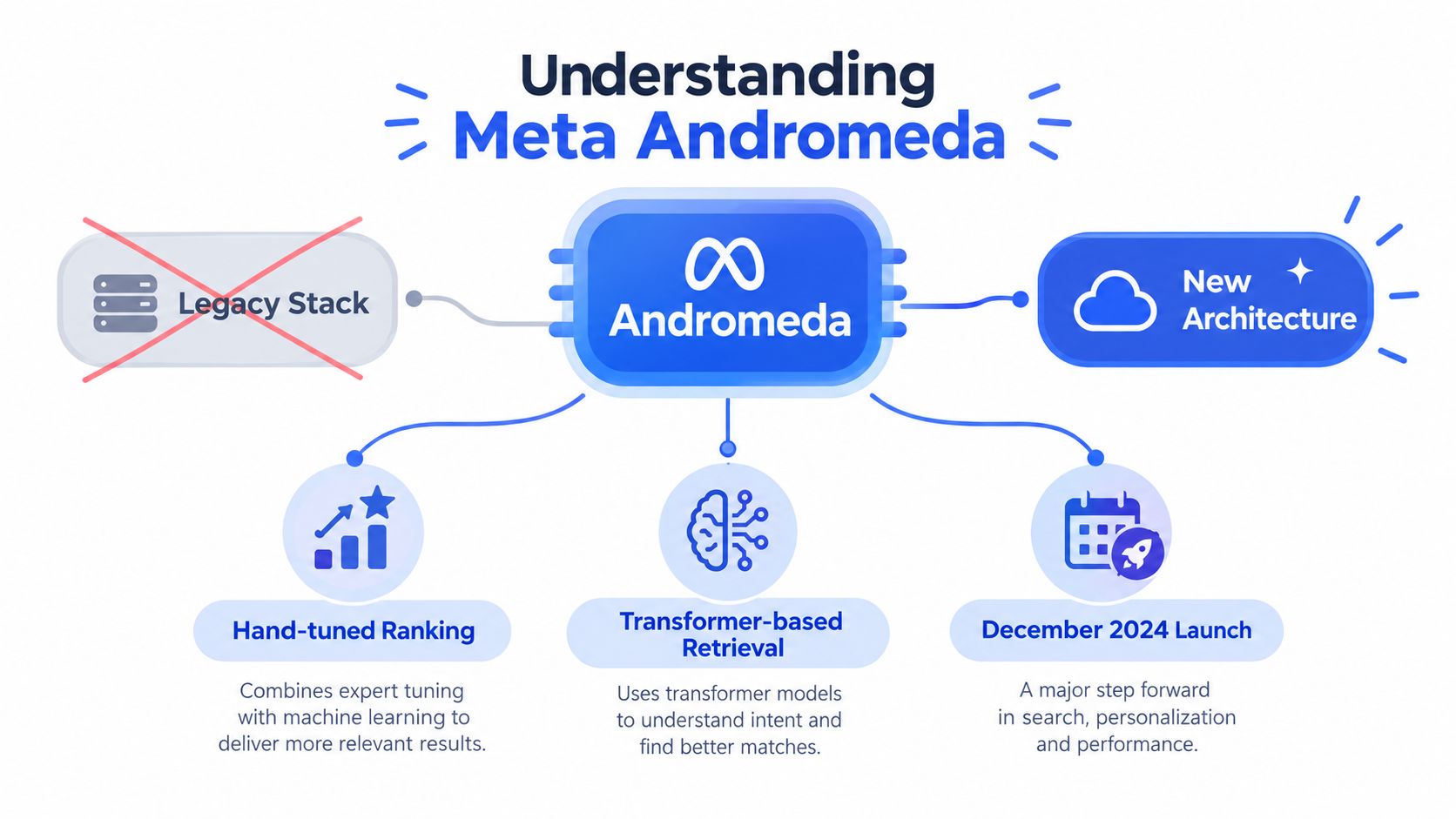
Meta announced Andromeda as “the most significant architectural change to ads retrieval in our history.” The change replaced a hand-tuned layered ranking stack with a transformer-based system, shifting more of the media buyer's influence away from audience micromanagement and toward the quality, diversity, and availability of creative inputs. Meta Andromeda's rollout and architecture are summarised here.
Table of Contents
- Understanding Meta Andromeda
- How Andromeda Retrieves and Ranks Ads
- The Performance Gap and Creative Volume
- Managing Advantage Plus and Flexible Ads
- Scaling with Rapid Ads
- Conclusion
Understanding Meta Andromeda
A familiar workflow looked like this: a media buyer refined the audience, separated prospecting from retargeting, adjusted CBO or ABO structures, and concentrated budget behind an apparent winner. The campaign structure carried much of the strategy. Creative was important, but it often sat inside a relatively narrow set of ads while the buyer controlled delivery through targeting and budget decisions.
Andromeda changes the starting point. Meta's system first has to retrieve plausible creative candidates for a person and context, then determine which candidates deserve consideration in the auction. That makes the ad library itself a strategic asset. A campaign with one excellent ad may still lack enough distinct inputs for the system to match different user situations, placements, and messages.
The architectural shift matters because Andromeda isn't another visible Ads Manager setting. It operates underneath the interface. By early 2026, it was described as fully live across Meta's ad inventory and the default ad-serving system on Facebook and Instagram. A practical reference for the surrounding Meta Ads setup is useful when auditing which controls remain in the interface and which decisions now happen inside delivery.
From hand-tuned layers to transformer retrieval
The previous approach depended heavily on layered ranking logic and manually tuned parameters. Andromeda uses a transformer-based architecture to process matching and ranking more concurrently. In practical terms, the system can evaluate relationships between the user, the context, the advertiser, and the creative rather than treating audience selection as the primary gate followed by a separate creative decision.
That doesn't make targeting irrelevant. It does mean that a carefully engineered audience can't compensate indefinitely for a thin or repetitive creative library. Your old playbook may have treated three similar ads as three tests. Andromeda is more likely to see them as a narrow cluster of inputs with limited additional information.
Operational reading: Andromeda doesn't remove the need for media buying judgment. It changes where that judgment pays off, from constant delivery intervention to better creative inputs and cleaner execution.
The result is a more unequal operating environment. Large teams can create multiple concepts, formats, and product narratives, then upload and label them consistently. A smaller advertiser may understand the strategy but lack the production capacity and workflow discipline to keep feeding it. The technical change therefore becomes an economic change, because the cost of producing and managing enough differentiated creative now sits closer to the centre of performance.
How Andromeda Retrieves and Ranks Ads
The important distinction is between retrieval and auction ranking. Retrieval determines which ads become plausible candidates. Auction mechanics then determine delivery and value among the candidates that survive the earlier filtering process.
Meta-related coverage describes Andromeda as narrowing millions of potential candidates to roughly 1,000 contenders before the auction. The rollout analysis and retrieval context provide that operational framing. The exact implication for a buyer is more important than the metaphor: if an ad isn't retrieved, bid adjustments, audience refinements, and post-launch budget changes can't rescue its delivery.
Why candidate selection changes the workflow
Under a retrieval-first model, every ad is both a message and a data input. A product demo, founder-led explanation, testimonial, static offer, and vertical video can express different relationships between product and user. Five headline edits on the same visual may provide less meaningful diversity than a smaller set of genuinely different concepts.
That distinction explains why some familiar tests fail. If a team changes only the button, headline, or background colour, it may report a high number of ads without creating a broad candidate pool. Andromeda's transformer-based matching can use richer patterns across creative and user context, but it still needs meaningful variation to identify those patterns.
Meta's Flexible ad format was designed to let the delivery system choose among combinations such as a single image, video, or carousel. That supports placement-specific rendering rather than forcing one fixed creative type across every placement. The operational benefit is strongest when related assets are correctly grouped and clearly labelled, because poor asset organisation can turn automation into uncontrolled variation. Meta's Flexible ad format documentation describes the format and its place in the ad setup flow.
What this means for CBO and ABO
CBO and ABO still control budget allocation, but they don't define the full candidate universe. A buyer can distribute spend across ad sets with precision and still give the retrieval system a weak collection of ads. Conversely, a consolidated structure with broader delivery may perform better when it contains differentiated, relevant creative that can be matched across contexts.
The practical test is not whether an account has many ads in Ads Manager. Ask three questions:
- Concept diversity: Do the ads represent different problems, promises, proof points, and visual treatments?
- Placement coverage: Can the system render suitable assets for feed, Stories, and Reels without forcing a poor crop or fixed format?
- Decision clarity: Can reporting distinguish concepts and formats, or do inconsistent names make the results unusable?
The media buyer's job is moving upstream. You're not only optimising delivery. You're curating the candidates that delivery is allowed to consider.
This is also why campaign volatility can persist after targeting changes. A buyer may keep modifying audiences while the system is changing which ads qualify for consideration. The visible symptom is a CPA or ROAS swing, but the underlying issue may be candidate quality, creative similarity, or insufficient variation rather than an incorrect audience setting.
The Performance Gap and Creative Volume
The broad result from the independent analysis is uncomfortable. Across 3,014 ecommerce advertisers, $834 million in ad spend, and 115.7 billion impressions, ROAS declined by 7% during the Andromeda rollout. The analysis of advertiser performance and creative volume also found that the top-performing advertisers ran about 395 live ads on average, compared with 296 for the bottom third.
That difference is a 33% gap in live-ad volume. It doesn't prove that adding ads automatically creates better economics. It does show that the advertisers performing best in the analysis had a much larger set of live inputs available to the system while the overall market experienced deterioration.
The two numbers tell different stories
The 7% ROAS decline describes the market-level outcome during rollout. The 33% live-ad gap describes the operating difference between stronger and weaker performers. Read together, they suggest that Andromeda didn't create a simple “more creative equals more ROAS” rule. Instead, creative volume may have acted as a buffer against a system-wide transition that hurt average efficiency.
| Metric | Value |
|---|---|
| Advertisers analysed | 3,014 |
| Ad spend covered | $834 million |
| Impressions covered | 115.7 billion |
| ROAS change during rollout | 7% decline |
| Average live ads among top performers | 395 |
| Average live ads among bottom third | 296 |
| Live-ad volume difference | 33% gap |
A high-volume team can lose individual tests and still preserve options. If one concept weakens, another may remain eligible for retrieval. A smaller advertiser with a few ads has less redundancy. When one ad loses relevance, frequency rises, or a placement fails to suit the asset, there may be no adjacent candidate ready to absorb delivery.
Volume isn't the same as variety
The economic mistake is to treat the table as a production quota. More files don't necessarily mean more useful information. Ten near-identical static ads can create operational noise without giving Meta distinct creative signals. A smaller portfolio containing different hooks, demonstrations, visual formats, and proof structures may be more valuable than a larger folder of cosmetic edits.
The analysis doesn't establish a break-even point where additional variants stop helping. It also doesn't establish that every advertiser should match the live-ad volume of the top group. Those thresholds depend on product breadth, market count, budget, production cost, and how quickly the team can distinguish a genuine concept from a temporary delivery anomaly.
For agency owners, this creates a capacity equation. Production is now part of media infrastructure. If the account needs frequent creative input but approvals, naming, upload, and QA take too long, the team will either test too little or publish without sufficient controls. Both outcomes make the account more dependent on whichever ad happens to retain delivery.
The useful comparison isn't “large account versus small account.” It's “portfolio with redundancy versus portfolio with no replacement candidates.”
A smaller advertiser can respond by narrowing the number of products or markets it tests at once, reusing strong concepts with entirely new executions, and measuring contribution rather than chasing a nominal ad count. The objective is not to imitate an enterprise library. It's to make each new asset add a distinct retrieval possibility at a production cost the business can sustain.
Managing Advantage Plus and Flexible Ads
Automation creates a second source of performance variance: the setting you intended to publish may not be the setting Meta applies by default. Advantage+ Creative is enabled by default in some creation flows, while Meta says enhancements can be turned off or customised. Those enhancements may alter image treatments, text overlays, or media presentation, which matters when a creative relies on a precise claim, layout, or brand treatment. Meta's Advantage+ Creative documentation explains that advertisers can disable enhancements at any time.
The right response isn't to disable every automated feature. It's to make the choice explicit, record it, and verify it after publishing. An account that mixes controlled and enhanced assets without clear naming can produce misleading comparisons. The performance difference may reflect a presentation change rather than the concept itself.

A publish-time control workflow
Use a simple control sequence for every batch:
- Define the treatment. Decide whether the batch permits Advantage+ Creative enhancements. Record the decision in the campaign or ad naming convention.
- Inspect the creation flow. Before publishing, open the Advantage+ Creative panel and check each enhancement state. Don't assume a previous default carries into a new batch.
- Separate controlled tests. If you're comparing creative concepts, keep presentation settings consistent. Otherwise, the test combines the concept with Meta's media treatment.
- Audit after publication. Check the live ads, not only the draft. Default-on automation can create setting drift if nobody verifies the final state.
- Apply bulk edits when needed. Meta's workflow allows you to select multiple ads in the Ads tab, choose Edit, open Advantage+ creative, customise or turn off enhancements, then save or publish. Meta's bulk-edit instructions document that path.
For teams producing product videos or variant assets with tools such as Veo3 AI product ads, the same principle applies. A faster production system increases the number of assets available, but it doesn't remove the need to control the enhancement layer and verify how each asset appears in delivery.
Plan the Flexible format migration
Flexible format has a useful role because it groups related assets and lets Meta automate media combinations. However, Meta's developer documentation says that starting in March 2026, Flexible format will no longer be available in Ad setup. Meta's Flexible format developer documentation is the relevant reference for the change.
Before that date, audit existing campaigns and identify where one Flexible ad contains several assets. Export the asset relationships, preserve the original concept names, and decide whether the replacement should use separate ads or another available setup. Don't wait until a launch window forces a hurried reconstruction.
Meta also provides bulk editing for Advantage+ Creative across selected ads. The documented workflow allows advertisers to select multiple ads, open the Advantage+ Creative panel, choose Edit all selected ads, and apply the same enhancement settings across the batch. The bulk editing reference makes this particularly useful for agencies that need one control decision applied consistently across a large group.
Scaling with Rapid Ads
The creative-volume gap becomes expensive when every asset still requires manual upload, naming, UTM entry, format selection, and Advantage+ checking. A practical high-volume workflow should reduce clerical work without hiding the decisions that affect the test.
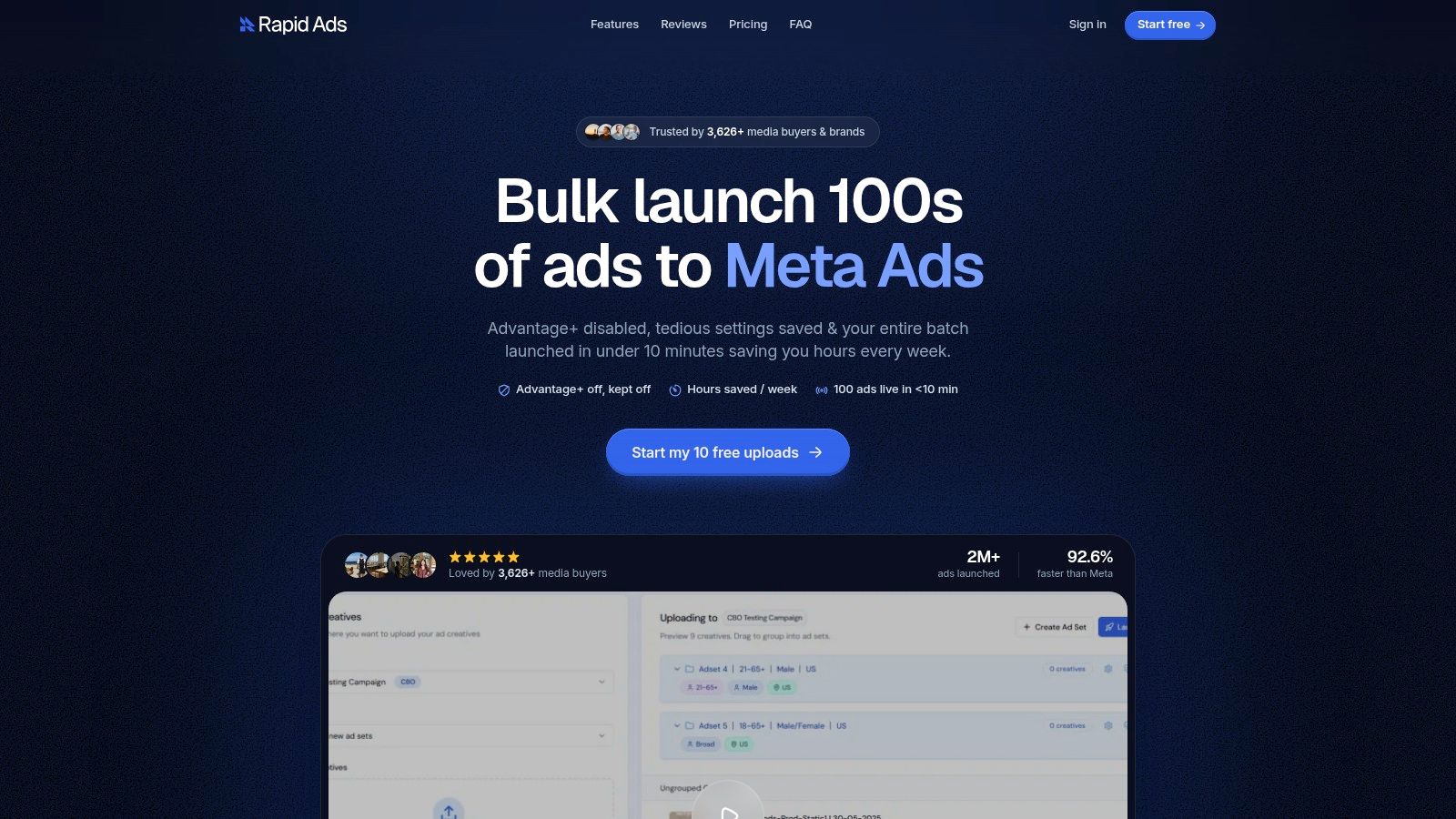
Rapid Ads is one option for this operating problem. It supports bulk uploads, grouping, custom naming conventions, aspect-ratio detection, multi-account management, and an auto-disable function for unwanted Advantage+ Creative enhancements. That combination is relevant when the constraint isn't creative ideation but the time between approved asset and controlled live test.
A batch workflow that preserves test structure
Start with the taxonomy, not the upload. Decide how the account will identify product, concept, hook, format, market, and control state. A name such as SKU_CONCEPT_HOOK_FORMAT_MARKET_ENH_OFF is more useful than a generic sequence because the same fields can later support analysis and bulk editing.
Then use the following sequence:
- Prepare the input pack: Separate approved images, videos, primary text, headlines, and destination details by concept. Avoid mixing unrelated products in one batch.
- Route by format: Let aspect-ratio detection identify 1:1 and 9:16 assets, then verify the resulting ad-set grouping. Automation should remove sorting work, not remove QA.
- Apply naming rules: Enforce the same ad and ad-set naming convention before publishing. This keeps concept-level reporting usable across accounts and markets.
- Set the control state: Use the auto-disable setting where strict creative control is required, then confirm that the published ads reflect the intended Advantage+ state.
- Publish in a reviewable batch: Keep the campaign structure consolidated enough to provide useful delivery data, but retain clear labels so weak concepts can be pruned without deleting the entire learning history.
A bulk interface is only valuable if it makes errors visible. Review the number of assets, the destination, the naming fields, the enhancement state, and the placement assumptions before launch. A fast upload that creates ambiguous reporting is a faster route to the wrong conclusion.
The following walkthrough is useful for teams assessing how a batch-oriented launch process fits into their current Ads Manager routine.
Where the economics improve
The value isn't that a tool magically creates differentiated creative. It reduces the cost of getting differentiated creative into a controlled retrieval pool. That matters most when a team already has approved assets waiting in folders, when several markets share a product concept, or when an agency manages repeated launches across multiple accounts.
Multi-account management also changes the QA model. An agency can standardise naming and enhancement rules across clients without relying on each buyer to remember a separate manual sequence. The buyer still owns the strategic decision, but the workflow reduces the chance that a default setting or inconsistent label invalidates the test.
Conclusion
Andromeda moved Meta advertising closer to a retrieval-first operating model. The consequence isn't just that automation has increased. The consequence is that the value of a campaign now depends more heavily on the quality and breadth of the candidate pool presented to the system.
The rollout data shows why a universal success story would be misleading. ROAS declined by 7% across the analysed advertiser set, while the strongest performers ran 395 live ads on average, compared with 296 among the bottom third. The sensible conclusion isn't that every account should produce an endless stream of variants. It's that advertisers with more useful creative redundancy were better equipped to absorb volatility.
That changes the media buyer's daily priorities. Audience and bid controls still matter, but they no longer compensate for weak creative coverage. The more impactful questions are whether each asset expresses a distinct concept, whether the naming structure supports fast diagnosis, whether Advantage+ settings are intentional, and whether the team can replace a declining ad before the account loses too many viable candidates.
Smaller teams shouldn't copy enterprise volume without checking production economics. They should build a sustainable portfolio, focus on meaningful variation, and remove manual friction from upload and QA. Agencies should treat creative operations as part of media buying infrastructure, not as an administrative afterthought.
Andromeda rewards precision before launch because delivery decisions happen after retrieval. If your workflow can't maintain clean inputs, controlled enhancements, and readable reporting, standard optimisation tactics will keep failing for reasons that look like media performance but originate in operations.
Rapid Ads provides bulk uploads, grouped creative launches, enforced naming conventions, multi-account management, and auto-disable controls for unwanted Advantage+ Creative enhancements. Visit Rapid Ads to test whether a more controlled publishing workflow can help your team build and manage the creative volume Andromeda now demands.



