Retargeting fails most often when teams treat it as one audience with one message. A product viewer from yesterday, a cart abandoner from last week, and a past purchaser are not interchangeable users, even if Meta places them in the same broad remarketing universe. Intent, recency, exposure, creative format, exclusions, bidding, and measurement must work together.
The strongest retargeting best practices therefore form an operating system, not a collection of ad tricks. This guide covers nine tactics for Meta Ads teams managing campaigns at scale, from audience architecture and message sequencing to Conversions API hygiene, catalogue campaigns, frequency control, and bulk execution. The decision sequence is practical: define the user state, assign the shortest sensible lookback, suppress overlap, match the message to intent, control exposure, then test whether reported conversions are incremental.
The timing principle is especially important. Research highlighted by the American Marketing Association found that retargeted ads brought 14.6% more users back to a website within four weeks, while 33% of the total effect generated in the first week occurred on the first day. The effect also declines as more time passes after the initial visit. That makes recency and measurement more important than expanding the retargeting pool.
Table of Contents
- 1. Segment audience layers with precise lookback windows
- 2. Rotate creative using fatigue thresholds
- 3. Keep cross-device signals consistent
- 4. Use dynamic product ads with catalogue-driven segmentation
- 5. Test carousel and collection formats without losing creative control
- 6. Sequence messages by exposure and intent
- 7. Apply exclusions before scaling spend
- 8. Standardise bulk workflows across accounts
- 9. Treat naming, attribution, and versioning as measurement infrastructure
- Retargeting Best Practices: 9-Point Comparison
- Turn the nine tactics into a weekly operating system
1. Segment audience layers with precise lookback windows
Audience architecture should follow the user's last meaningful action. A product viewer, cart abandoner, lead form opener, high-value page visitor, and past purchaser represent different levels of intent, so combining them under “website visitors” creates avoidable message and budget conflicts.
For ecommerce, start with separate layers and explicit rules:
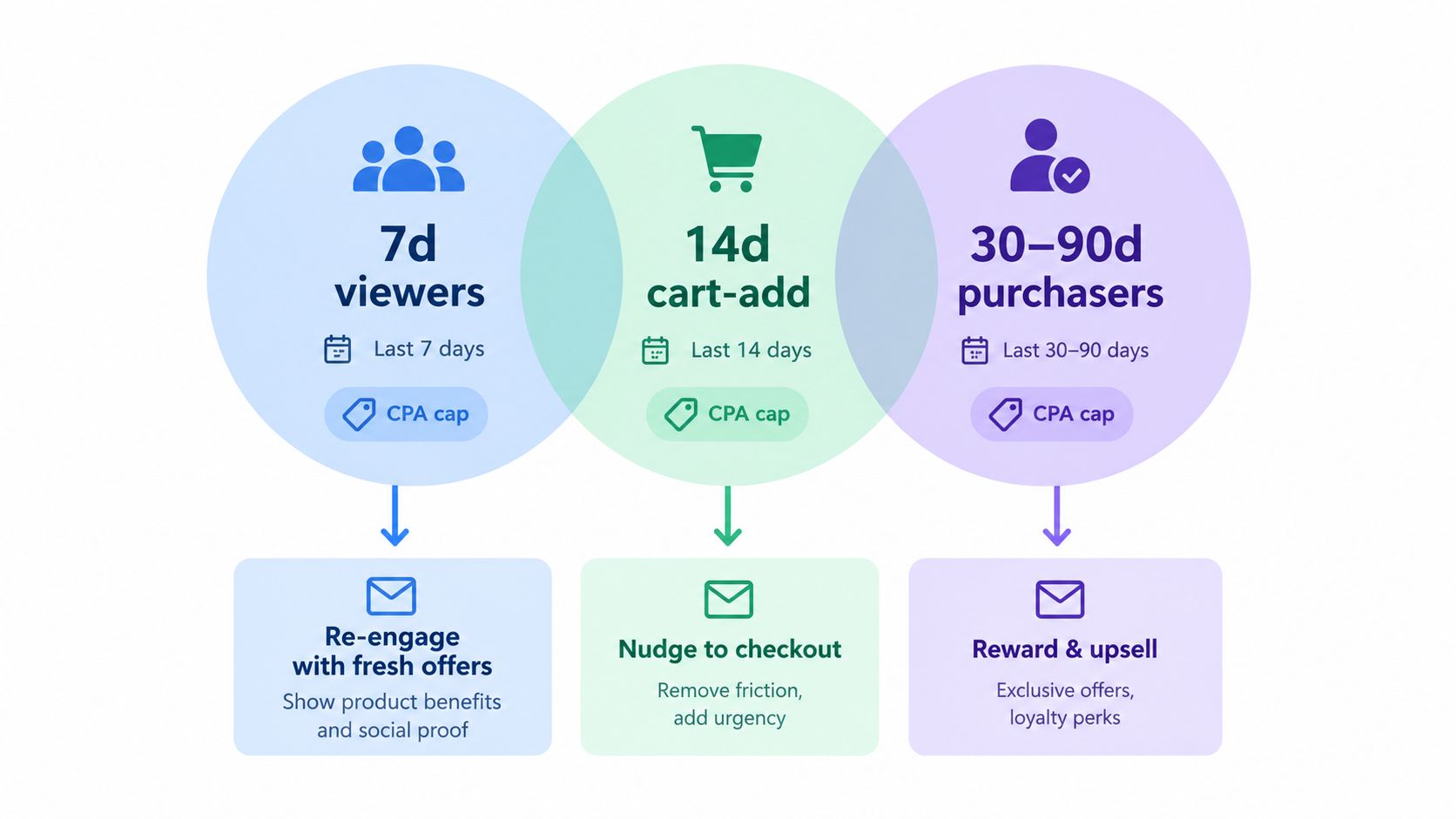
- Product viewers: Set a 7-day window for users who viewed a product but did not add it to their cart, consistent with Meta funnel guidance from Stackmatix.
- Cart abandoners: Set a 14-day window for users who added an item to their cart but did not purchase. Use reassurance about delivery, returns, payment, or product fit rather than repeating an awareness message.
- General visitors: Use a 30-day window when the purchase cycle supports continued consideration.
- Considered purchases: Test 30 to 60 days when buyers require research. A short impulse-purchase window can exclude users who remain commercially valuable.
The window should match the buying cycle, not a default account setting. A longer lookback increases reach, but it also combines recent intent with users whose interest may have faded.
Make the logic visible in Ads Manager. A name such as RETARGET | Cart Abandon | 14d | Category records the action, window, and product scope, which makes audits and handoffs faster. Set budgets and bid controls by segment where the value of each user state differs. Rapid Ads can apply targeting, budgets, caps, and Advantage+ auto-disable rules in bulk when this structure must be deployed across several accounts.
Keep segment logic visible
Assign a distinct creative purpose to each layer. Product viewers may need education and proof. Cart abandoners may need delivery, returns, or payment reassurance. Past purchasers should enter replenishment, cross-sell, or loyalty flows instead of receiving the acquisition offer again.
Automation can blur these boundaries. Review the Advantage+ creative tab at ad level before publishing, then disable or customise enhancements that conflict with a controlled creative setup. This check matters when one message must remain consistent across several audience layers.
Review audience size and delivery weekly. If a high-intent segment cannot spend efficiently, extend its lookback only when the buying cycle supports that change. Record the reason for each window adjustment so increased volume is not mistaken for improved intent.
2. Rotate creative using fatigue thresholds
Creative fatigue requires an operating decision, not a subjective judgment that an ad “looks old.” Review 7-day frequency, outbound CTR, conversion efficiency, and the gap between recent and lifetime results together. Benly's 2026 Meta retargeting guidance places warm retargeting around 5 to 7 impressions per person over 7 days. Hotter audiences may tolerate more pressure for short periods, but rising exposure without a conversion response is a reason to refresh or broaden delivery.
Use a weekly review with three decision checks:
- Exposure versus response: If frequency rises while CPA or ROAS weakens, hold the budget rather than treating available audience volume as proof of demand.
- Message fit: A product viewer who has not acted may need proof, comparison, or reassurance instead of another product-shot variation.
- Controlled iteration: Duplicate the strongest concept, change one meaningful variable, and keep the original active until the new version has enough delivery for a fair comparison.
Record each variation with a stable suffix, such as RETARGET_ProductShot_V1 and RETARGET_ProductShot_V2. Analysts can then compare the underlying creative idea with its iterations, rather than treating every upload as an unrelated ad. A fixed weekly pause routine also limits reactive changes based on one weak day.
Match refresh speed to audience pressure
Audience size and recency determine how quickly to rotate. A small, recent, high-intent pool can saturate faster than a broad consideration audience, so it may require more creative variation. The broader pool can support a longer testing cycle. Do not impose a universal CTR cutoff before establishing the account baseline. A CTR decline is more actionable when it coincides with rising frequency, weaker conversion rate, or declining incremental lift.
Rapid Ads' bulk duplicate feature can create controlled variations before the original is paused. Build the replacement set first, verify copy and destinations, then rotate assets on a scheduled day. This workflow avoids a delivery gap and preserves a clean comparison between old and new versions.
Practical rule: Treat frequency as a diagnostic signal, not a standalone pause command. Pair it with conversion efficiency and audience size before changing spend.
3. Keep cross-device signals consistent
A retargeting audience is only as reliable as the events feeding it. Browser pixels can miss activity when consent is absent, browser restrictions intervene, or a user changes device. For high-value actions, run Conversions API alongside the Meta Pixel so server-side events can supplement browser signals while remaining subject to consent and data-governance requirements.
Start with events that affect revenue or lead quality, such as purchase and lead submission. Validate them in Events Manager, then implement deduplication so one purchase isn't counted once through the browser and again through the server. A duplicated conversion can make an ad set appear more efficient while corrupting both ROAS and audience suppression.
Use a consistent event schema across mobile and desktop. Where consent permits, pass appropriate hashed customer information, such as email or phone, to support matching across devices. A CDP, ecommerce integration, or event platform can normalise those inputs before forwarding them to Meta. The implementation choice matters less than consistent event names, reliable timestamps, and documented ownership.
The AppsFlyer benchmark summary reported by RocketshipHQ shows why this deserves operational attention. Apps running retargeting had a median 30% lift in conversion rates versus non-retargeted cohorts, but only 15% of apps actively ran paid retargeting after ATT, compared with 25% before ATT. The same summary reports that iOS adoption fell by about 40% after ATT. Those figures don't prove that every retargeting campaign creates incremental sales, but they do show why privacy-safe infrastructure and owned data inputs now matter.
Audit event quality before changing creative
Check event receipt, deduplication, consent handling, match quality, and purchase-value transmission before interpreting a performance decline. If Meta is receiving fewer eligible events, a creative refresh won't repair the audience.
Server-side tracking improves signal resilience. It doesn't remove the need for consent, clean suppression lists, or incrementality testing.
4. Use dynamic product ads with catalogue-driven segmentation
Dynamic Product Ads are strongest when the catalogue reflects what the user considered. A person who viewed a specific product should see that product, a relevant alternative, or a logical complement. A generic catalogue ad can waste that intent by showing unrelated inventory.
Separate the catalogue logic by product category, price band, margin, and inventory status. Don't automatically include every SKU. Exclude products that are unavailable, commercially unattractive, or unsuitable for retargeting. The audience segmentation belongs in the campaign structure, but the catalogue should determine which product appears within that audience.
For a fashion advertiser, shoes, dresses, and accessories may require different creative framing and budget decisions. For a business with rapid inventory changes, the feed must update quickly enough to prevent ads for unavailable products. The operational risk isn't only poor relevance. A catalogue can also steer spend toward products that convert but fail to protect margin.
Test catalogue relevance against static creative
Run DPA alongside a static retargeting control instead of replacing every existing ad immediately. Compare product-level conversion rate, contribution margin, checkout quality, and frequency. If users click but don't buy, inspect product attributes, imagery, price, availability, and recommendation rules before blaming the audience.
Flexible Ads can combine multiple product or creative variations so Meta can select combinations for different users. Keep the product set intentional, and use catalogue rules to prevent clearance or low-margin inventory from becoming the default recommendation. Refresh product imagery when the visual system no longer matches the current brand or landing page.
Use product-level reporting to identify which categories deserve more budget. Aggregate ROAS can hide a category that absorbs spend while another category delivers stronger commercial value. DPA should automate relevance, not eliminate merchandising judgment.
5. Test carousel and collection formats without losing creative control
Single-image retargeting can become repetitive because the user sees the same product and proposition at every exposure. Carousel and Collection formats give the advertiser more room to sequence products, objections, proof points, or complementary items. They also create a richer testing surface, but that surface must be labelled correctly or the result becomes difficult to interpret.
Start with 5 to 7 carousel cards, rather than treating a long catalogue as a creative strategy. Use the first cards to establish the strongest product or argument, then use later cards for proof, variants, or complements. Give each card a distinct role. Repeating the same headline across every card makes the format look larger without making the message more useful.
Use card-level UTMs such as ?card=1 to connect engagement and conversion data back to the creative position. The ShortGenius Meta ad creator is a relevant reference for teams developing Meta ad variations, but the measurement standard should live in your own UTM taxonomy and analytics system.
Separate optimisation from narrative testing
Meta's Advantage+ options can optimise asset combinations, which is useful when the objective is broad performance. It can undermine a deliberate narrative test when the order of cards is part of the hypothesis. If card order matters, review the Advantage+ creative settings in Ads Manager and disable enhancements that alter the intended sequence. Meta's official enhancement controls explain where advertisers can inspect and change those settings.
Test Collection ads first with audiences that have a clear product relationship, such as past purchasers or recent high-intent visitors. A collection that begins with a hero asset and then removes product-search friction may be more appropriate for those users than for a broad video-engager audience. Judge the format against static creative using the same attribution window, exclusions, and conversion definition.
6. Sequence messages by exposure and intent
Message sequencing should follow both exposure and intent. A product viewer may still need differentiation, while a repeat visitor may need proof. Someone returning frequently may be ready for a direct offer, interested in another product, or better removed from the campaign.
Start with the user's most recent meaningful action, then layer exposure on top:
- First exposure: Establish product context, frame the problem, or provide a concise introduction.
- Middle exposure: Address objections with demonstrations, comparisons, reviews, or other proof.
- Higher exposure: Make a conversion-focused request, introduce urgency, change the product angle, or suppress the user if intent has not developed.
Frequency alone creates weak decisions. Five impressions for a recent cart abandoner indicate more intent than five impressions for a passive video viewer. Combine frequency with action and recency, then exclude higher-frequency groups from lower-frequency ad sets. This prevents one person from qualifying for conflicting messages at the same time.
Sequence the offer, not just the format
A discount should not automatically become the second message. Offering it too early can train users to delay purchase, reduce margin, and hide a product or trust problem. Resolve hesitation with information first. Reserve an incentive for users who continue to show intent and whose expected value supports the cost.
Set the sequence rules in the audience configuration, not in a manual spreadsheet. Refresh audiences automatically where possible, and record the entry and exit condition for each band. For example, define whether a user advances after another meaningful action, remains in the same band after an impression, or exits after inactivity. Use naming such as RETARGET | Freq Band | Proof | V2 so operators can identify the message, audience state, and creative version quickly.
The American Marketing Association's retargeting research supports prompt initial follow-up. Because response is concentrated early, delaying the first relevant message can miss the period of strongest responsiveness. Review sequence performance by exposure band, action type, and recency, rather than treating one blended retargeting result as a sequencing verdict.
7. Apply exclusions before scaling spend
Exclusion logic is where audience architecture becomes budget control. Exclude recent purchasers from acquisition-style retargeting, then create a separate customer audience for replenishment, cross-sell, or retention. A buyer shouldn't continue seeing the ad for the product they've already purchased unless the message has changed to a legitimate post-purchase use case.
The AdLibrary targeting guide recommends excluding current retargeting segments from prospecting and suppressing recent purchasers from acquisition retargeting. It also identifies a 7 to 30-day purchaser exclusion range, depending on the campaign and product cycle. Use the shorter end for products with frequent repeat purchases and a longer suppression period for durable goods, unless an upsell campaign needs the customer sooner.
Build exclusions from canonical systems. Your order database, subscription platform, CRM, and returns system should define who has purchased, cancelled, churned, or requested support. Manual CSV lists become stale and can create both wasted spend and missed retention opportunities.
Document exceptions
A recent purchaser may belong in an accessory campaign but not in a discount campaign for the original product. A churned SaaS account may need win-back messaging rather than acquisition proof. Create separate audiences for those exceptions instead of weakening the global suppression rule.
Before applying a new exclusion account-wide, test delivery and conversion impact in a controlled campaign. Layered exclusions can shrink a high-intent pool quickly, so document each rule in the campaign name or operating notes. The team should be able to answer who was excluded, why, and for how long without reconstructing the logic from memory.
8. Standardise bulk workflows across accounts
Scale creates a different failure mode. The strategy may be sound, but a team duplicates the wrong ad set, applies the wrong cap, omits an exclusion, or publishes inconsistent names across client accounts. Bulk execution needs a pre-publish control system, not only a faster upload method.
Use one naming taxonomy across campaigns, ad sets, and ads. A useful pattern is Channel | Objective | Segment | Lookback | CreativeVersion. For example, META | Sales | Cart Abandon | 14d | V2 tells the analyst what the ad set is supposed to do without opening every setting.
Build reusable templates for:
- Audience structure: Intent layers, lookbacks, purchaser exclusions, and overlap rules.
- Creative mapping: Which formats and concepts belong to each segment.
- Measurement: UTMs, event names, attribution windows, and reporting labels.
- QA: Budget, bid or cost controls, destinations, placements, enhancement settings, and suppression lists.
Rapid Ads is relevant when a team needs to drag and drop images, video, and copy in bulk, group assets into ad sets, apply naming conventions, and manage multiple accounts from one workflow. Its bulk upload and duplicate functions can reduce repeated Ads Manager actions, while the Advantage+ auto-disable feature supports teams that need creative settings to remain controlled.
The agency dashboard KPI guidance from ClipCreator is useful context for the reporting side of this process. Reporting only works when campaign construction is consistent enough for dashboards to identify the same segment and stage across accounts.
Scale rule: Bulk publishing should standardise repetitive execution, not standardise every strategic decision. Keep local exceptions documented and visible.
9. Treat naming, attribution, and versioning as measurement infrastructure
Measurement breaks when campaign labels describe execution but not intent. Use a naming system that lets analysts compare audience quality, reconcile platform and analytics results, and trace performance changes to a specific creative. Include the audience action, lookback window, funnel stage, and creative version in each ad set or ad name.
For example:
RETARGET | Product View | 7d | Proof | V1RETARGET | Cart Abandon | 14d | Objection | V2RETARGET | Purchaser | 30d | Cross-Sell | V3
These labels make a review faster without opening every setting. They also expose inconsistent windows or missing versions before those errors reach a performance report.
UTMs should preserve the same hierarchy without generating an unmanageable number of dashboard rows. In a carousel campaign, a parameter such as ?card=1 can identify the card position, while campaign and ad-set parameters retain the audience and funnel context. Consistency matters more than the parameter label. Define the convention once, document permitted values, and reject exceptions during launch QA.
Platform-reported conversions require a separate incrementality check. Last-click reporting can make retargeting appear more effective than it is because users close to conversion are more likely to see and click these ads. The multi-touch attribution overview from OtterAB explains how attribution approaches differ, but no model replaces controlled testing.
Where the platform and consent framework allow it, use a holdout group of 10% to 15% of retargeting-eligible users. Compare exposed and withheld users with the same conversion definition and observation period. Treat the difference as an incrementality estimate, not proof that every platform-reported conversion came from the ad.
Keep a changelog for launch date, copy, visual, landing page, enhancement state, catalogue version, and the reason for each revision. Run a weekly naming and UTM audit. That workflow catches taxonomy errors before they distort dashboards or make comparisons across accounts unreliable.
Retargeting Best Practices: 9-Point Comparison
| Item | 🔄 Implementation Complexity | ⚡ Resource Requirements | 📊 Expected Outcomes | Ideal Use Cases | ⭐ Key Advantages / 💡 Quick Tip |
|---|---|---|---|---|---|
| Segmented Audience Layers with Precise Lookback Windows | High, requires disciplined pixel/server events and multiple ad sets | Medium–High, tracking infra, analytics, multiple creatives | High, better ROAS, precise CPA/ROAS attribution | Ecommerce & lead-gen where user intent varies by action/time | ⭐ Granular intent matching; 💡 Name ad sets clearly and monitor segment sizes weekly |
| Creative Fatigue Rotation with Performance Thresholds | Medium, needs rules engine and cadence governance | Medium, steady creative pipeline and dashboarding | Medium–High, stabilizes CTR/ROAS over time | Brands with frequent ad airing and large creative inventories | ⭐ Prevents fatigue, speeds discovery of winners; 💡 Rotate by audience size, not arbitrary days |
| Cross-Device and Cross-Platform Audience Consistency | High, engineering lift for CAPI and deduplication | High, server-side infra, CDP or engineering support | High, recover lost users, better attribution, less duplication | Mobile-heavy sites, companies impacted by iOS tracking limits | ⭐ More accurate audiences and attribution; 💡 Start CAPI with high-value events first |
| Dynamic Product Ads with Catalogue-Driven Segmentation | Medium, catalogue setup and ViewContent event accuracy required | Medium, clean product feed, image/metadata maintenance | High, strong product-level ROAS and scaled personalization | Large-SKU ecommerce, inventory-driven merchants | ⭐ Scales personalization across SKUs; 💡 Exclude low-margin/poor-quality SKUs in feed rules |
| Advantage+ Carousel and Collection Formats with Creative Asset Testing | Medium, creative bundling and Advantage+ considerations | Medium, varied assets (images/videos) and card-level UTMs | Medium–High, higher CTR, improved AOV and engagement | Retail, DTC, high-AOV products where narrative helps | ⭐ Higher engagement per ad; 💡 Limit to 5–7 cards and test order before locking |
| Sequential Messaging with Custom Audience Retargeting Funnels | High, needs frequency tracking and funnel orchestration | Medium–High, multiple ad sets, tailored creatives per stage | High, improved conversion efficiency and clearer stage attribution | Brands with repeat exposures and sizable audiences | ⭐ Improves ROAS by staged messaging; 💡 Start with 3 bands to reduce overhead |
| Exclusion Rules and Negative Audience Targeting to Prevent Wasted Spend | Low–Medium, logic design and automated syncs needed | Low–Medium, reliable CRM/order integration required | Medium, reduces wasted spend and improves CPM/relevance | Any advertiser seeking margin protection and cleaner audiences | ⭐ Cuts wasted spend and protects UX; 💡 Source exclusions from canonical systems |
| Bulk Workflows, Naming Conventions, and Multi-Account Management | Medium, initial template/config setup | Medium, platform tooling (bulk uploader), governance | High, massive setup time savings and consistent reporting | Agencies and teams scaling many accounts/campaigns | ⭐ Saves hours and reduces errors; 💡 Enforce a single naming taxonomy and audit regularly |
| Naming, Attribution and Creative Versioning Best Practices | Low, governance and tooling for automated tagging | Low, UTM templates and version control processes | Medium, cleaner analysis and reliable attribution | Teams running frequent tests and cross-account reporting | ⭐ Enables accurate attribution and faster analysis; 💡 Append version suffixes and run weekly audits |
| Creative Fatigue Rotation with Performance Thresholds (duplicate entry avoided) | , | , | , | , | , |
Turn the nine tactics into a weekly operating system
The nine tactics work best as a review cadence. Start with data integrity, then inspect audience architecture, then evaluate performance and creative. Don't begin by adding another format if the account is sending duplicate purchase events or continuing to target recent buyers.
Monday event and audience validation
Confirm that Pixel and Conversions API events are arriving, deduplicating, and carrying the expected values. Check purchase, lead, and other conversion events in Events Manager. Review consent handling and match quality before interpreting a sudden CPA or ROAS change.
Then inspect exclusions. Confirm that purchasers, leads, subscribers, churned users, and other suppressed groups are being removed from the correct acquisition campaigns. Check exceptions separately, especially upsell and win-back audiences. A suppression rule that works for acquisition can be wrong for retention.
Tuesday audience and overlap review
Review each segment by action and lookback. Product viewers, cart abandoners, general visitors, and past purchasers should have distinct purposes. Compare the current audience composition with the intended composition, then check overlap between ad sets and frequency bands.
Use shorter windows for hotter behaviours and longer windows only when the purchase cycle supports them. Meta guidance commonly distinguishes 7 days for checkout abandoners, 14 days for add-to-cart users, and 30 days for general visitors, while considered purchases may justify 30 to 60 days according to Stackmatix's funnel recommendations. These are starting points, not permanent settings.
Wednesday performance and exposure review
Compare CPA, conversion rate, ROAS, and contribution margin by segment, not only at campaign level. A high aggregate ROAS can hide weak product categories, stale audiences, or a campaign that receives credit for users who would have converted anyway.
Review 7-day frequency. Independent 2026 guidance places many warm retargeting campaigns around 5 to 7 impressions per person over 7 days through Benly's Meta retargeting recommendations. If frequency rises while conversion quality falls, rotate creative, broaden the audience only when appropriate, or suppress inactive users.
Thursday creative and format review
Compare new versions with their predecessors using consistent attribution settings. Inspect carousel card performance, catalogue relevance, landing-page continuity, and the state of Advantage+ creative enhancements. If the account tests a fixed narrative, confirm that Meta hasn't altered the intended asset combination.
Refresh creative based on audience pressure and performance evidence, not a calendar alone. Rapid Ads can help duplicate winners, apply naming conventions, attach UTMs, and publish variations across accounts. That removes repetitive execution work, but the team still needs to decide which hypothesis each variation tests.
Friday budget and incrementality review
Reallocate budget only after checking delivery, audience size, exclusions, and measurement quality. Retargeted display campaigns have been reported at around 0.7% CTR, compared with 0.07% for standard display, a roughly 10x difference, in the benchmark summary from SearchLab's 2026 retargeting statistics. That gap supports prioritising warm audiences, but it doesn't establish incremental profitability by itself.
Use holdouts, multi-touch analysis, or marketing mix modelling where the account has enough volume and governance to support them. The central question is not whether Meta can claim a conversion. It's whether exposure changed the outcome compared with a credible non-exposed group.
Start with segmented windows, conversion exclusions, and measurement hygiene. Add sequential messaging after the audience rules are stable. Add catalogue, carousel, and Collection formats after the team can isolate product and creative effects. Use Rapid Ads where bulk uploads, naming enforcement, Advantage+ auto-disable, and multi-account workflows remove repetitive work without hiding the strategic decisions that control performance.
Rapid Ads helps performance teams bulk-upload creative, apply consistent naming and UTMs, manage multiple Meta ad accounts, and keep Advantage+ creative settings controlled during large retargeting builds. Visit Rapid Ads to test a workflow designed for launching segmented, versioned Meta campaigns without repeating every Ads Manager action by hand.