You launch a new batch of Meta creatives, see CTR climb, and shift budget toward the apparent winners. Three days later, CPA is moving in the wrong direction. The ads are getting attention, but the landing page is leaking intent after the click. Without a controlled experiment, you can't tell whether the problem is the message, the audience, the offer, or the page itself.
Landing page A/B testing gives media buyers a way to isolate that post-click variable. Done properly, it becomes part of the same operating loop as creative testing, not a quarterly design exercise. The discipline is simple to describe and difficult to maintain: define the business event, estimate the traffic, hold the campaign conditions steady, and stop only when the evidence is strong enough to justify a production decision.
Table of Contents
- Why Media Buyers Skip Landing Page Tests
- Designing Testable Landing Page Hypotheses
- Traffic Math and When to Stop a Test
- Tracking, Tools, and Platform Setup
- Running the Experiment and Declaring Winners
- Turning Landing Page Insights into Media Buyer Actions
Why Media Buyers Skip Landing Page Tests
An agency can produce a constant stream of new hooks, UGC edits, thumbnails, and primary-text variations inside Ads Manager. Creative testing has an obvious operating rhythm. You create ads, group them into ad sets, watch CTR and thumb-stop signals, then move budget or kill underperformers. The post-click experience often gets a single URL attached to every ad and disappears from the testing plan.
That creates a misleading diagnosis. A new creative may generate cheaper clicks because its promise is sharper, while the landing page still presents the old promise, a different offer, or a slower path to action. The media buyer then blames audience quality or campaign structure for a problem that begins after the click.

The post-click gap
Consider a common DTC workflow. The team tests several product angles, finds that a pain-point video attracts qualified traffic, and sends every variation to the same product page. One version of the page leads with a feature list. Another could lead with the exact pain point expressed in the ad, clarify the offer earlier, and remove a distracting route to checkout. If the team never tests those page experiences, it can't quantify whether the winning creative is being converted efficiently.
The issue gets larger across agency accounts. Different buyers may use different URL parameters, attribution windows, audience mixes, or conversion definitions. A page can appear to win because one variant received a better traffic mix. A clean landing page experiment prevents that operational noise from being mistaken for customer preference.
Practical rule: Treat the landing page as a variable in the acquisition system, not as a fixed destination.
Why this belongs in the media-buying loop
The business metric should reflect the buying objective. For an ecommerce campaign, that may be purchases or revenue. For lead generation, it may be qualified leads rather than form starts. CTR can help identify where attention changes, but it can't establish whether the page improved acquisition economics.
Historical evidence makes the point. In a documented Kiva donation-page experiment, the preferred version produced an 11.5% increase in donation revenue at 95% confidence, as reported in this conversion optimisation case-study compilation. The result matters because the experiment evaluated donation revenue, the page's commercial objective, rather than treating clicks as the final answer.
Skipping structured landing page A/B testing leaves every creative launch partially uncalibrated. You may know which ad earns the click, but not which post-click experience turns that click into the event your account is paid to generate.
Designing Testable Landing Page Hypotheses
A useful hypothesis connects one page change to one measurable acquisition outcome. “Make the page feel more premium” gives a designer direction but gives a media buyer no decision rule. “Matching the headline to the ad's pain-point angle will increase completed lead submissions because visitors will see message continuity immediately” defines the change, expected mechanism, and conversion event.
Write the hypothesis around the paid Meta workflow. Keep the creative, audience, offer, and budget conditions stable enough to isolate what happens after the click. Test one meaningful page variable at a time, such as the hero promise, form length, proof block, or call to action. Bundling several edits may produce a lift, but it will not show which change created it.
Choose one primary conversion event. Use purchase completion for a direct-response store, qualified lead submission for a B2B funnel, or another event tied to the account's commercial value. Keep scroll depth, CTA clicks, and form starts as diagnostic signals. They can explain a result, but they should not replace the event that determines whether the page improved acquisition.
Set the baseline before traffic arrives
Use recent Meta-driven traffic to establish the control conversion rate. Separate materially different sources when needed, since cold prospecting and retargeting can behave differently even when they share a URL. Record the current rate, audience definition, offer, attribution window, and conversion definition before building the variant.
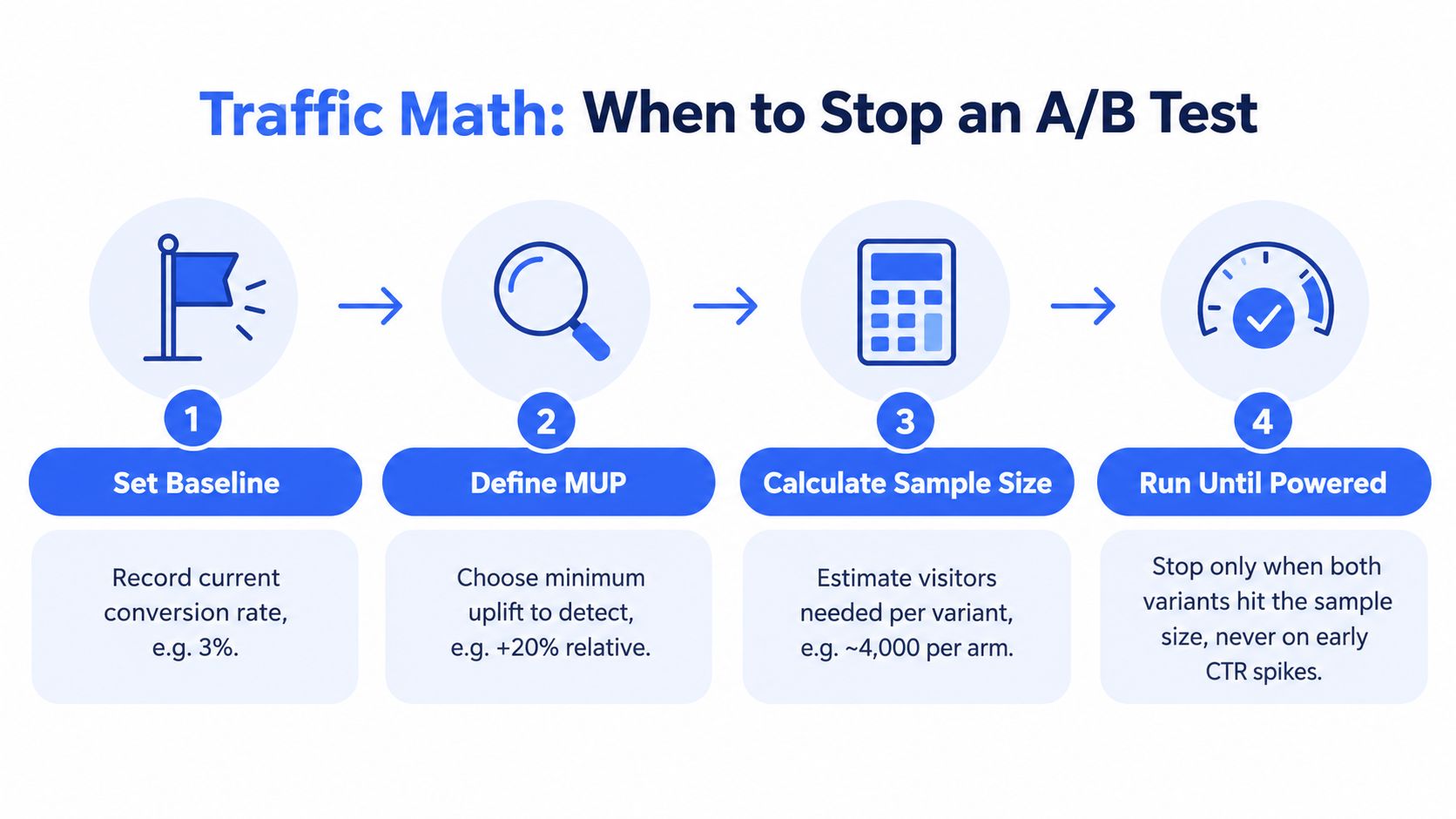
Define the minimum detectable effect, or MDE. This is the smallest improvement worth acting on after considering CAC, implementation effort, margin, and risk. A page converting at 5% with a target of detecting a 20% relative improvement is a different experiment from one seeking a marginal change. The published landing-page A/B testing guide uses the former example, moving from 5% to 6%, and estimates approximately 3,700 visitors per variation, or about 7,400 overall.
A smaller MDE requires more patience. If the improvement would barely change allowable CPA, a long test or complex rollout may not justify the spend. Set the threshold around a commercial decision, not a visually noticeable redesign.
Pre-register the operating rules
Before launch, record:
- Primary event: The conversion that decides the experiment.
- Baseline: The recent rate for comparable Meta traffic.
- MDE: The minimum relative or absolute improvement worth shipping.
- Alpha: Commonly 0.05, corresponding to a commonly used 95% confidence threshold, as described in the statistical planning guidance from CXL.
- Power: Commonly 80%, giving the test a reasonable chance of detecting the defined effect.
- Allocation: A stable split between control and variant.
- Run window: At least a complete weekly cycle, with longer coverage when purchase timing or promotions can distort results.
- Decision rule: The conditions for shipping, extending, or closing without a winner.
Name the exact surface being changed. “Variant B uses the ad's core promise in the hero headline, keeps the same offer and form, and is expected to improve completed applications.” That scope keeps a page experiment from becoming an unmeasurable bundle of design edits.
Traffic Math and When to Stop a Test
The fastest way to create a false winner is to stop when the dashboard first turns green. Early conversion data is lumpy, particularly when the page's baseline rate is low. Meta pacing can concentrate a certain audience profile on one day, while weekday mix, promotion timing, and delayed purchases create differences that disappear later.
Sample size should come from the baseline and MDE, not from the amount of traffic available today. The published testing guide illustrates the impact of baseline performance: at a 3% baseline, detecting a 10% relative lift to 3.3% may require roughly 28,700 visitors per variation, while detecting a 20% relative lift to 3.6% may require about 7,200 per variation. Smaller expected changes require materially more traffic.
Split visitors, not conclusions
Use a consistent random assignment method. A visitor should remain in the same experience, rather than flickering between variants on refresh or across sessions. Send comparable Meta traffic to both versions, keep the audience and offer constant, and avoid routing one variant mostly through a specific creative, placement, or retargeting pool.
The test should run through at least a complete weekly cycle. A longer window may be appropriate when customers need time to purchase, when campaigns refresh audiences gradually, or when promotions affect intent. A three-day test with high spend can still be underpowered if the conversion event occurs after a delay or the account's daily mix changes.
A practical decision routine looks like this:
- Pause for a technical failure: Stop or invalidate the run if one URL breaks, the pixel fires inconsistently, assignment flickers, or a form fails.
- Extend an underpowered run: If neither variant has reached the pre-set sample requirement, treat the result as unfinished.
- Close on the pre-registered threshold: Declare a winner only when the confidence rule and practical-impact threshold are both met.
- Record an inconclusive result accurately: “No reliable difference detected under this design” is not the same as proving equivalence.
Don't confuse significance with value
A statistically reliable lift can still be too small to justify implementation risk, engineering time, or a change to a proven funnel. Conversely, an inconclusive result may just reflect insufficient power. The CXL statistical framework recommends defining the MDE, alpha, power, randomisation, and analysis plan before exposure, then evaluating uncertainty alongside practical impact.
For media buyers, the stopping question is therefore not “Which line is higher today?” It is “Has each arm received enough comparable traffic to evaluate the effect we said was worth acting on?” That question protects budget from dashboard-driven overreaction.
Tracking, Tools, and Platform Setup
A well-designed page can still produce an unusable result if the tracking layer changes between variants. Landing page A/B testing needs identical audience conditions, offer terms, attribution windows, and conversion definitions. If the control counts qualified leads and the variant counts form starts, the experiment has no meaningful winner.
Start with a launch checklist:
- URL integrity: Confirm that both pages resolve correctly on mobile and desktop, preserve parameters, and don't redirect one version through a different tracking path.
- Event consistency: Fire the same pixel and server-side events for the same actions, with matching deduplication logic.
- UTM discipline: Use a naming scheme that identifies campaign, ad set, creative, and landing-page variant without changing the source or medium between arms.
- Audience parity: Keep targeting, placements, exclusions, budget structure, attribution window, and offer stable.
- Assignment stability: Verify that users don't switch variants because of cookies, redirects, cache behaviour, or inconsistent query handling.
- Enhancement control: Review Advantage+ creative enhancements and other automated delivery settings so the ad experience doesn't change while the page is being evaluated.
Compare setup approaches
A client-side testing platform can make page changes fast, but it adds another layer that needs QA. A split-URL setup is often easier to reason about when the two pages have substantial layout differences, provided redirects and tracking remain consistent. A server-side experiment can reduce front-end flicker, but it usually requires more development coordination.
The right choice depends on the account's risk tolerance and release process. A visual editor may suit a tightly scoped headline or form change. A controlled deployment may be better for a complete checkout-path variation. In both cases, version control matters. Store the hypothesis, screenshots, URL, event definition, allocation, launch date, and shutdown decision in the same experiment record.
The Kiva example shows why the final business event matters. The preferred version generated an 11.5% revenue increase at 95% confidence, while a separate mobile-site test described in the same case-study collection involved more than 240,000 unique users and found that a menu labelled “menu” received 20% more unique clicks than a hamburger-menu design at 99% statistical confidence. Those results aren't interchangeable. Revenue, clicks, confidence, and sample size answer different questions.
Measurement rule: Never publish a lift without naming the event, sample context, and uncertainty that produced it.
For Meta operations, keep the ad configuration as stable as the page configuration. If one arm receives a different attribution window or a different creative enhancement, you aren't isolating the landing page. Naming conventions should identify the page version directly, such as LP_Control and LP_HeroPainPoint, while the campaign and ad set names preserve the broader account structure.
Running the Experiment and Declaring Winners
Launch the control and variant from the same campaign conditions whenever the platform setup allows it. The objective is to make the landing page the meaningful difference, not to introduce a second experiment through budget, targeting, creative, or placement changes.
Before enabling delivery, complete a dry run from ad click to final conversion. Check the mobile rendering, page speed, form validation, checkout flow, confirmation event, CRM handoff, UTMs, and reporting labels. Test the actual links used in Ads Manager, not only the clean URLs in a browser.
Use a fixed monitoring rhythm
Monitor for failures, not for excuses to rewrite the test. A broken form, missing event, or incorrect redirect requires intervention. A disappointing daily result doesn't. Don't change the headline, add a testimonial, alter the offer, or shift allocation because one variant trails for a short period. Each mid-test edit makes attribution harder and weakens the original hypothesis.
Review the same dashboard fields at each checkpoint:
- Primary conversion rate by variant
- Total conversions and qualifying status
- Spend and conversion value, where relevant
- CPA or revenue efficiency
- Traffic allocation and audience mix
- Event and attribution health
- Technical error rate
CTR can explain why a variant receives different post-click behaviour, but it shouldn't override the primary conversion event. A page that earns more clicks but fewer qualified leads isn't a winner for a lead-generation account.
Sign off before rollout
At the end of the run, compare the result with the pre-registered threshold. Record the sample, confidence estimate, practical effect, risks, and any segment observations before changing production traffic. If the variant wins clearly, deploy it first to the campaign or account where the experiment ran, monitor the post-rollout conversion path, then expand only when the implementation matches the tested version.
If the run is inconclusive, don't force a winner. Document the failed or uncertain hypothesis, identify whether the test lacked traffic or whether the observed effect was too small, and choose the next test accordingly. A decisive “not enough evidence” protects the account better than a weak rollout based on a noisy spike.
Turning Landing Page Insights into Media Buyer Actions
A landing page result becomes valuable when it changes what the team launches next. If a message-led hero outperforms a generic product introduction, turn that learning into new hooks, primary-text angles, thumbnails, and UGC briefs. If a shorter form improves qualified submissions but lowers lead quality, send the finding to the CRM and sales team before reallocating budget.
Maintain a backlog organised by commercial impact:
- Messaging: Which pain point, outcome, or objection deserves new creative volume?
- Offer framing: Does the page suggest a stronger bundle, guarantee, trial, or qualification step?
- Audience fit: Did the result hold across prospecting, lookalike, retargeting, and market segments?
- Funnel friction: Did users convert better because the page clarified the offer, reduced fields, or shortened the path?
- Deployment scope: Should the result influence one ad set, one market, or every account using the same proposition?
The handoff should include the winning page version, the exact hypothesis, the primary event, the tested traffic conditions, and the next creative implications. That record prevents an agency from repeating the same aesthetic test in another account without understanding why the original version worked.
For large Meta programmes, operational consistency matters. Clean naming, controlled URLs, stable attribution, and documented variants make it possible to connect a page insight to bulk creative production and multi-account launches. The best landing page ab testing programme doesn't sit inside a CRO report. It feeds the next media plan, the next batch of ads, and the next budget decision.
Rapid Ads helps media buyers launch and manage Meta campaigns in bulk, with bulk creative uploads, enforced naming conventions, UTM tagging, multi-account management, and auto-disable controls for unwanted Advantage+ creative enhancements. Use Rapid Ads to reduce manual campaign setup and put more operating time into properly powered landing page experiments, analysis, and scaling.