Most advice about Facebook ads that convert is too format-first. It tells you to test video against static, square against vertical, UGC against polished creative. That matters, but it's rarely the main reason an account scales.
The primary bottleneck is system design. Teams don't lose because they forgot to try a different CTA button color. They lose because they can't consistently turn audience insight into distinct creative angles, launch those angles in a clean testing structure, and read the results without polluted data. At scale, execution quality inside Ads Manager matters just as much as raw creative talent.
If you're running Meta across multiple offers, markets, or client accounts, the question isn't “how do I make one good ad?” It's “how do I build a repeatable machine for producing Facebook ads that convert, without drowning in upload work, messy naming, and inconclusive tests?”
Table of Contents
- The Pre-Launch Framework for High Conversion
- Designing a Defensible Testing Matrix
- Configuring Campaigns for Meaningful Data
- Interpreting Results and Scaling Winners
- Building Your In-House Conversion System
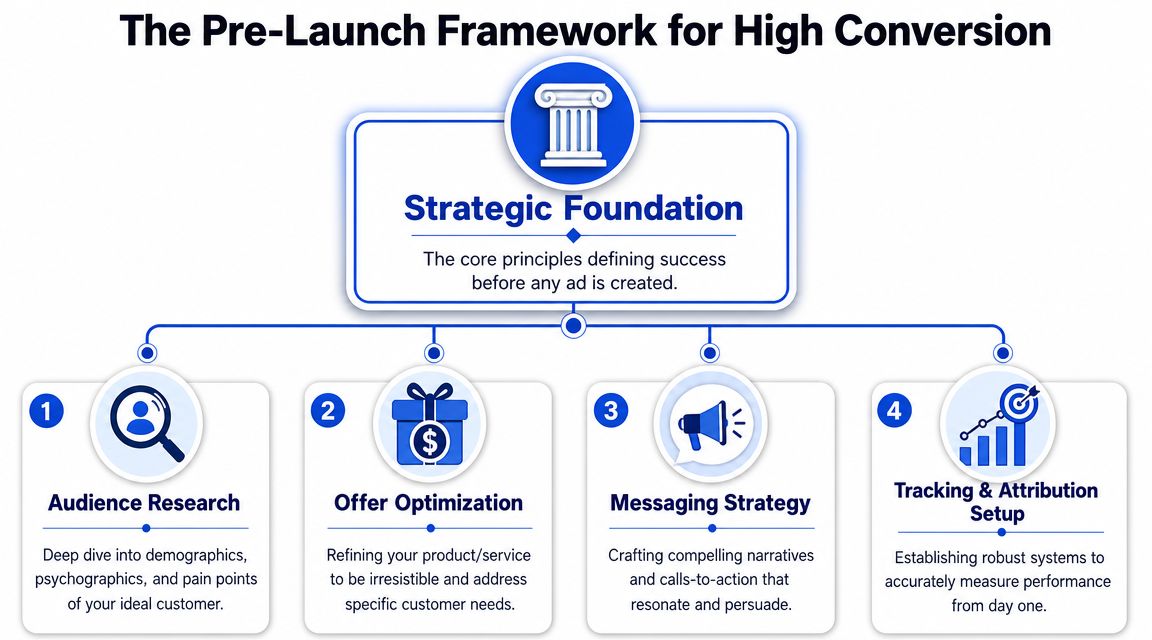
The Pre-Launch Framework for High Conversion
Most weak Meta accounts don't have a creative problem first. They have a diagnosis problem. The team starts in Ads Manager instead of starting with the buyer, the offer, and the exact reason someone should care right now.
That's why format-only testing disappoints so often. Guidance on creative strategy has pointed out that creative angle often matters more than format, and that changing only the visual format can create the illusion of optimization while conversion economics stay flat, especially when the underlying promise never changes across variants, as discussed in Leadenforce's take on creative angle vs format.
Start with jobs, not interests
Interest stacks are useful later. They're a poor substitute for understanding the job the product is being hired to do.
A cleaner planning model is to break the audience into JTBD-style avatars. Not broad personas like “female founder” or “gym enthusiast.” Actual buying situations:
- Pain-led buyer: actively trying to stop a specific frustration
- Outcome-led buyer: chasing a visible gain or status shift
- Comparison buyer: evaluating alternatives and risk
- Skeptical buyer: needs proof before clicking
- Convenience buyer: values speed, simplicity, or reduced effort
Once you map those, you can line up your offer against each one. If the product solves the same problem in different ways, each way can become a separate angle. That's the raw material for Facebook ads that convert.
Practical rule: If your team can't explain why five different people would buy the same product for five slightly different reasons, you're not ready to produce creative at scale.
Build angles before you build assets
Creative angle testing should happen before script writing, design, or editing. Otherwise the team spends days producing asset variations that all say the same thing.
For most offers, I'd rather see 3 to 5 distinct angles than a pile of near-identical hooks with different backgrounds. Common angle buckets include:
| Angle type | What it does | When it works best |
|---|---|---|
| Problem to solution | Names the pain, then resolves it | Pain-aware cold traffic |
| Benefit-led | Leads with the desired outcome | Aspirational or impulse-driven buys |
| Proof-led | Uses testimonials, demos, or transformations | Skeptical audiences and retargeting |
| Mechanism-led | Explains why the product works differently | Comparison-stage buyers |
| Objection-led | Handles doubt upfront | Expensive, unfamiliar, or trust-sensitive offers |
Pre-launch quality is determined during this stage. If the angle is weak, the best editor in the room won't save it. If the angle is strong, even simple execution can generate signal.
Executing Creative and Copy at Scale
The best creative systems don't start with “make more ads.” They start with “make more distinct hypotheses.” Once the angle is defined, copy and visual production become an execution problem, not a guessing game.
Write for the first thumb stop
Meta creative lives or dies in the opening beat. The hook has to do one of three things immediately: call out the buyer, surface the pain, or show the outcome.
Two frameworks still hold up in-feed because they force clarity:
PAS
- Problem: name the friction fast
- Agitate: make the cost of ignoring it feel real
- Solve: present the offer as the bridge
AIDA
- Attention: stop the scroll
- Interest: create relevance
- Desire: build want
- Action: reduce friction on the click
That doesn't mean writing old-school direct response copy word for word. It means structuring the message so the user can process it in motion, on a phone, with half their attention elsewhere.
A few hook patterns consistently produce cleaner tests than vague branding lines:
- Direct pain hook: “Still dealing with…”
- Outcome hook: “How to get… without…”
- Mechanism hook: “Why most [category] products fail…”
- Qualification hook: “For [specific buyer] who want…”
The ad doesn't need to say everything. It needs to earn the click from the right person.
Match copy structure to placement behavior
Placement isn't cosmetic. It changes how the message is consumed. One industry summary reports that Feeds account for 55% to 65% of impressions, Stories 30% to 40%, and Reels 10% to 20%, with placement-level CTR ranges varying by surface, which is why placement-specific creative matters so much, according to this roundup of Facebook ad delivery and CTR patterns.
That has direct production implications:
- Feed creative: can carry denser copy, stronger static overlays, and product detail
- Stories: need immediate visual context and low-friction CTA framing
- Reels-style assets: need motion, pacing, and a stronger first-second pattern interrupt
Teams that ignore this usually get misleading performance reads. They think an angle failed when the underlying issue was that they forced one asset style across incompatible placements.
Production breaks before strategy does
This is the part most advanced teams underweight. Once you've got multiple angles, multiple hooks, and assets for both 1:1 and 9:16, manual workflow becomes the bottleneck.
In native Ads Manager, the slow part isn't decision-making. It's operational drag. Uploading variants one by one, assigning the right aspect ratios, maintaining ad-level naming, checking previews, duplicating ad sets, fixing UTMs, and catching settings drift all create friction. That friction leads teams to test less than they should.
A scalable creative workflow usually needs:
- An angle library with approved messaging buckets
- A hook bank tied to each buyer stage
- Asset templates for Feed and vertical placements
- Copy modularity so primary text, headline, and CTA can be recombined
- Launch ops discipline so creative volume doesn't destroy reporting quality
When that's in place, creative testing stops being a special project. It becomes a weekly operating rhythm.
Designing a Defensible Testing Matrix
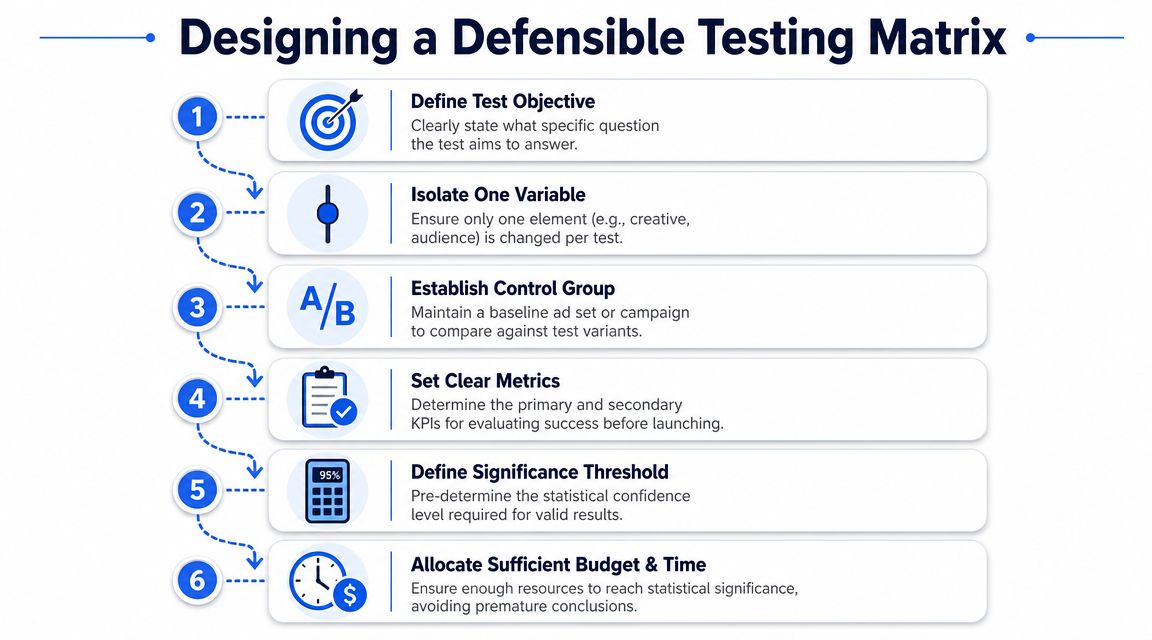
Most Meta tests fail before they launch. Not because the ad is bad, but because the setup can't answer a clean question.
If you change the audience, the angle, the visual style, and the offer framing at the same time, you haven't run a test. You've created noise and labeled it experimentation.
Test one question at a time
A defensible Meta workflow isolates one variable at a time and gives it enough runway to produce signal. A commonly cited benchmark is to run a test for at least 3 to 4 days and collect a minimum of 100 conversions per variation before calling a winner, as outlined in HashMeta's guidance on high-converting Facebook ad testing.
That standard matters because underpowered tests create false confidence. A variant can look strong for a day because delivery was favorable or early conversion distribution was lopsided.
A practical sequence for test priority:
| Priority | Variable | Why it usually matters most |
|---|---|---|
| First | Audience | It changes intent quality the fastest |
| Second | Offer | It changes economics and click motivation |
| Third | Creative angle | It changes message-to-market alignment |
| Fourth | Copy or visual details | It refines, but rarely rescues, a weak setup |
The mistake isn't testing small elements. The mistake is testing them before the bigger levers are stable.
ABO for diagnosis, CBO for validated expansion
ABO is usually better when you need a clean read on a specific variable. It gives each ad set its own budget and prevents Meta from starving one branch of the test too early.
CBO is stronger after you've already narrowed the field and want the algorithm to allocate budget across validated inputs. It's an optimization layer, not a substitute for experimental discipline.
Use the split like this:
- ABO when you're comparing audience clusters, offer framings, or angle families
- CBO when you've identified the inputs worth scaling and want more efficient budget allocation
- Flexible Ads when your goal is asset assembly efficiency, not strict variable isolation
Clean testing is less about clever setup and more about refusing to answer more than one question per launch batch.
Naming discipline is part of test design
Most reporting chaos comes from naming laziness. If the ad name doesn't tell you what changed, the data won't help when results come back.
A naming convention should encode the decision variables. Something like:
Date_Objective_Audience_Angle_Format_Hook
At ad set level, include what controls spend and targeting. At ad level, include what defines the message hypothesis.
A useful comparison:
- Bad name:
New test 3 - Better name:
2026-01_PUR_Broad_ProblemSolution_UGC_HookA - Best name: whatever your team uses consistently enough to survive volume
That sounds boring until you're reviewing hundreds of ads across multiple markets. Then naming becomes analysis infrastructure, not admin.
Configuring Campaigns for Meaningful Data
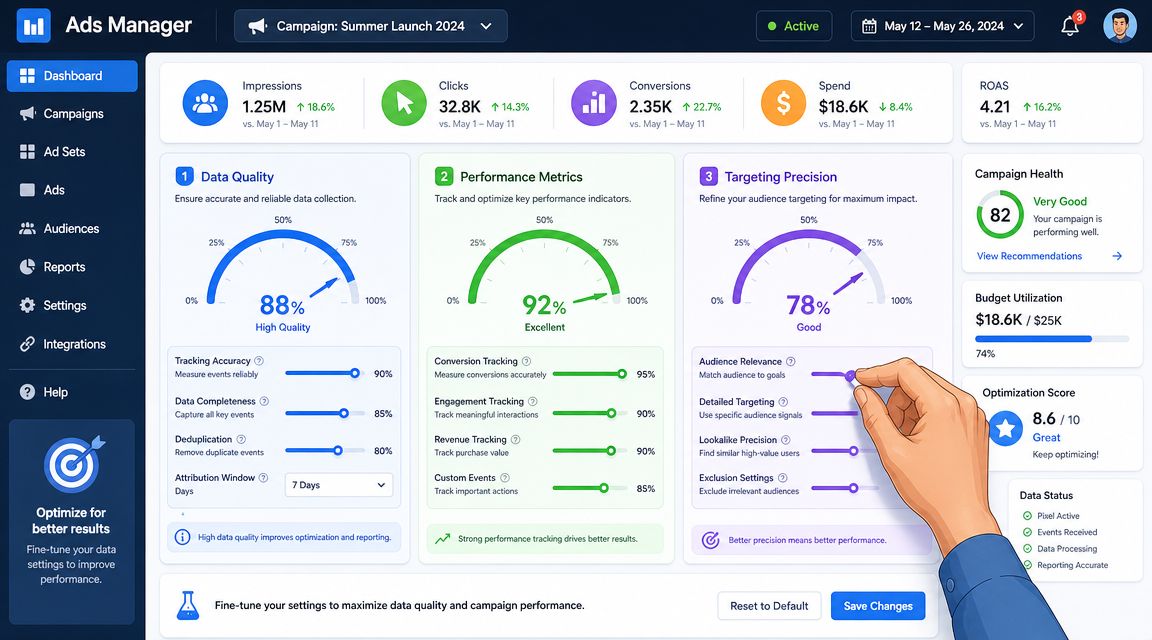
A well-designed test can still get wrecked by campaign settings. In such cases, many advanced accounts lose integrity. The strategic work is solid, the creative is decent, but Meta's defaults or account habits make the read unreliable.
Use benchmarks as a sanity check, not a target
Benchmarks help diagnose whether an account is broadly healthy. They don't tell you what your account should force itself to become.
Across industries, the average Facebook ad conversion rate was reported at 8.95% in 2025, while fitness reached 14.29% in the benchmark set, and 3% or lower was framed as a sign an account needs work in these Facebook ad conversion benchmarks. The useful takeaway isn't “my account must hit the same number.” It's that if your funnel is sitting in the low single digits for too long, you probably don't have a minor optimization problem.
Use those numbers to ask better questions:
- Is traffic quality weak?
- Is the landing page breaking the promise made in the ad?
- Is the offer too soft for the audience's intent level?
- Is the campaign setup introducing junk variability?
Settings that quietly ruin clean reads
The biggest issue in many Meta accounts isn't visible in the ad itself. It's in the settings layer.
Common sources of distorted results:
- Automatic creative changes: if Meta modifies presentation or enhancements, your “same ad” may no longer be the same ad
- Uncontrolled placement spread: if one ad is built for Feed but spends heavily elsewhere, the result says more about mismatch than about message quality
- Audience expansion in the wrong phase: useful for scale, risky for diagnosis
- Attribution inconsistency: if teams compare tests using different windows or reporting views, they create fake lessons
This is why serious testing teams treat setup controls as part of the experiment, not a background detail.
Build ad sets to answer a real buying question
A good ad set structure reflects an actual decision point. Not just a media buying preference.
Examples of valid ad set questions:
- Will broad targeting respond to this angle better than a higher-intent seed audience?
- Does proof-led messaging convert better than mechanism-led messaging for this offer?
- Does this product need education before it needs urgency?
Examples of weak ad set logic:
- Splitting audiences so narrowly that delivery gets unstable
- Launching many tiny ad sets because the team wants “granularity”
- Mixing prospecting and retargeting logic in the same learning environment
If the ad set structure doesn't map to a clear buying hypothesis, the reporting screen will look busy without becoming useful.
Interpreting Results and Scaling Winners
Most accounts don't struggle to find occasional winners. They struggle to scale without breaking them. That usually happens because the team reacts to early green numbers instead of following a rules-based read.
Don't scale on emotion
A winner should earn the right to more spend. It shouldn't get budget because the thumbnail looks strong or because someone on the team likes the comments.
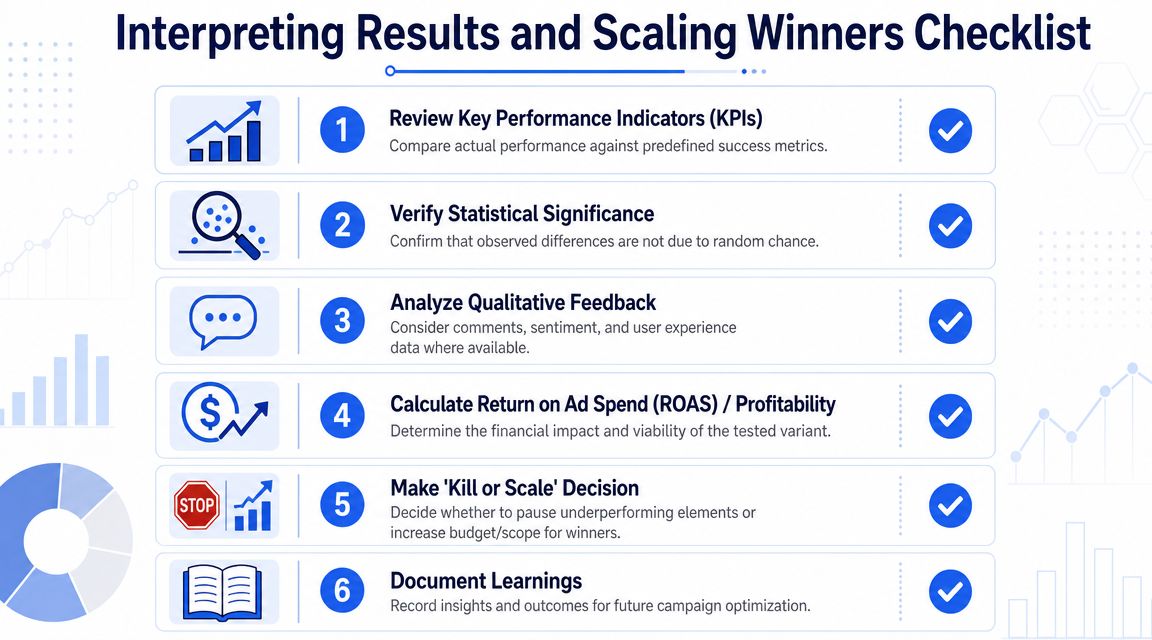
A disciplined read usually checks four layers in order:
Signal quality
- Did the variant get enough clean conversion volume?
- Was the runtime long enough to smooth short-term noise?
Economic quality
- Is the result acceptable at the contribution margin level?
- Does it still hold after you account for the full funnel, not just reported platform return?
Comparative quality
- Did it beat the control?
- Did it beat sibling variants that tested the same core question?
Operational repeatability
- Can the angle produce more assets?
- Can it travel into adjacent audiences or placements?
If you can't explain why an ad won, you probably can't scale it reliably.
What a winner actually looks like
The strongest winners usually have three traits.
First, they're built on a clear angle, not just a nice asset. That means the insight can be reused across hooks, cuts, creators, and formats.
Second, they survive scrutiny beyond top-line ROAS. The ad might not be the prettiest unit in the account, but it brings in traffic that behaves properly after the click.
Third, they fit a broader account thesis. A proof-led winner in one audience can often expand into lookalikes, broad segments, or adjacent creative treatments if the buying motive stays intact.
A quick decision framework:
| Outcome | What it usually means | Action |
|---|---|---|
| Strong economics, weak volume | Good message, limited reach | Expand horizontally |
| Strong volume, weak economics | Broad appeal, weak buyer quality | Tighten audience or offer |
| Moderate economics, clear trend | Possible winner, needs confirmation | Hold and gather more data |
| Weak economics, unstable delivery | Noisy setup or bad fit | Pause and diagnose |
Scale with controlled aggression
Vertical scaling works when the ad set remains stable as budget rises. Horizontal scaling works when the core insight is portable.
Use vertical scaling when:
- the audience is broad enough
- frequency pressure isn't distorting performance
- the result is consistent, not just promising
Use horizontal scaling when:
- the angle has clearly validated
- you want to test adjacent audiences, countries, or LAL tiers
- creative fatigue is likely before audience exhaustion
The teams that scale best don't just “increase budget.” They preserve the conditions that made the ad win in the first place.
Building Your In-House Conversion System
Facebook ads that convert don't come from a single trick. They come from an operating system.
The operating model that compounds
The durable version looks like this:
Strategy first
- define buyer jobs
- map offer strengths to real motives
- turn those motives into distinct creative angles
Production second
- create modular copy
- build placement-specific assets
- maintain enough throughput to test meaningfully
Testing third
- isolate one variable
- structure campaigns to answer one buying question
- enforce naming so analysis stays usable
Scaling last
- validate signal before declaring a win
- scale with rules, not mood
- document what transferred and what didn't
This is what separates an account that occasionally catches a good week from one that keeps learning. The compounding effect doesn't come from one ad. It comes from how quickly the team can turn insight into launch, launch into data, and data into the next cleaner test.
That's also why operational efficiency matters more than most media buyers admit. If your team burns hours on uploads, naming cleanup, ratio sorting, and settings checks, you won't test enough angles. And if you don't test enough angles, strategy quality won't show up in the numbers.
The advantage isn't just better creative. It's a better production and decision system around the creative.
If your team is already doing the strategic part well but Ads Manager is slowing down execution, Rapid Ads is worth a look. It's especially useful when you're launching high creative volume across multiple ad accounts and need bulk uploading, enforced naming conventions, automatic aspect-ratio sorting, and a reliable way to keep Advantage+ creative enhancements disabled so your test conditions stay intact.