If you're still asking whether Facebook ads work, the wrong metric is usually answering the question.
A platform that can still generate an average 1.71% CTR at $0.70 CPC for traffic campaigns and a 7.72% conversion rate for lead campaigns is plainly capable of producing response at scale, according to WordStream's 2025 Facebook benchmark report. The harder question is whether that response is incremental, profitable, and stable after privacy loss, modeled conversions, and Meta's increasing automation.
That distinction matters more now than it did before iOS tracking disruption. A post-iOS account can show healthy in-platform conversion numbers and still disappoint in finance reporting. It can also look mediocre on click metrics while producing efficient customer acquisition because the account is measured correctly and built around strong creative, clean event setup, and disciplined holdout testing. Senior buyers already know this. Skeptical clients usually don't.
The practical answer is that Facebook ads do work, but not in the simplistic way most reporting decks imply. They work when you align campaign objective to funnel stage, enforce measurement discipline below the click, and treat creative operations as a production system rather than a one-off launch task.
Table of Contents
- Do Facebook Ads Work or Just Report Good Numbers
- The 2026 Performance Benchmark Report
- Attribution vs Incrementality The Real ROI Question
- The Three Levers of Scalable Success
- Diagnosing Stalled Performance A Troubleshooting Workflow
- Your Action Plan for Testing and Scaling on Meta
Do Facebook Ads Work or Just Report Good Numbers
For experienced advertisers, “Do Facebook ads work?” isn't really a traffic question. Meta can still buy attention efficiently. The actual issue is whether the account is generating business outcomes that would not have happened otherwise.
That's why this debate gets muddled. One camp points to in-platform ROAS, low CPCs, and improving click-through rates. The other points to iOS14, attribution loss, and accounts that looked profitable in Ads Manager but weak in blended reporting. Both are partly right. They're just answering different questions.
The useful way to frame the problem
A Facebook campaign can succeed in at least three different ways:
| Lens | What it tells you | Where it misleads |
|---|---|---|
| Top-funnel response | Whether the ad earns attention and clicks | High CTR can hide weak unit economics |
| Attributed conversion performance | Whether Meta reports downstream actions | Reported conversions may not equal incremental lift |
| Incremental business impact | Whether spend caused additional revenue or leads | Harder to measure and slower to validate |
The mistake is treating these as interchangeable.
Client-side reality: the platform reports outcomes. Finance cares whether the outcomes were caused by spend.
What changed after privacy loss
Post-iOS, Meta became less of a deterministic tracker and more of a probabilistic one. That doesn't make the channel unusable. It means media buyers need a stricter operating model.
The accounts that still perform tend to share the same traits:
- Clear event hierarchy: Purchase, qualified lead, or another economically meaningful event is set as the actual optimization target.
- Reliable instrumentation: Pixel and Conversions API health are watched in Events Manager, not assumed.
- Structured reporting: Buyers use breakdowns by placement, audience, and creative instead of reading blended campaign averages.
- Incrementality mindset: Teams separate “Meta says it converted” from “the business can verify lift.”
That's the standard clients should use in 2026. Not whether Meta can generate a click. Whether it can generate verified growth under disciplined measurement.
The 2026 Performance Benchmark Report
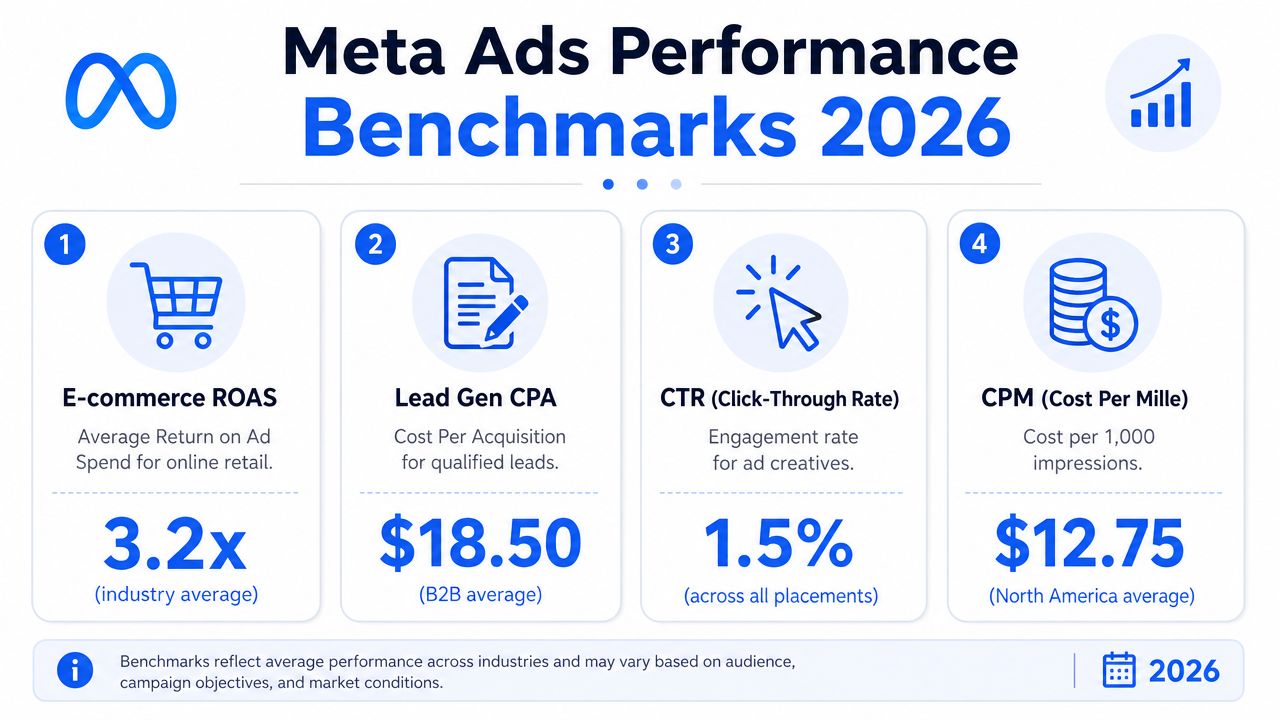
Meta reaches a user base measured in the billions, and benchmark studies still show click and conversion activity at costs many advertisers can make work. The question is not whether the platform can generate response. The useful question is whether your account is clearing the minimum efficiency thresholds that justify more testing.
What the benchmark floor looks like
One broad market read comes from Increv's 2025 Facebook ads stats compilation, which cites an average CTR of 1.44%, a median CPC of $0.54, and an average conversion rate of 9.21% across industries. The same compilation notes that Reels video ads can reach 1.94% CTR or higher when they are built for vertical viewing with audio, and that Meta had 3.065 billion monthly active users in 2025.
Those figures do not set your target CPA or promise profit. They establish a floor for market viability. If an account sits materially below broad click and conversion benchmarks before any serious saturation, auction pressure, or offer fatigue, the problem is usually execution. Creative, offer quality, landing page alignment, or event setup tend to break before the channel itself does.
A second pattern matters more than any blended average. Performance changes sharply by campaign objective, placement, device, and creative format. KlientBoost's Facebook ad statistics roundup is useful here because it highlights how much CPC and engagement can vary across placements. That point matters operationally in 2026 because Advantage+ distribution pushes spend into whatever inventory clears delivery and predicted action goals fastest. If your creative only works in feed, automation can expose that weakness quickly.
Why averages mislead skeptical advertisers
A single benchmark table can make Meta look either cheap or ineffective depending on which number gets highlighted. Neither reading is sufficient.
A traffic campaign with acceptable CPC can still fail if session quality is poor. A lead campaign can show efficient on-platform conversion rates while sales quality falls apart in the CRM. Reels can outperform feed on CTR and still underdeliver on qualified outcomes if the message is built for attention but not for intent.
That is why advanced teams use benchmarks as a screening tool, not a verdict. Benchmarks help answer three narrower questions:
- Is the account earning enough attention to compete in the auction? If CTR is persistently weak, the problem is often creative angle, first-frame design, or audience-message fit.
- Is click pricing within a range the funnel can support? Cheap traffic helps only if downstream conversion rates hold after the click.
- Is delivery finding the right inventory mix? Placement-level variation can make blended averages look healthy while one or two surfaces carry the account.
The non-obvious takeaway is that Meta often still works at the media level before it works at the business level. The platform can usually buy attention. The hard part is converting that attention into verified incremental revenue under automated delivery, limited signal visibility, and constant creative fatigue.
For skeptical advertisers, that distinction matters. Benchmarks support the case that Meta remains a scalable demand-generation channel. They do not prove ROI. They tell you the market is active, the inventory is liquid, and efficient response is still available for advertisers with disciplined creative testing and measurement.
Attribution vs Incrementality The Real ROI Question
The number most advertisers trust first is usually the number they should challenge first.
Why platform ROAS isn't the final answer
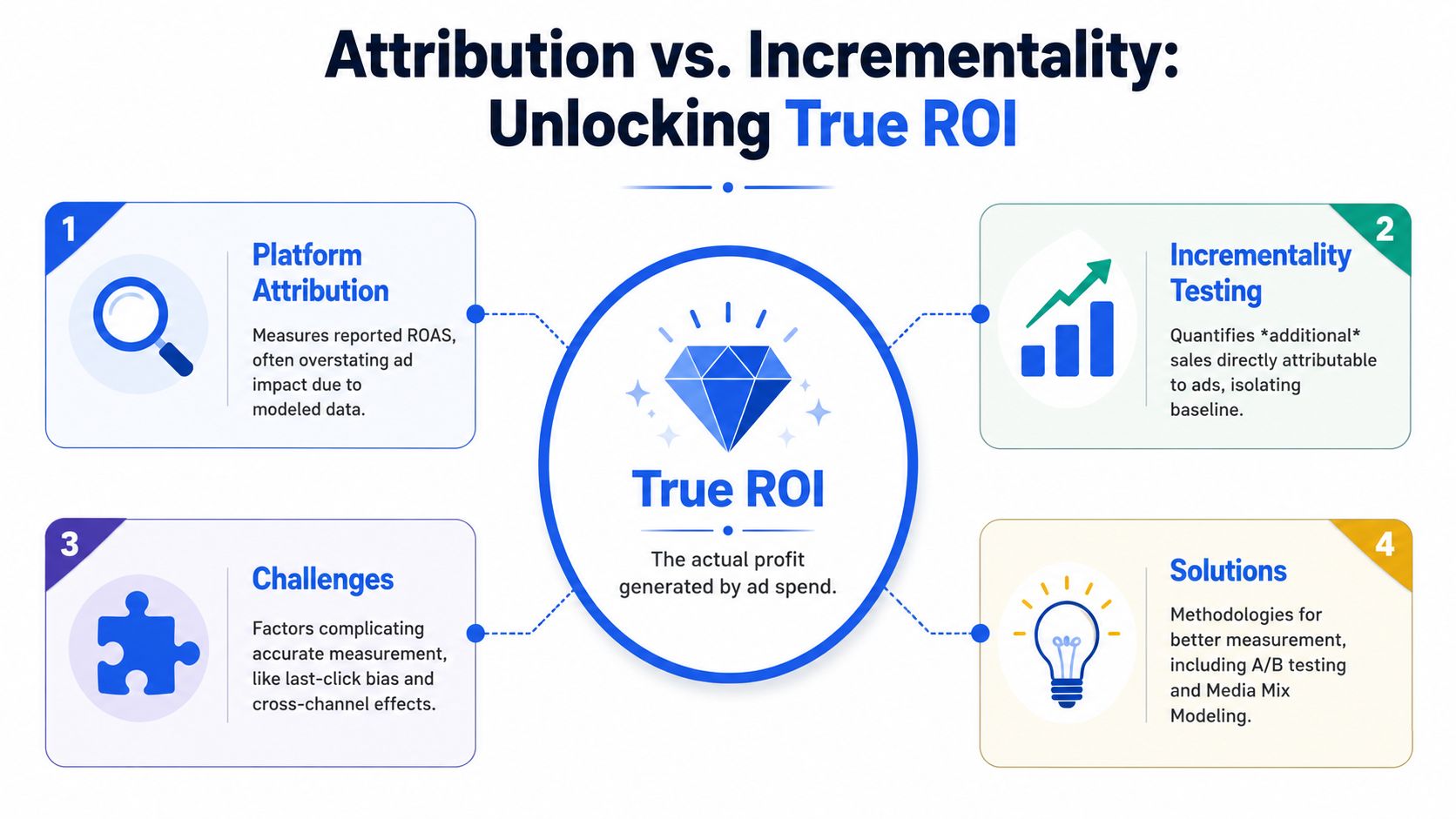
Meta reports attributed conversions. That's useful, but it isn't the same thing as proving causation. If a customer was already likely to buy, retargeting-heavy delivery can still claim credit for the conversion. If privacy loss forces more modeled measurement, the reporting layer becomes even less literal.
That's why the strongest current guidance on this issue is not “trust platform ROAS more” but “test lift directly.” Recent Meta guidance and independent measurement commentary summarized by Coursera note that platform-reported conversions can overstate true lift, and that Meta now emphasizes lift testing as the definitive method for measuring incremental impact.
In client terms, attribution asks: Which conversion did Meta report? Incrementality asks: What happened because Meta spent the money?
How to measure causal impact in practice
You don't need a perfect measurement environment to improve this. You need a hierarchy of proof.
Start with the strongest available method for your account:
Conversion Lift in Meta
- Best when spend is high enough and event volume is sufficient.
- Useful for isolating exposed versus holdout groups inside Meta's environment.
- Stronger than relying on reported ROAS alone.
Geo holdout tests
- Suppress or reduce spend in matched regions.
- Compare movement in the business metric that matters, not just in-platform conversions.
- Works well for brands with geographic spread and stable sales reporting.
Audience holdouts
- Exclude a known segment from exposure.
- Compare downstream outcomes against the exposed population over the same period.
- Especially useful when retargeting is consuming a large share of budget.
Blended trend validation
- Not a substitute for lift testing, but still useful.
- Check whether spend increases correspond with business-level movement after controlling for known seasonality and promo changes.
Practical rule: if most of your “great” Meta performance comes from warm retargeting pools, you haven't proved growth. You've proved capture.
A compact way to consider it:
| Measurement approach | Good for | Main weakness |
|---|---|---|
| Platform attribution | Fast optimization feedback | Can over-credit conversions |
| Lift testing | Causal impact | Harder to run, slower to learn |
| Geo or holdout testing | Business validation | Requires clean test design |
| Blended reporting | Executive confidence | Can hide channel-level nuance |
The skeptical client usually asks the right question. They just ask it imprecisely. “Do Facebook ads work?” really means, “Will Meta create sales I wouldn't have gotten anyway?” If that's the question, the only serious answer comes from incrementality testing.
The Three Levers of Scalable Success
Accounts that scale on Meta in 2026 tend to share the same operating pattern. They do not rely on audience hacks or attractive reported ROAS. They produce enough creative to feed the system, structure campaigns around the buyer journey, and keep budget allocation tight enough that performance can be interpreted with confidence.

Creative velocity
Creative is now the primary input variable in many mature Meta accounts. Once pixel quality, event prioritization, and conversion feedback are reasonably sound, incremental gains usually come from what the user sees, not from endlessly slicing audiences.
Fresh Pies' overview of how Facebook ads work reflects that shift. The practical implication is straightforward. Teams need a repeatable system for generating and testing new concepts, formats, and hooks before fatigue sets in.
That changes how creative should be managed:
- Format-specific production: Reels and Stories need native vertical assets. Resized feed ads often preserve the message but lose the context that drives response.
- Hook-first testing: The opening angle often changes results faster than rewriting body copy or adjusting targeting.
- Clear naming conventions: Concept, format, audience, market, and iteration should be visible at the ad level so analysts can identify what drove the result.
- Controlled automation: If automatic enhancements keep changing the asset, the test result mixes creative performance with platform intervention.
Creative volume on its own is not enough. The goal is interpretable variation. A team that launches 30 loosely labeled ads can learn less than a team that launches 8 clearly structured tests.
For advertisers running high asset volume across accounts, workflow discipline becomes part of performance. Rapid Ads is built for bulk Meta ad uploads, naming control, multi-account publishing, and keeping Advantage+ creative enhancements disabled when buyers want a cleaner test environment.
Funnel architecture
Meta still rewards alignment between message and user intent. The problem in many stalled accounts is not traffic quality. It is asking one campaign to do three different jobs.
Prospecting should create new demand efficiently enough to justify spend in incrementality testing. Mid-funnel should move engaged users closer to decision. Retargeting should convert known intent without absorbing so much budget that it inflates reported efficiency and masks weak customer acquisition.
A workable structure looks like this:
| Funnel layer | What the campaign should do | What usually breaks it |
|---|---|---|
| Prospecting | Generate qualified new demand | Using conversion-heavy creative before interest exists |
| Mid-funnel | Move engaged users toward evaluation | Repeating top-funnel messaging without adding proof or product detail |
| Retargeting | Convert known intent efficiently | Taking too much budget share and overstating growth contribution |
This matters for more than reporting hygiene. It affects how scale behaves. If retargeting carries the account, platform ROAS can stay stable while incremental lift flattens because spend is harvesting users who were already close to purchase.
A strong retargeting campaign shows that Meta can capture demand efficiently. Growth depends on whether prospecting creates demand that did not exist before exposure.
Budget control and bidding discipline
Budget strategy should make learning easier, not more complicated. Meta's automation works best when the account gives it a clear objective, enough conversion signal, and enough spend concentration to separate signal from noise.
Several operating rules hold up consistently:
- Use fewer campaigns with clearer roles: Budget fragmentation slows learning and makes root-cause analysis harder.
- Use ABO for structured tests: It gives cleaner reads when the goal is to compare concepts, audiences, or bid approaches.
- Use CBO after winners are established: It allocates spend more efficiently once the account has lower variance.
- Match bid strategy to certainty: Cost caps and bid controls work better after acceptable acquisition economics are known.
- Read performance below the top line: Placement, region, age, and ad-level breakdowns often show whether the issue is creative fatigue, weak traffic quality, or delivery imbalance.
The non-obvious point is operational. Meta performance often breaks before media efficiency visibly breaks. Naming drift, campaign sprawl, uncontrolled creative enhancements, and unclear budget roles can all produce acceptable dashboard numbers while reducing test quality and making incremental lift harder to prove later.
The accounts that keep working are usually the ones that stay measurable while they scale.
Diagnosing Stalled Performance A Troubleshooting Workflow
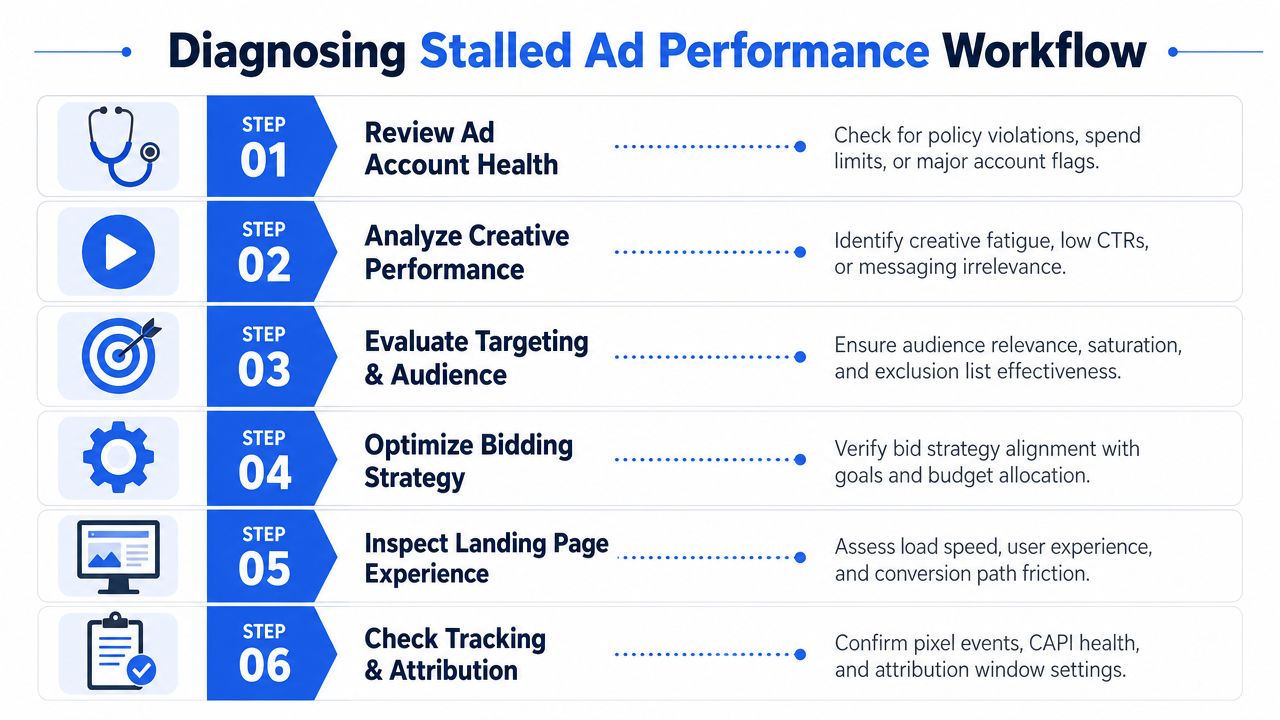
When performance drops, many commonly look at the wrong layer first. They start with bids or audiences because those are easy to change. In practice, the fastest path is to trace the conversion path from bottom to top.
A simple visual checklist helps keep that process honest.
Start with the conversion path
The useful proof of whether campaigns work is usually not CTR. It's down-funnel efficiency. Improvado's guide to Facebook ads makes that point directly, arguing that metrics like ROAS, cost per conversion, and conversion rate matter more than clicks alone, and that buyers should use Meta Ads Manager, Events Manager, custom conversions, and breakdown reports to isolate what's driving results.
Use that logic in order:
Check the business event first
- Has cost per conversion worsened?
- Has the qualified lead rate or purchase efficiency changed?
- If top-funnel numbers are stable but business outcomes are down, the problem is likely post-click or tracking-related.
Inspect the funnel handoff
- Compare link clicks, landing page views, and your primary conversion event.
- If clicks hold but landing page views soften, page load or destination quality may be failing.
- If landing page views are stable but conversions fall, the issue is offer, trust, form friction, or event firing.
Validate event integrity in Events Manager
- Confirm the right event is prioritized.
- Check whether browser and server events are deduplicating correctly.
- Review whether recent site changes broke parameters, confirmation pages, or event rules.
Later in the workflow, this video is a useful companion for reviewing Meta troubleshooting logic in practice.
Then isolate delivery, audience, and measurement issues
Once the conversion path checks out, move up into delivery diagnosis.
A disciplined review usually follows this order:
- Creative deterioration: Pull performance by ad over time. If CTR or conversion efficiency weakens unevenly across ads, fatigue is likely creative-specific, not account-wide.
- Placement mismatch: Use breakdowns to find whether one placement is absorbing spend without holding conversion quality.
- Audience saturation: If a narrow segment is taking repeated spend and new creative isn't entering rotation, delivery can stagnate.
- Optimization drift: Review whether Meta-enabled enhancements, placement expansion, or objective settings shifted from the original test design.
- Attribution confusion: If Ads Manager says recovery happened but the business doesn't see it, stop optimizing to the report and validate against the actual outcome metric.
Audit standard: If you can't explain which audience, placement, and creative combination is producing the conversion event, the account isn't ready for aggressive scaling.
The point of this workflow is to stop random changes. Most stalled accounts don't need more activity. They need a cleaner diagnosis.
Your Action Plan for Testing and Scaling on Meta
A reported 3x ROAS can coexist with flat total revenue. That gap is why Meta performance in 2026 has to be judged on incremental lift, not platform-reported efficiency alone.
The practical question is whether Meta changes business outcomes after you account for retargeting, branded search demand, and attribution overlap. Skeptical teams are usually reacting to a real problem. Ads Manager often measures who got credit. Finance cares about what changed.
A strong action plan starts with that distinction. It then builds a test system that can hold up under automation, creative fatigue, and partial measurement loss.
A practical test sequence
Start with one acquisition use case where Meta has already shown acceptable unit economics earlier in this article. Define success before launch in a metric the business already trusts, such as qualified pipeline, first-purchase customers, contribution margin, or new-customer revenue. If that definition stays vague, optimization shifts toward the cleanest-looking Ads Manager column, which is often the least useful one for deciding whether spend should increase.
A disciplined sequence looks like this:
Set a baseline
- Pull current acquisition cost, lead-to-close rate, and blended revenue or pipeline contribution.
- Separate prospecting from retargeting before reviewing efficiency.
- Document what happens with lower spend or no spend so the comparison is real.
Run one controlled creative test
- Keep audience, budget structure, and offer stable.
- Change one variable at a time: hook, angle, format, or landing page promise.
- Judge the result on the conversion event finance uses, not on click-through rate.
Validate measurement
- Review Pixel and Conversions API event quality in Events Manager.
- Confirm deduplication is functioning and event prioritization reflects the actual funnel.
- Compare Meta-reported conversions against CRM or backend outcomes before treating them as proof of performance.
Test for incrementality
- Use Meta lift studies if the account qualifies and spend is high enough.
- If that is not available, run a geo holdout, audience holdout, or scheduled pause test.
- Measure the difference in orders, qualified leads, or revenue between exposed and unexposed groups.
What to do before you scale
Budget increases should come after two forms of validation. The first is platform performance. The second is business validation in your store, CRM, or sales data. Accounts that skip the second step often scale retargeting demand, branded intent, or one temporary creative winner that cannot be repeated.
Scale only when these three conditions are true at the same time:
- Creative production is repeatable: The team can launch fresh variants every week without weakening the offer or lowering quality.
- Measurement is defensible: Meta results are directionally consistent with Shopify, CRM, or closed-won data.
- Prospecting economics hold: New-customer acquisition remains acceptable outside remarketing traffic.
If one condition fails, more spend usually produces more reported conversions before it produces more incremental profit.
That operational layer matters more than many teams expect. Meta automation is effective at finding available demand, but it can also compress targeting, placement, and creative decisions into a black box if naming conventions, test design, and account controls are loose. In practice, creative throughput and measurement discipline now limit scale as often as audience size or bid strategy.
If your team is producing enough variants that execution quality is affecting test quality, Rapid Ads can help with bulk uploads, naming consistency, multi-account publishing, and tighter control over Advantage+ creative settings. That is useful when the strategy is sound but workflow issues are causing setup drift, reporting errors, or delays in launching new concepts.
Facebook ads still work for brands that measure the right outcome. The winning accounts in 2026 are not the ones reporting the highest in-platform ROAS. They are the ones proving lift, separating attribution from contribution, and maintaining enough creative volume and operational control to scale without losing signal.