Up to $53,088 per violation is the civil-penalty exposure identified in the FTC's Consumer Reviews and Testimonials Rule guidance for knowing violations. For a media buyer, the operational concern isn't just the original testimonial. It's every derivative asset, translated overlay, copied ad and landing-page placement that carries the same defect.
FTC advertising guidelines become a volume problem when teams scale creative faster than they scale evidence and disclosure checks. Meta's approval status answers a platform-policy question. It doesn't establish that your claim is substantiated, your creator used the product or your disclosure is legally sufficient.
Table of Contents
- FTC Rules That Govern Meta Ads at a Glance
- Disclosure Wording and Placement by Creative Format
- Material Connections That Trigger Disclosure
- Substantiation Before Every Objective Claim
- Reviews and Testimonials Under the Consumer Reviews Rule
- Compliant and Non-Compliant Ad Copy Compared
- Who Carries Liability Across Brand, Agency and Creator
- Scaling Disclosure and Evidence Across Bulk Launches
- Run This Compliance Checklist Before Every Launch
FTC Rules That Govern Meta Ads at a Glance
A single Meta ad campaign can sit inside four separate federal compliance frameworks at once. The table maps what each covers and where exposure begins.
| Rule or guide | Latest update | What it governs | Exposure for Meta advertisers |
|---|---|---|---|
| Endorsement Guides | Revised June 28, 2023 | Testimonials, expert endorsements, material connections, virtual influencers, tags, incentivized and employee reviews | Enforcement under FTC Act Section 5 for deceptive endorsements, including undisclosed connections and unsupported claims |
| Consumer Reviews and Testimonials Rule | Effective October 21, 2024 | Fake reviews, misrepresented experiences, sentiment-conditioned incentives, prohibited review suppression and fake social-influence indicators | Civil penalties for knowing violations |
| Substantiation expectations, including the Notice of Penalty Offenses | Issued 2023 | Objective claims supported before publication, including health-related claims | Unsupported claims can be deceptive or unfair under the FTC Act |
| FTC Act Section 5 | Ongoing | Unfair or deceptive advertising, including claims in ads, landing pages and creator scripts | Enforcement exposure across the campaign. Copied variants can expand the conduct at issue, but they are not automatically separate civil penalties |
The FTC's revised Endorsement Guides, issued June 28, 2023, were the first major revision in 14 years, following the 2009 update. They address fake reviews, social-media tags, virtual influencers, incentivized reviews and employee endorsements, and warn that a platform's built-in disclosure tool may not be sufficient.
Read the table as overlapping obligations, not alternative compliance routes. A creator video can trigger endorsement requirements, product-claim substantiation and review-rule restrictions simultaneously. An employee testimonial does not escape scrutiny because you uploaded it through a brand account.
The FTC's Notice of Penalty Offenses Concerning Substantiation, issued in 2023, reinforces that advertisers need support before disseminating objective claims. A later research project does not cure the absence of an adequate basis when the ad first ran.
Map obligations to the actual campaign
Section 5 analysis is not confined to the image or video file. Review the complete presentation: primary text, headline, overlays, spoken script, offer qualifications and destination page. A cautious headline will not neutralize an unsupported promise delivered on camera.
Do not turn per-violation exposure into automatic arithmetic. In a hypothetical batch of 100 variants, an unsupported headline creates 100 placements requiring investigation and potential correction. That does not establish 100 separately punishable violations, and ordinary Section 5 deception does not automatically carry the review rule's civil-penalty ceiling.
The FTC continues to bring enforcement attention to review and endorsement practices. Treat penalty exposure as a reason to identify the applicable legal provision, knowledge requirements and conduct, not as a universal fine calculator.
Keep the platform-policy workstream separate using the Facebook ad policies reference. Where teams also schedule organic endorsements through Social Media Scheduler's Facebook scheduling tool, place those posts in the same creator-approval inventory rather than leaving them outside paid-media controls.
Before reviewing performance, ask:
- Rule coverage: Which obligations does each live ad trigger?
- Evidence gaps: Which objective claims lack a documented basis?
- Review gaps: Which variants have never received substantive review?
Disclosure Wording and Placement by Creative Format
| Creative format | Where the disclosure goes | Common failure | Check before upload |
|---|---|---|---|
| Static image | In the image when needed to make the relationship clear, legible at feed size | Corner text disappears in another placement | Inspect every crop and keep text away from interface overlays |
| Video in feed or Reels | On screen and spoken early, with supporting primary text | Caption-only disclosure doesn't reach viewers watching the video | Watch with sound off in a mobile preview |
| Flexible ad | In every endorsement image and video variant that needs it | An unlabeled asset becomes the served version | Review assets individually, not just the assembled ad |
| UGC testimonial overlay | Visible overlay and verbal disclosure in the creator's language | Translation removes or obscures the relationship | Check every language version |
| Primary text only | In the opening lines, before See more | Disclosure appears after truncation | Confirm visibility without expanding the text; assess whether the creative also needs disclosure |
The recurring failure is a disclosure that exists in the upload but not in the viewing experience. The table gives a conservative production standard, not an FTC-mandated template for each Meta format. Legal sufficiency depends on whether the intended audience can notice and understand the disclosure in context.
The FTC's Endorsement Guides questions and answers identify Ad, Paid ad, #ad, Advertising and Advertisement as wording likely to work when clearly and conspicuously presented. The FTC doesn't prescribe a universal phrase, and the disclosure must use the endorsement's language, so a Spanish endorsement needs a Spanish disclosure.
Approve the rendered disclosure
Treat disclosure copy as an approved component of the primary text, caption and creative. A Meta branded-content label can support that presentation, but don't assume the label alone resolves every disclosure obligation.
For production, use this sequence:
- Read the opening frame: Can a viewer identify the commercial relationship before absorbing the recommendation?
- Inspect alternate crops: Preview square and vertical versions separately, including feed, Stories and Reels placements.
- Mute the video: Confirm that the visual disclosure remains understandable without the spoken statement.
- Check interface interference: Keep text clear of buttons, captions and other overlays using the Reels safe-area guidance.
- Inspect collapsed text: Verify that the disclosure appears before See more, rather than relying on a fully expanded desktop preview.
Don't mistake burned-in text for an automatic pass. Small type, poor contrast, rapid transitions or a cluttered opening frame can make embedded wording ineffective.
Production rule: Approve what the viewer can perceive, not merely what the export file contains.
Localization needs the same rendered review as the original asset. Longer translated wording can wrap into an obscured area, and replacing a caption can accidentally delete the disclosure entirely.
Make the disclosure a protected field in your copy handoff. Every duplication, Copy-To account operation and market-localization step should preserve it, with a new check when wording, layout or placement changes.
Material Connections That Trigger Disclosure
A material connection is a relationship that could affect how consumers evaluate an endorsement's credibility. The FTC's Disclosures 101 guidance identifies financial, employment, personal and family relationships, including payment, free products and discounts.
The benefit doesn't need to arrive as a fee. A creator who receives product, an affiliate who earns commission and an employee recommending their employer's merchandise all require relationship analysis. The relevant question is what the audience would reasonably expect, not whether the creator calls the arrangement a sponsorship.
Match the relationship to the endorsement
| Relationship | Meta campaign example | What the briefing must capture |
|---|---|---|
| Financial | Creator paid per post or affiliate paid on sales | Payment arrangement and any continuing commission |
| Noncash benefit | Product gifting or a creator-only discount | What was received and why |
| Employment | Staff member appears in testimonial-style content | Employment relationship and proposed disclosure |
| Personal or family | Founder's relative or close friend recommends the product | Relationship that could affect credibility |
| Incentivized customer | Customer receives a benefit for submitting a review | Incentive terms and whether sentiment affects eligibility |
Don't apply different standards just because you change distribution. The same relationship can matter in organic content, a whitelisted creator asset or paid media in Meta Ads Manager. Buying distribution doesn't erase the connection behind the recommendation.
For agencies coordinating influencer campaigns for e-commerce brands through Crescade, the useful handoff is a relationship record attached to each creator asset. A deliverables spreadsheet that lists only handle, posting date and usage rights leaves the disclosure decision unresolved.
Ask these questions before scripting:
- Benefits received: What did the creator receive, including products, discounts or access?
- Tracked earnings: Do purchases through a link generate compensation?
- Personal ties: Is the creator employed by, related to or personally connected with the brand?
- Code ownership: Does a discount code generate a benefit for that creator?
- Customer incentives: Was any reward offered for submitting the testimonial?
A positive answer should trigger explicit disclosure review and, where required, disclosure in every derivative endorsement. Put it in the endorsement itself, not exclusively in a profile biography, contract, separate disclosure page or destination the viewer may never open.
Substantiation Before Every Objective Claim
| Claim type | Evidence standard | Hypothetical Meta claim | Proof to hold before launch |
|---|---|---|---|
| General objective claim | Reasonable basis matched to likely interpretation | Fits any bag | Specifications and testing sufficient for the breadth of the claim |
| Health or safety claim | Competent and reliable scientific evidence | Reduces joint pain | Relevant scientific evidence evaluated by qualified experts |
| Expert endorsement | Examination specialists ordinarily use for that conclusion | Dermatologist approved | Expert credentials and documented examination or testing |
| Testimonial result | Supported result and accurate communication of generally expected performance | Most users sleep better | Evidence for the claimed outcome and any required typical-results disclosure |
| Campaign performance presented as product proof | Marketing results aren't product substantiation | Our winning ad proves it works for everyone | Evidence supporting the product claim independently of campaign metrics |
The FTC's Advertising FAQs for small business explain that advertisers need a reasonable basis before dissemination, with evidence matched to the claim. Health and safety claims generally require competent and reliable scientific evidence, such as tests or studies evaluated by qualified experts using accepted methods.
The difficult part is matching proof to the advertisement's likely interpretation. A product specification showing dimensions doesn't establish that an item fits every bag. A narrow test doesn't support a broad promise because the copywriter avoids an explicit guarantee.
Evaluate the promise, not the evidence folder
An endorsement doesn't reduce the evidentiary burden. If the brand couldn't substantiate a statement directly, putting it in a creator's mouth doesn't make it defensible.
Expert endorsements require particular care. Record what the specialist examined, which methods they used and whether that work supports the conclusion presented. Credentials alone don't establish that the expert performed the relevant evaluation.
The FTC's advertising-endorsements guidance also distinguishes authentic experience from substantiated claims and warns against implying results consumers shouldn't generally expect. A genuine success story can still convey an unsupported typical-results message.
A strong ROAS result proves that the campaign generated attributed revenue under your measurement setup. It doesn't prove the product promise.
Build a claim-evidence register
Use a controlled spreadsheet or database rather than a folder of disconnected PDFs. Each claim record should identify the approved wording, implied meaning, evidence location, evidence date, limitations, approving reviewer and permitted markets.
Connect that record to campaign, ad, market, landing page and creative version. Keep qualification language beside the approved claim so a buyer can't copy the promise without the limitation that makes it accurate.
Apply explicit publication gates:
- Missing proof: Block the claim rather than leaving a request for evidence open after launch.
- Overbroad wording: Narrow the statement to what the evidence supports.
- Changed presentation: Re-review materially changed headlines, visuals, testimonials, prices, results and targeting context.
- Incomplete qualifications: Return the asset for revision when necessary limitations are absent or unreadable.
Use ad copy best practices to improve expression within the supported claim boundary. Don't let copy testing redefine that boundary without a corresponding evidence review.
Reviews and Testimonials Under the Consumer Reviews Rule
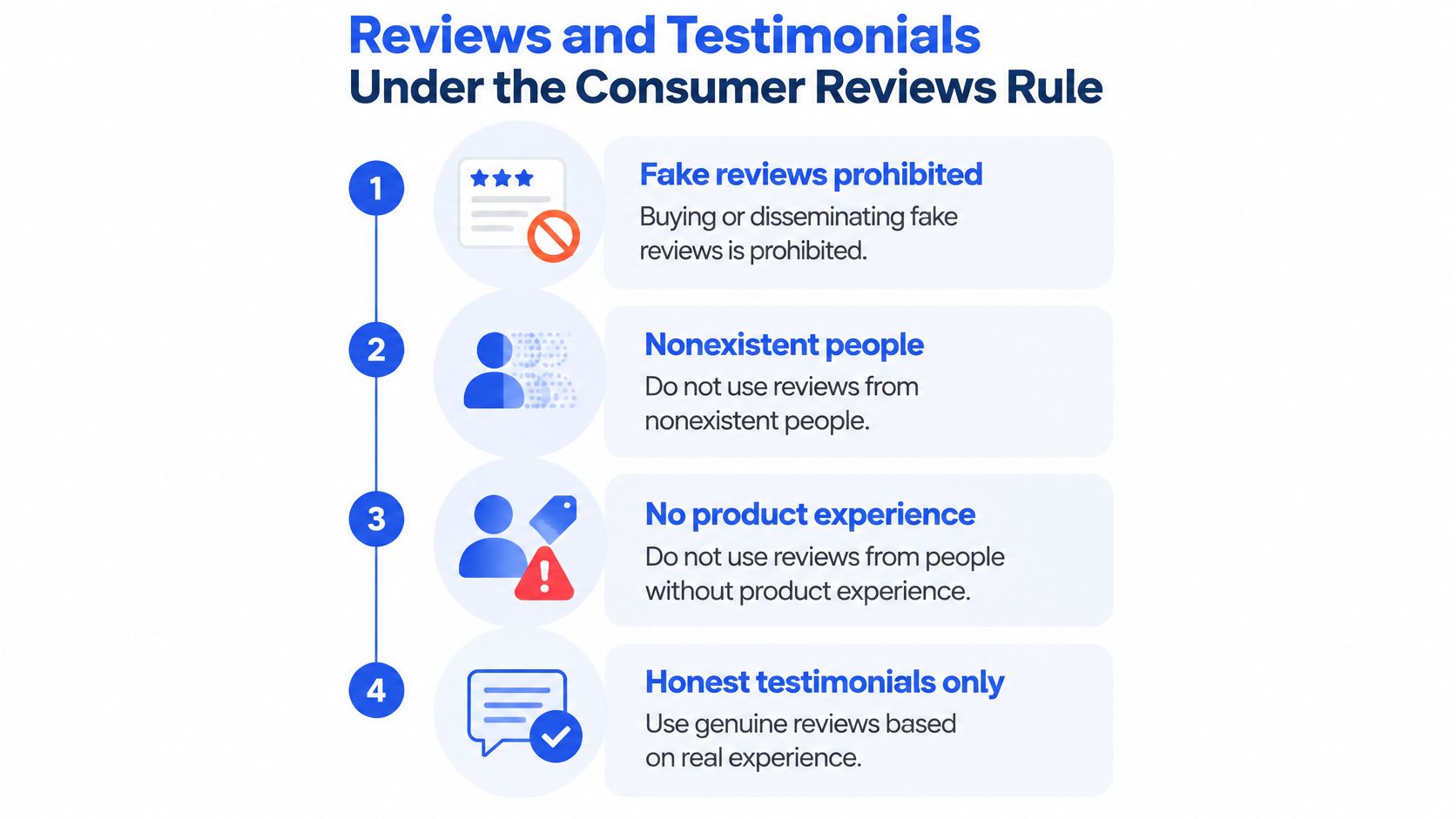
The Consumer Reviews and Testimonials Rule prohibits buying or disseminating fake reviews, including reviews attributed to nonexistent people or people without product experience. It also addresses materially misrepresented experiences, incentives conditioned on positive or negative sentiment, prohibited negative-review suppression and buying or selling fake social-influence indicators such as bot-generated followers or views.
Authenticity is necessary, but it isn't the entire test. A real customer's words can become misleading when an advertiser edits away an important limitation, presents a selected rating as representative or conceals the reviewer's insider relationship.
The source-experience checks are straightforward enough to make visible in the production workflow.
Distinguish selection from distortion
Choosing a genuine positive testimonial for an ad isn't automatically unlawful review suppression. The problem arises when the advertiser misrepresents what the selection means, distorts the customer's experience or presents a review display as representative while improperly withholding negative feedback.
Say a customer reports that a product helped after a lengthy adjustment period. Cutting the quote to imply immediate success changes the claim, even if every remaining word came from the original review. Shortening for a video hook isn't permission to remove context that materially affects meaning.
Likewise, collecting feedback with a sentiment-neutral incentive differs from paying only for praise. A disclosure doesn't cure an incentive that is conditioned on a positive rating.
Use a source-asset decision path
- Verify actual experience. Confirm that the reviewer or creator used the relevant product, not merely another product from the same brand.
- Preserve meaning. Compare the proposed excerpt, subtitles and spoken script with the original submission, including material limitations.
- Disclose relationships and incentives. Check the rendered creative, not just the review-collection form.
- Document consent and identity. Preserve the source review, permission to use it and enough identifying information to reconnect the ad to its origin.
- Separate participation from sentiment. Keep reward eligibility independent of whether the response is favorable.
- Audit the destination. Inspect testimonial blocks, aggregate ratings and review presentation on the landing page as well as the ad.
Run this path once per source asset before approving derivatives, rather than rediscovering the same provenance questions during every upload. Then check each derivative for changes in meaning, disclosure and presentation.
Create a dependency list linking the approved review to its exports, localizations and destination pages. If the source review fails validation, that list gives the media buyer a concrete withdrawal scope instead of a search through account history.
For multi-market campaigns, preserve the original alongside the translation. A translated testimonial can be grammatically fluent while overstating certainty, shortening the reported timeframe or dropping a caveat that limited the original claim.
Compliant and Non-Compliant Ad Copy Compared
| Ad line or execution | Verdict | Problem | Compliant fix |
|---|---|---|---|
| Hypothetical testimonial claiming a customer lost 6 kg in 3 weeks, performed as personal experience by a creator who never used the product | Non-compliant as presented | Creator represents an experience they didn't have; result also needs support and typical-results analysis | Use an authentic, supported account and clearly communicate generally expected performance |
| Gifted creator video with #ad only after See more | Non-compliant as presented | Viewers can miss the relationship disclosure | Put clear disclosure on screen and in the opening primary text |
| Hypothetical claim of clinically proven wrinkle reduction backed only by a 14-person internal test that doesn't establish that conclusion | Non-compliant on the stated facts | Evidence doesn't match the clinical claim | Obtain evidence matching the claim or narrow the copy to a defensible tested result |
| Five-star rating calculated only from selected favorable reviews but presented as the overall customer rating | Non-compliant as presented | Curated feedback is misrepresented as representative | Use an accurately calculated rating with an honest description of its scope |
| Affiliate review with a tracked link and conspicuous Paid ad label | Potentially compliant, verify remaining claims | Relationship disclosure doesn't establish truthful experience or product substantiation | Preserve disclosure and verify actual use, claim support and destination consistency |
| Dermatologist video with documented examination and on-screen disclosure | Potentially compliant, verify examination sufficiency | The examination must support the particular conclusion | Retain the expert's evaluation and limit the statement to its supported scope |
These are hypothetical executions, not findings about particular advertisers. The numerical outcomes and test size illustrate claim review, not evidence that those results occurred or that a particular sample size automatically determines legal sufficiency.
The FTC's influencer guide ties endorsement compliance to honest experience, supported claims and obvious disclosure of material relationships. That framework explains why the apparently acceptable rows still need factual verification.
Fix the defect that actually matters
A disclosure fix and an evidence fix solve different problems. Adding Paid ad won't make an invented experience truthful. Commissioning stronger product research won't make a buried gifted-product disclosure conspicuous.
For the clinical-sounding example, don't assume internal research is unusable or that sample size alone settles the issue. Evaluate the study design, relevant population, measured endpoint, methods and claim breadth with an appropriately qualified reviewer.
For rating claims, inspect the denominator and selection method. The creative team shouldn't turn a collection of approved testimonial cards into an overall satisfaction claim unless the underlying records support that interpretation.
A useful reviewer response is specific enough for production:
- Disclosure defect: Move the relationship statement into the visible creative and opening text.
- Evidence defect: Remove the clinical conclusion until an appropriate reviewer approves support for that wording.
- Experience defect: Replace the performance with an authentic account, without implying that a scripted actor personally achieved the result.
- Rating defect: Recalculate from the appropriate review population and describe the scope accurately.
AI-generated spokespeople and synthetic customer identities need heightened scrutiny. Don't approve a fabricated customer experience because the visual looks plausible. Require genuine, documented underlying experience, accurate presentation and applicable disclosure, or remove the testimonial execution.
Who Carries Liability Across Brand, Agency and Creator
Responsibility doesn't stop with whoever clicked Publish in Ads Manager. A brand, an agency involved in preparing or disseminating deceptive endorsements, and a creator can each face exposure based on their conduct and the applicable legal standard.
The FTC's announcement of its updated advertising guides emphasizes advertiser monitoring responsibilities and addresses the roles of endorsers and intermediaries. Treat liability as fact-specific, not automatically identical across every participant.
Assign approval and correction rights
A creator remains responsible for the experiences and opinions they express. A brand-authored script isn't a safe basis for claiming personal use that never happened.
Use creator agreements and agency statements of work to establish practical controls:
- Disclosure wording: Require language the intended audience understands, with approved placement instructions.
- Prepublication approval: Cover the script, captions, overlays and final rendered export.
- Actual-use confirmation: Obtain a written account of product use and the experience being represented.
- Correction and takedown rights: Give the brand a way to stop content when claims or disclosures change.
- Whitelisted-asset editing rights: Secure permission to make necessary compliance edits within the agreed usage scope.
Don't confuse these contract terms with a transfer of regulatory responsibility. Their purpose is to make review, correction and withdrawal executable.
Monitor what remains live
Assign named owners to the original creator post, paid derivatives and destination page. For each approved claim, retain who signed off, when they approved it and which evidence version they reviewed.
Monitoring should detect changed captions, removed disclosures and newly improvised claims. When a creator departs from the approved script, the response needs to include affected paid assets, not just a message asking them to edit the organic post.
Accountability test: Can your team identify who can pause the asset, who can correct it and who can authorize its return?
Give the media buyer pause authority, the evidence owner claim-review authority and the account lead responsibility for coordinating correction. That separation prevents a performance decision from becoming a legal approval.
Scaling Disclosure and Evidence Across Bulk Launches
Near-duplicate ads require traceable approvals, not a blanket assumption that the original export covers everything. A changed qualifier, price, headline or testimonial can change what consumers understand, even when the rest of the asset remains identical.
Keep the evidence record visible alongside the creative workflow.
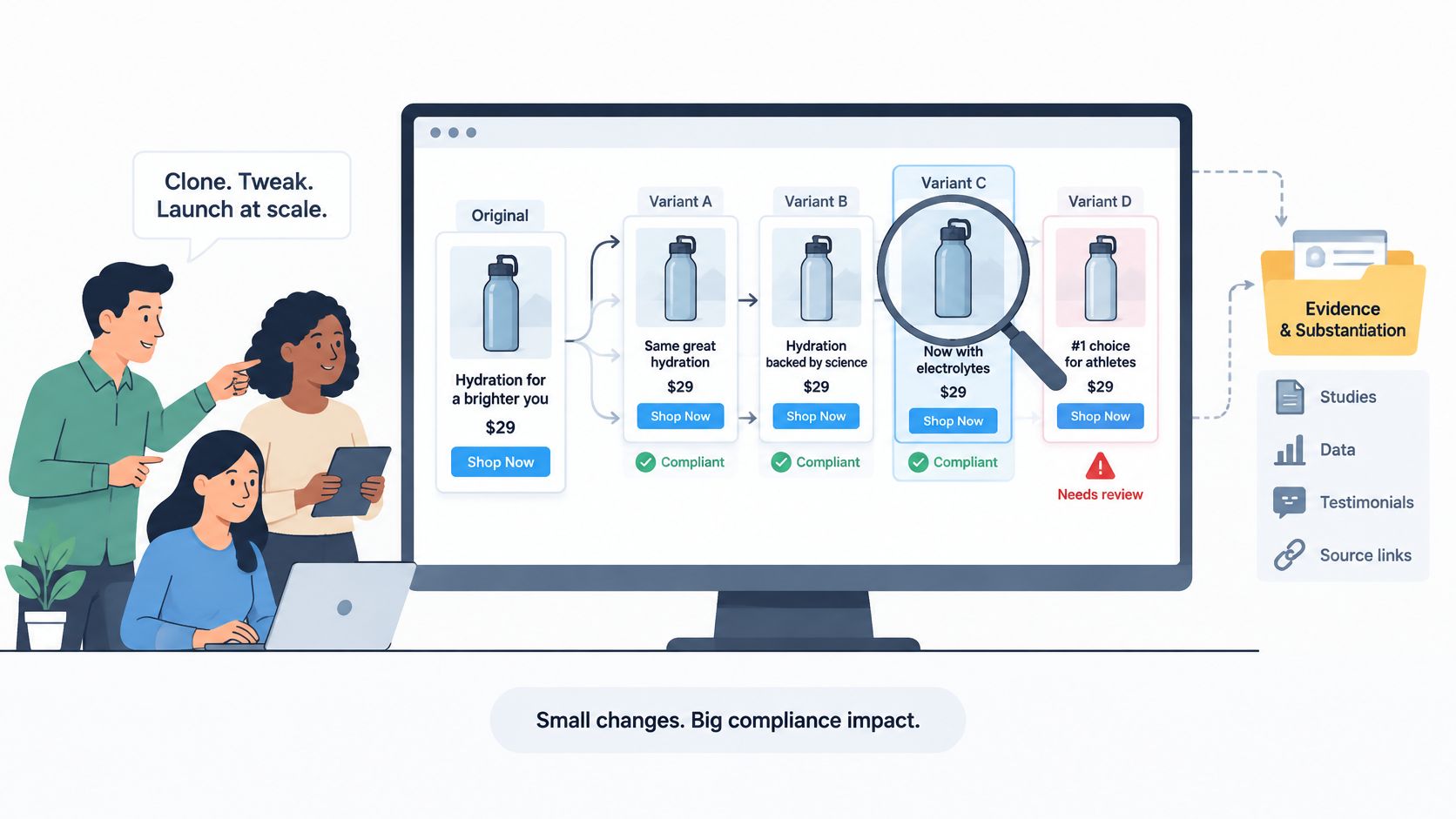
Each register row should tie approved claim wording and disclosure text to the campaign, ad set, ad, market, landing page and creative version. Use market and version tokens in Ads Manager names, then attach the resulting ad identifiers after publication.
Control transformations after approval
When teams build Meta image ads with ProdSnap, review the exported asset after composition, not just the original copy document. Moving a disclosure, changing visual emphasis or replacing product imagery can alter the presentation that the reviewer approved.
Apply the same discipline to Advantage+ creative enhancements. Where enhancements can alter approved wording or imagery, disable the relevant transformations and inspect the live presentation rather than assuming the upload preview is final.
Flexible ads require asset-level controls because Meta selects combinations. Check each image, video, headline and text component, then assess whether permitted combinations could separate a claim from an essential qualification.
For implementation context, review the workflow demonstration alongside your own account settings.
Keep operational automation separate from judgment
Rapid Ads supports bulk uploading, CSV copy imports, multi-account workflows and Advantage+ auto-disable controls; our naming rules run on every ad set and creative. Those controls can preserve an approved configuration, but a person must still maintain the evidence register and review changed rows.
Record two distinct statuses:
- Platform status: Approved, rejected or pending in Meta.
- Compliance status: Approved against specified evidence, disclosures and a recorded creative version.
An accepted upload isn't legal sign-off. Release the batch only when both statuses permit launch, and preserve the reviewed export so the team can compare it with what runs.
Run This Compliance Checklist Before Every Launch
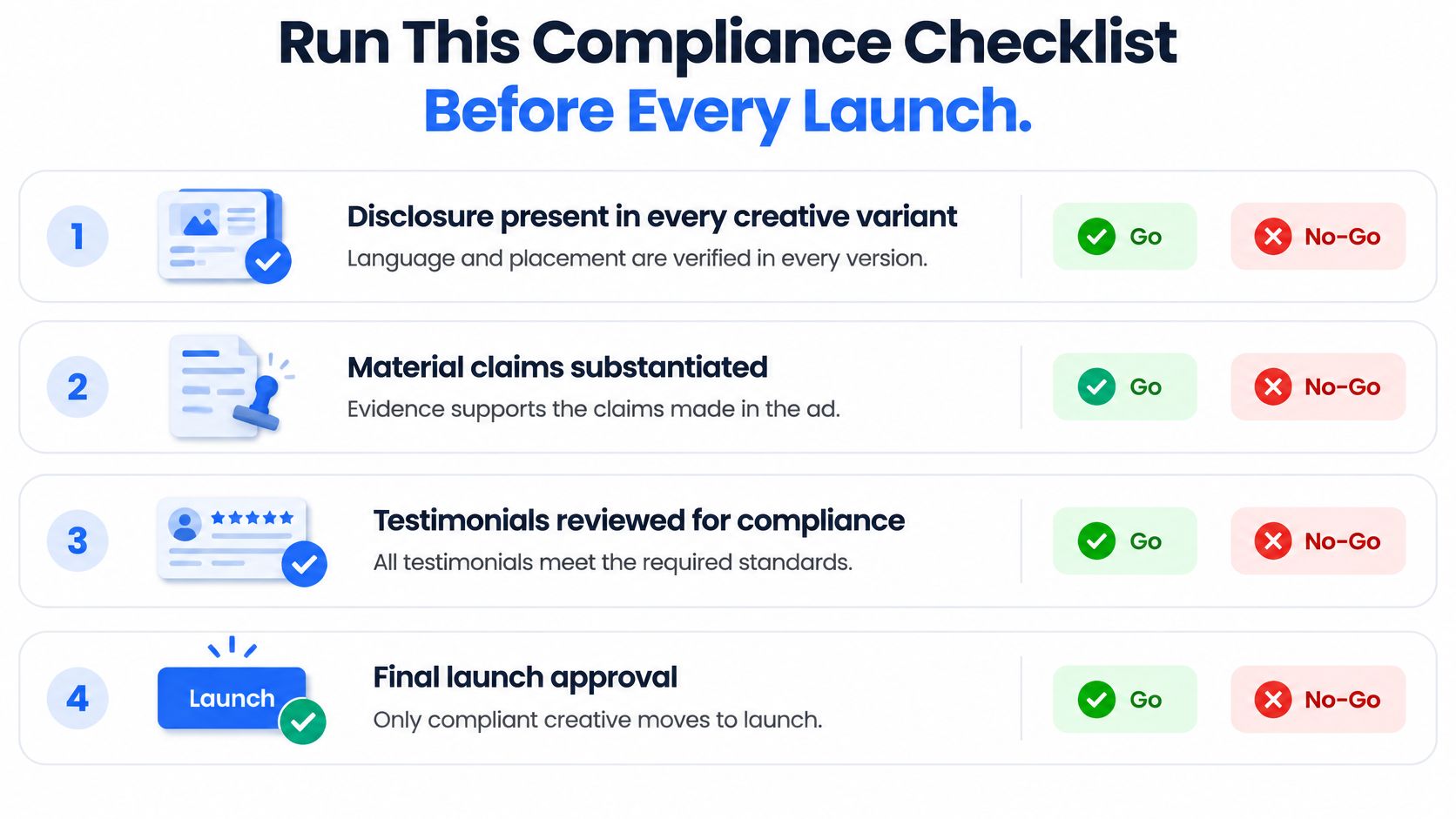
Use this as a go or no-go gate, not a retrospective score. Assign an owner to every unresolved item and withhold affected assets until the defect is corrected.
The visual checklist groups the controls; the release record should retain the detailed decisions.
Verify in release order
- Inspect disclosures. Confirm that required wording appears in every creative variant, language and placement, with readable rendered previews.
- Verify material relationships. Disclose the relevant connection within the endorsement itself.
- Confirm actual use. Keep the creator's product-use confirmation with the source asset.
- Check evidence timing. Link every objective claim to adequate evidence held before launch.
- Escalate health and safety claims. Obtain qualified expert review of the supporting scientific evidence and proposed wording.
- Compare the destination. Resolve differences between the ad, offer, landing-page claims and testimonial presentation.
- Protect review meaning. Confirm that editing hasn't distorted experience and that review displays don't misrepresent suppressed or selected feedback.
- Inspect incentive terms. Reject rewards conditioned on positive or negative sentiment.
- Clear synthetic executions. Remove fabricated customer identities or experiences; require documented genuine experience and accurate presentation for any approved testimonial use.
- Validate traceability. Put market and version identifiers in ad and ad set names, and connect them to the register.
- Trigger change review. Reassess altered headlines, visuals, testimonials, prices, results or targeting context before release.
- Separate approvals. Record Meta platform approval independently from compliance sign-off.
- Retain the audit trail. Preserve source-review identity, permissions, evidence versions, rendered assets and approval history.
Pilot before applying templates broadly
A failed item should identify the affected assets, the correction owner and the condition for release. Don't let a partial batch approval become permission to publish unresolved variants through a later duplication.
Run the full checklist on a single campaign before scaling. Log every no-go, correct the naming and disclosure templates, and retest the exports before applying those templates across the wider launch.
Rapid Ads is an Official Meta marketing partner, but that credential doesn't replace advertiser review or establish FTC compliance. Keep the final release decision with the people responsible for the claims, evidence and rendered creative.
Rapid Ads offers bulk Meta ad uploads and controls for preserving approved naming and creative settings across launch workflows. Visit Rapid Ads and use the Free Tier to upload up to 10 ad creatives at no cost, then test your disclosure templates and evidence-register handoff before expanding the batch.
