Most advice on Facebook ads for dropshipping still overweights the wrong variable. People obsess over hooks, UGC angles, and interest stacks as if the only reason a store stalls is weak creative. Creative matters. But once you're testing products seriously, the primary bottleneck is operational. Slow launches, messy naming, inconsistent ad-level settings, broken test hygiene, and too much manual work inside Ads Manager kill more winners than is typically realized.
That matters because Meta is still where most dropshipping operators get paid traffic. One industry roundup says 68% of dropshipping stores get most of their traffic from Meta ads, and 12.82% of Shopify stores' traffic comes from Facebook, which tells you this channel still sits at the centre of customer acquisition for this model in Carro's dropshipping statistics roundup. If Meta is your primary testing environment, then speed and control inside that environment aren't side issues. They're the system.
The teams that scale FB ads for dropshipping don't just make better ads. They build a launch process that lets them test more angles, read results faster, and keep account structure clean enough to know what won.
Table of Contents
- Beyond the Basics of FB Ads for Dropshipping
- Campaign Architecture for Rapid Testing
- The Dropshipper Creative and Copy Formula
- A Repeatable Three Phase Testing Methodology
- Budgeting Bidding and Scaling Playbooks
- ROAS Killers and Quick Diagnostic Checks
Beyond the Basics of FB Ads for Dropshipping
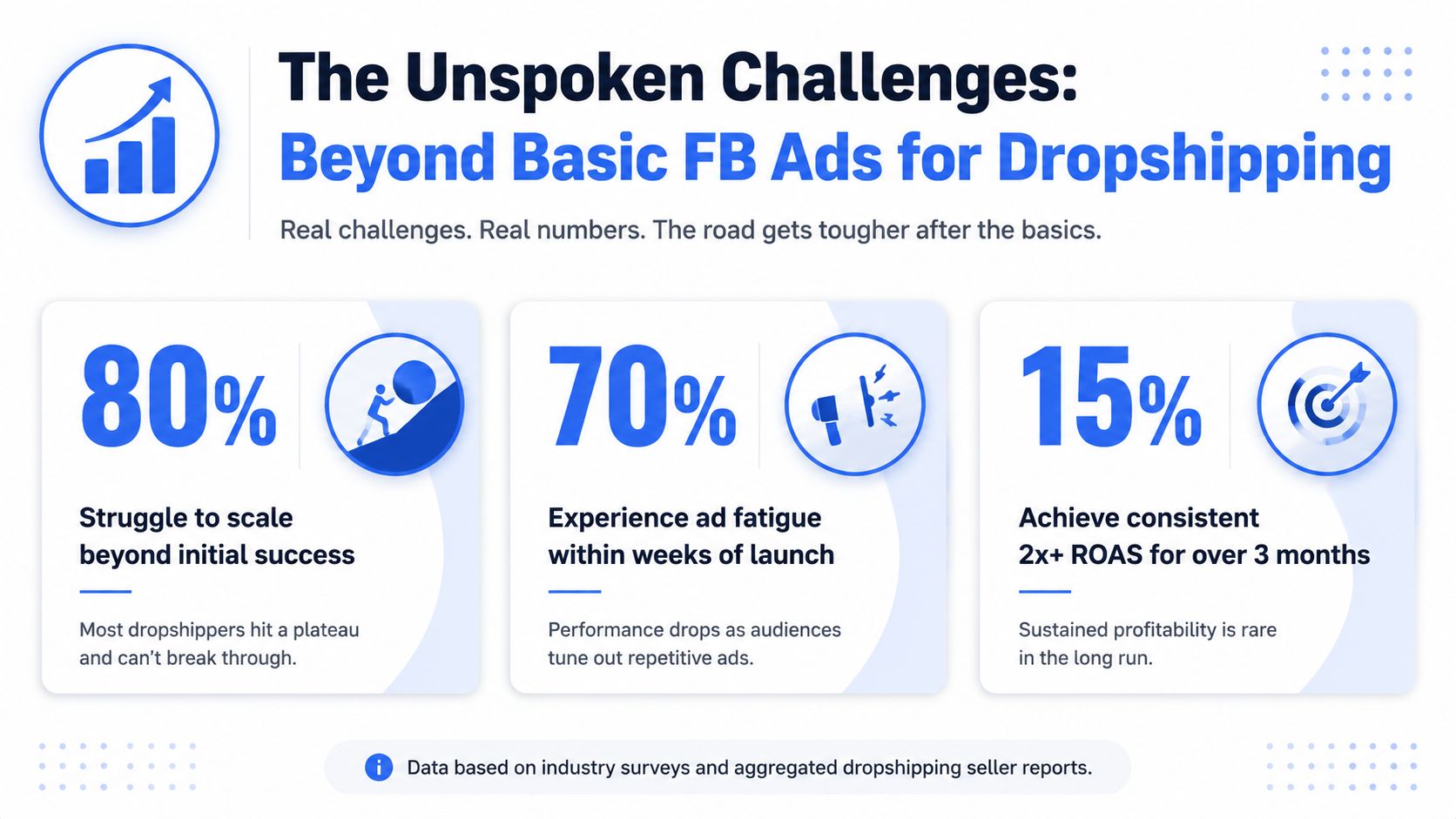
A lot of dropshipping accounts do not fail because the product is weak or the ad angle misses. They fail because the operator cannot push enough clean tests through Ads Manager without introducing noise.
That is the actual ceiling. Throughput.
Good buyers treat Meta as an execution system, not just a traffic source. If launching five new ads takes half a day, naming changes every week, and one person selects different identities, URLs, or placements each time, the account becomes hard to read fast. Then bad decisions follow. Winners get killed early. Losers stay live too long. Retests happen by accident because nobody can tell what already ran.
The bottleneck is operational control
High-velocity testing only works when volume and discipline increase together. More creatives alone do not help if the setup makes analysis unreliable.
The first cracks usually show up in three places:
- Creative throughput: Editors and buyers produce angles faster than the account can launch them.
- Naming discipline: Ad names miss product, hook, format, market, or date, so breakdowns turn into manual detective work.
- Setting consistency: Small changes to identity, destination URL, CTA, placement mix, or ad-level options create hidden variables.
A simple test exposes the problem. If two buyers can launch the same product test and produce different naming, different ad settings, and different reporting views, the account is not systemised. It is just spending.
What experienced buyers actually optimise for
The target is faster product decisions with fewer false positives.
That changes how the account gets built. A strong operating model is designed to answer three questions quickly: what launched, what changed, and what earned the result. If those answers are not obvious from the campaign name, ad name, and standard columns, the workflow is too loose for scale.
Here is what that looks like in practice:
| Focus | What it looks like in practice |
|---|---|
| Launch speed | New angles, hooks, and edits go live without rebuilding the campaign every time |
| Variable control | Each test changes one meaningful input, not audience, creative, and landing page all at once |
| Readable reporting | Names show product, angle, format, audience type, market, and version clearly |
| Team handoff | Another buyer can open the account and understand what is live in minutes |
This is the difference between random testing and a repeatable buying system. One can occasionally find a winner. The other can keep producing them under pressure.
Campaign Architecture for Rapid Testing
Campaign structure decides whether your first week produces signal or noise. Most dropshippers don't lose because they picked the wrong interest. They lose because they built a campaign that makes clean analysis impossible.
Use a structure that answers one question at a time
For product testing, keep the objective simple. Use a Sales campaign with Website as the conversion location. Then decide what you want the campaign to answer.
If you're testing a new product, the first question isn't “what's the perfect audience?” It's usually one of these:
- Does this offer get clicks at all?
- Which creative angle earns attention fastest?
- Does broad traffic convert on the product page?
- Which audience refinement improves efficiency after the creative proves itself?
When one campaign tries to answer all four questions, results get muddy. Keep separate campaigns for separate decisions.
A clean testing setup usually includes:
- One product per campaign: Don't mix products inside the same test.
- One variable per layer: If ad sets test audiences, ads should hold the same landing page and comparable creative logic.
- Consistent naming: Include product, country group, campaign goal, audience type, and creative angle in the name.
ABO for testing and CBO for expansion
For early testing, I favour ABO because it forces even spend across ad sets and keeps Meta from shoving budget into one ad set before you've learned enough. That matters when you're comparing broad, single-interest, or demographic segments and you want a fair read.
Once you've found a clear winner and you're no longer trying to compare ad sets evenly, CBO usually becomes more useful. At that stage, you're asking Meta to distribute budget across proven options rather than evaluate unknown ones.
A simple comparison:
| Setup | Best use | Main advantage | Main risk |
|---|---|---|---|
| ABO | Early testing | Cleaner comparison across ad sets | Slower to exploit a breakout winner |
| CBO | Scaling proven assets | Budget shifts toward stronger ad sets automatically | Can hide weak testing discipline if used too early |
Broad campaigns don't fix bad inputs. They just spend faster on them.
The technical settings that save bad tests
Some setup choices look minor but have a real effect on conversion quality.
A commonly recommended setup for scale-oriented dropshipping is to keep the conversion location on the product page rather than the homepage, connect the Facebook and Instagram identities at the ad level, and test multiple creatives while monitoring CTR and CPM together, as outlined in this Meta ads setup walkthrough for dropshipping campaigns.
That advice lines up with what happens in accounts:
- Product page over homepage: Fewer clicks between ad and purchase intent. Less friction, less leaking.
- Identity chosen at ad level: You keep control over how the ad appears in each surface.
- CTR and CPM read together: High CTR with ugly CPM can still be hard to scale. Low CPM with weak CTR often means the market doesn't care.
My non-negotiable pre-launch checklist
Before any test goes live, check these:
- Destination page: Send traffic to the product page, not a generic collection or homepage.
- Mobile fit: The product page has to load cleanly on mobile, because that's where most Meta traffic behaves like direct response traffic.
- Creative grouping: Separate feed-style assets from vertical assets if you want cleaner readouts by format.
- Naming logic: The ad name should tell you what the asset is without opening the preview.
- Identity match: Make sure the correct page and IG identity are attached before publishing.
If these basics aren't right, scaling conversations are premature. You're still debugging setup.
The Dropshipper Creative and Copy Formula
Most losing dropshipping ads fail before the first click. Not because the product is terrible, but because the ad never makes the buyer feel the problem sharply enough to care.
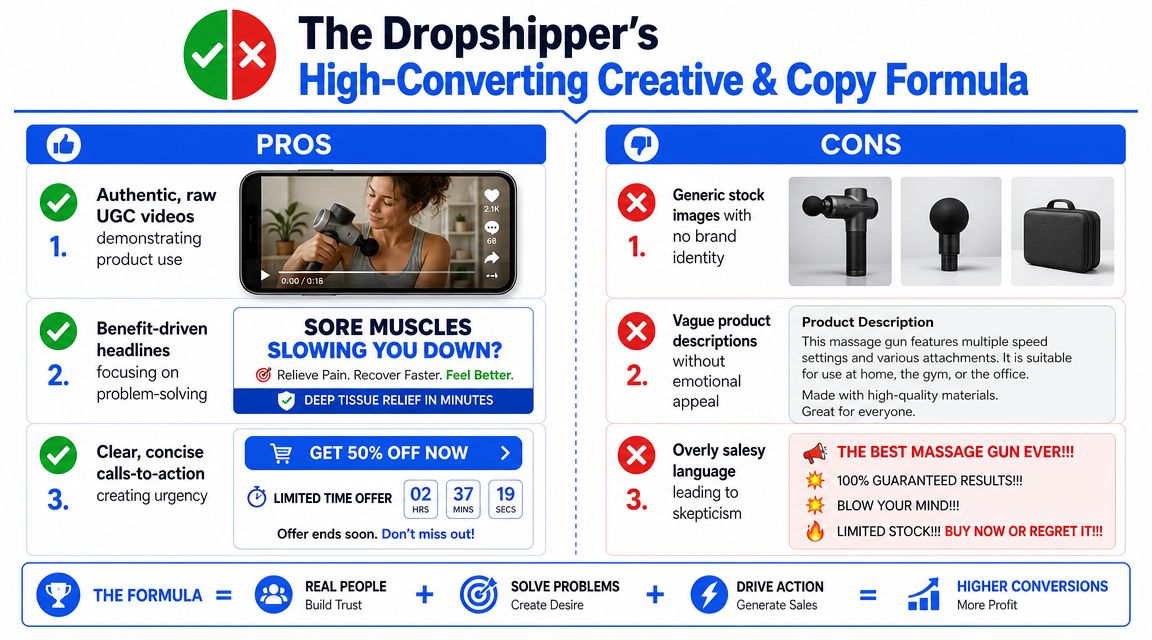
The creative pattern that keeps working is simple. Problem, agitation, solution, social proof. Not as a formula to copy mechanically, but as a sequence that matches how direct-response buyers process low-consideration products in-feed.
What high signal creative actually looks like
The first frame has one job. Stop the scroll by making the buyer recognise themselves. For a posture device, that might be the visual of slumping at a desk. For a pet tool, it might be fur all over a car seat. For a kitchen gadget, it might be the annoying manual workaround people already hate.
Then build pressure:
- Problem: Show the frustrating state clearly.
- Agitation: Make the inconvenience feel persistent or expensive in time, effort, or discomfort.
- Solution: Demonstrate the product in use, fast.
- Social proof: Layer buyer reaction, visual proof, or creator-style endorsement.
This doesn't require polished studio production. In fact, a lot of dropshipping winners look better when they feel native to Reels, Stories, or a feed post. Raw footage often beats over-produced footage because the buyer reads it as closer to real use.
Use CTR and CPC as creative triage metrics
Creative should earn the right to stay live. Don't get emotionally attached to the edit because the hook sounded smart in Slack.
One dropshipping-focused industry article reports an average CTR of 2.5% and CPC of $0.60 for Facebook ads, while another guide says CTR should stay above 2% and CPC below $1 for healthy performance in TrueProfit's Facebook ads benchmarks for dropshipping. Those aren't guarantees of profitability, but they're useful triage numbers.
Use them properly:
| Signal | What it usually means |
|---|---|
| CTR above 2% | The angle and opening are at least generating interest |
| CTR below that level | The hook, offer framing, or visual stop power likely needs work |
| CPC below $1 | Traffic cost is still in a workable range for many tests |
| High CPC with weak CTR | The market isn't engaging, or the creative is mismatched to the audience |
If the ad can't attract a click at healthy benchmark territory, don't jump straight to audience theory. Fix the asset first.
Creative diagnosis: A bad ad can make a good product look unscalable.
Copy should carry the sale if the video is watched on mute
Copy for FB ads for dropshipping shouldn't read like a brand manifesto. It should sound like a sharp sales argument compressed for an impatient buyer.
I like a simple structure:
- Lead with the pain or desired outcome
- State the mechanism
- Remove doubt
- End with a direct CTA
Examples of what tends to work better:
- Benefit-first headlines: Focus on what changes for the buyer, not what the product is called.
- Specific body copy: Mention use case, friction removed, and why this is easier than the existing workaround.
- Short CTA language: “Shop now” works when the ad has done the work. The CTA doesn't need to rescue weak positioning.
What usually underperforms:
- Feature lists with no tension
- Generic “must-have” language
- Claims that sound too polished to trust
- Long captions that bury the actual offer
A strong ad can survive average copy. Weak creative rarely survives even strong copy. But when both line up, the account gets much easier to manage.
A Repeatable Three Phase Testing Methodology
Random testing burns time because it asks Meta to solve too many unknowns at once. A better workflow separates creative validation from audience discovery and scaling. That sounds basic, but most accounts still skip steps and then wonder why results look unstable.
Start with this visual model, then apply it exactly.
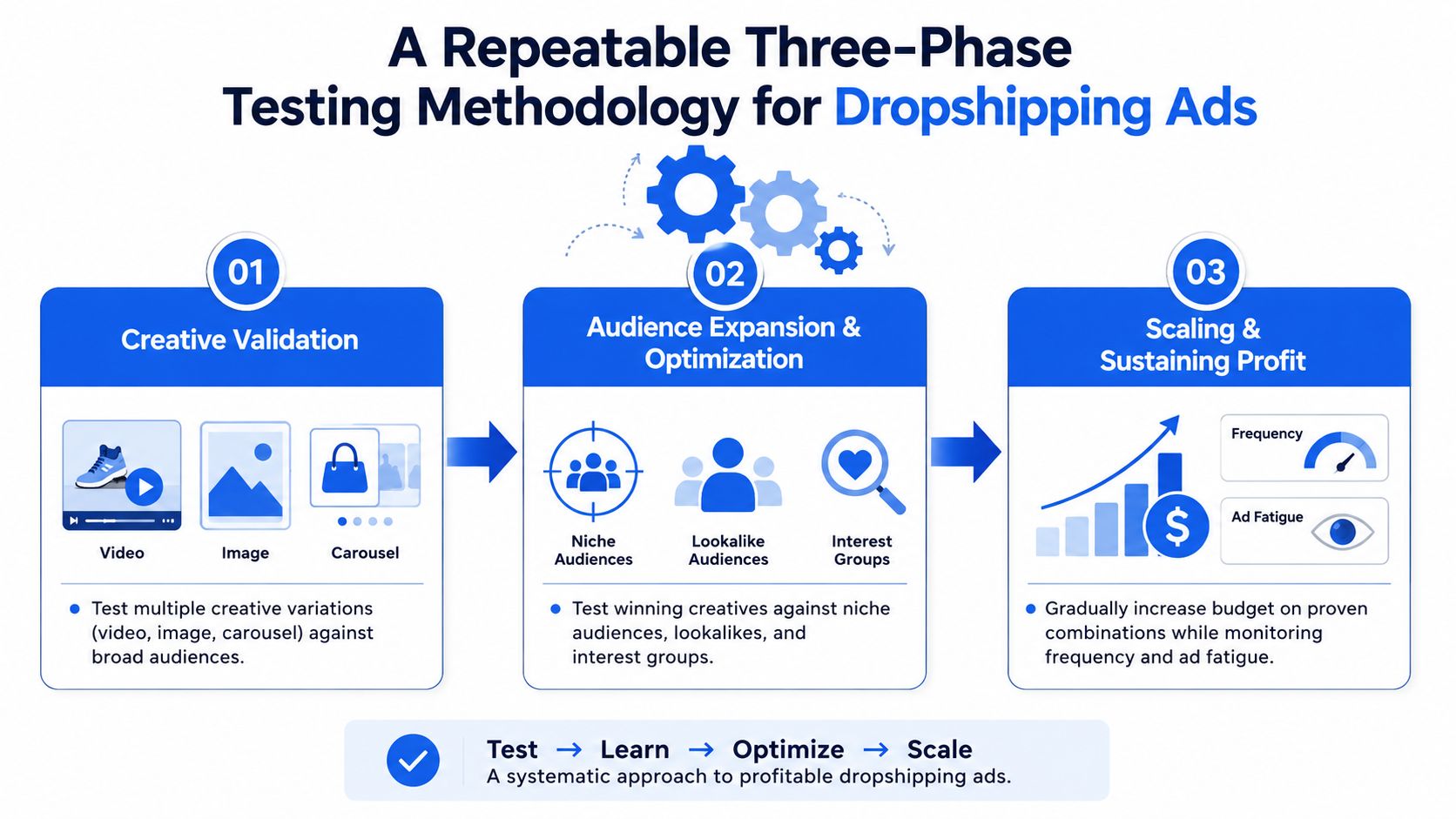
Phase one with PPE to rank angles fast
The first job is to find out which creative deserves conversion traffic. A practical workflow used by dropshippers is to start with at least 3 creative variations and run a PPE split test before moving into sales campaigns, as described in this Meta testing workflow video for dropshipping.
PPE isn't the end goal. It's a filter.
Use it to compare:
- Different hooks for the same product
- Different creator styles
- Different openings on the same script
- Static image versus video if the product can sell both ways
You're not trying to prove profitability in PPE. You're trying to identify which ad gets people to react, pause, and engage enough to justify purchase-focused spend.
A practical setup inside this phase:
| Element | Recommendation |
|---|---|
| Creative count | Start with at least 3 variations |
| Test logic | Keep the offer constant and change the angle |
| Success read | Look for the asset that clearly outpulls the others on attention and engagement quality |
| Next step | Move only the best-performing assets into sales testing |
If three creatives look equally average, don't pick a winner by force. Make three better creatives.
A lot of media buyers skip PPE because they want direct purchase data immediately. That's fine if you already have a mature creative engine. If you don't, PPE is a cheap way to stop weak assets from contaminating your purchase campaign.
Here's a useful walkthrough before you build your own variant library:
Phase two with broad sales campaigns
Once a creative has shown life, move it into a Sales campaign and let Meta search broadly. The same workflow recommends using broad targeting across all shippable countries, all ages, and no interests to identify the winning demographic before narrowing later.
This phase often surprises newer buyers because it feels too open. But the point isn't laziness. It's discovery. If the product and creative are strong, broad can reveal where conversion intent clusters without forcing your assumptions onto the test.
Keep this phase clean:
- Use the validated creative only
- Avoid stacking interests too early
- Read breakdowns carefully
- Watch who buys, not just who clicks
The useful output here is demographic signal. You want to know whether the offer is attracting a clear age or gender skew, whether one country group behaves better, and whether the broad campaign is finding conversion pockets on its own.
Phase three with interest stacks and lookalikes
Only after broad gives you a directional read should you start narrowing.
The same workflow recommends taking the winning demographic and combining it with single-interest stacks, then launching lookalikes once sufficient data exists. That sequence matters. Lookalikes work best when they're built from useful source data, not wishful thinking.
A disciplined third phase usually includes:
- Demographic narrowing: Keep the age and gender profile that broad exposed.
- Single-interest tests: Don't cram too many concepts into one ad set if you're trying to learn.
- Lookalike launch: Use them after the account has enough meaningful event data to justify the move.
The mistake here is obvious but common. Buyers jump from one broad win straight into too many lookalikes, too many interest bundles, and too many duplicated campaigns. Suddenly the account is full of noise again.
A cleaner way to think about the three phases:
- Phase one answers which creative angle deserves spend.
- Phase two answers who the market finds first under broad conditions.
- Phase three answers which refinements can scale the proven combination.
That order removes a lot of fake complexity from FB ads for dropshipping.
Budgeting Bidding and Scaling Playbooks
Bad scaling usually starts before the budget change.
The account is already messy. Test campaigns and scale campaigns are mixed together. Naming is inconsistent. Three versions of the same winning ad are live with slightly different settings, so nobody knows which result is real. Then spend gets pushed up and performance looks random.
That is why budgeting and bidding for dropshipping has to be tied to account operations. If the build process is slow or sloppy, scale breaks long before the product does.
Read the win before you scale it
A winning campaign still needs a postmortem.
Identify the variable that carried the result. In practice, that usually falls into one of four buckets:
- Creative angle: The same message wins across more than one audience.
- Audience pocket: The ad is decent, but one segment is doing the heavy lifting.
- Placement behaviour: One format or placement is carrying cheap conversions.
- Geo mix: One country or country cluster is keeping blended CPA in range.
If that answer is still fuzzy, hold spend flat and keep reading the account. Scaling an unclear win usually creates fake volume. Spend rises, CPA drifts, and the team ends up debating attribution instead of fixing the setup.
I care more about repeatability than a single good day. A winner worth scaling should hold up across enough spend and enough time that you can trust the signal.
Vertical scaling versus horizontal scaling
Use vertical scaling when delivery is stable and the ad set is still converting at a CPA you can tolerate. Use horizontal scaling when one pocket is getting crowded or when you want more volume without forcing one ad set to do all the work.
| Method | Best when | Benefit | Risk |
|---|---|---|---|
| Vertical scaling | One ad set is clearly winning | Keeps engagement, comments, and learning in one place | Large budget jumps can reset delivery patterns |
| Horizontal scaling | You need more reach, more geo coverage, or more buying pockets | Expands volume without relying on one ad set | Creates clutter fast if the structure is weak |
For vertical scaling, I prefer smaller budget increases on a schedule instead of aggressive jumps. If an ad set is spending cleanly and purchase volume is steady, raise budget in controlled steps and give it time to settle. Inside Meta, that usually means changing one variable, then checking spend distribution, CPM, CTR, CPC, and CPA before the next edit.
For horizontal scaling, duplicate only the proven combination. Keep the same post ID when possible. Change one dimension at a time: country cluster, audience type, or creative variant. Do not duplicate a half-tested stack into six ad sets and call that scaling. That is just multiplying uncertainty.
Budget rules I use in dropshipping accounts
Testing budgets and scaling budgets should live in different lanes.
A simple setup works well:
- Testing campaigns: Small daily budgets built to answer one question fast.
- Scale campaigns: Higher budgets reserved for combinations that already proved they can convert.
- Creative refresh budget: Spend set aside for new iterations, because a scaling plan without fresh ads dies early.
For broad testing, I want enough budget for Meta to get real conversion feedback, but not so much that a weak concept burns through cash before noon. For scale campaigns, budget needs to match the product's margin and conversion rate, not the team's appetite. A product with thin contribution margin cannot absorb sloppy CPM inflation.
Newer buyers often get trapped. They treat budget as the growth lever. In dropshipping, the primary lever is test velocity with clean tracking. If the team can launch 20 disciplined creative variations with consistent naming, clear URLs, and stable ad settings, it will usually outpace a team that keeps forcing budget into yesterday's winner.
Bidding choices that actually matter
Keep bidding simple unless there is a clear reason to intervene.
For most dropshipping accounts, start with Highest Volume during testing. It gives Meta room to find buyers and gives you a cleaner read on whether the offer and creative deserve more spend.
Move to cost controls only when one of these is true:
- CPA is drifting above the level the product can support.
- Spend is scaling, but efficiency collapses as delivery broadens.
- The account has enough conversion history that tighter control will not choke delivery.
If you use Cost Per Result Goal or another cost control, set it near a real target CPA, not an idealized number from your spreadsheet. Set it too low and delivery stalls. Set it too loose and it behaves almost like no control at all.
I also avoid changing bid strategy and budget at the same time unless there is a clear emergency. If performance improves, you will not know which edit caused it. If performance worsens, you created the problem yourself.
Operations are often the real scaling bottleneck
As noted earlier, the hard part is rarely finding one winning ad. The hard part is launching, naming, and managing enough structured tests that winners keep coming.
That shows up in the account fast:
- Naming breaks reporting: You cannot sort winners by hook, angle, format, or offer type.
- Build errors creep in: Wrong URL, wrong page identity, missing UTM, or the wrong creative enhancement setting.
- Launch speed drops: New tests take too long to build, so the team protects old winners instead of replacing them.
- Multi-product accounts get noisy: One product's scale campaign starts contaminating another product's testing workflow.
At that point, scaling becomes an operations problem. The fix is a stricter build system inside Ads Manager, with naming rules, duplicated templates, asset folders, and a hard split between test campaigns and scale campaigns. Teams managing high creative volume often add external workflow software for bulk builds and consistency, but the principle matters more than the tool. The account has to stay readable under pressure.
Practical scaling rules that hold up
These rules save more money than clever bidding tricks:
- Scale the proven variable first. If the hook is carrying the ad, push that hook into adjacent audiences or markets before rewriting the offer.
- Keep test and scale campaigns separate. Testing answers questions. Scaling harvests what already answered them.
- Preserve ad-level winners. If one post ID has strong engagement and clean conversion history, do not throw it away without a reason.
- Edit less, observe more. One change at a time keeps diagnosis clean.
- Retire clutter early. Dead ad sets, duplicate variants, and unclear names slow every decision after that.
A good scaling system feels boring. That is the point. Boring accounts are easier to read, easier to optimize, and much easier to grow without blowing up CPA.
ROAS Killers and Quick Diagnostic Checks
When a campaign slips, most buyers change the wrong thing first. They blame audience fatigue, then targeting, then bids. Sometimes that's right. Often it isn't.
The fastest way to lose money is to treat every dip like a targeting issue when the actual problem sits in the ad, the landing page, or the way you're reading attribution.
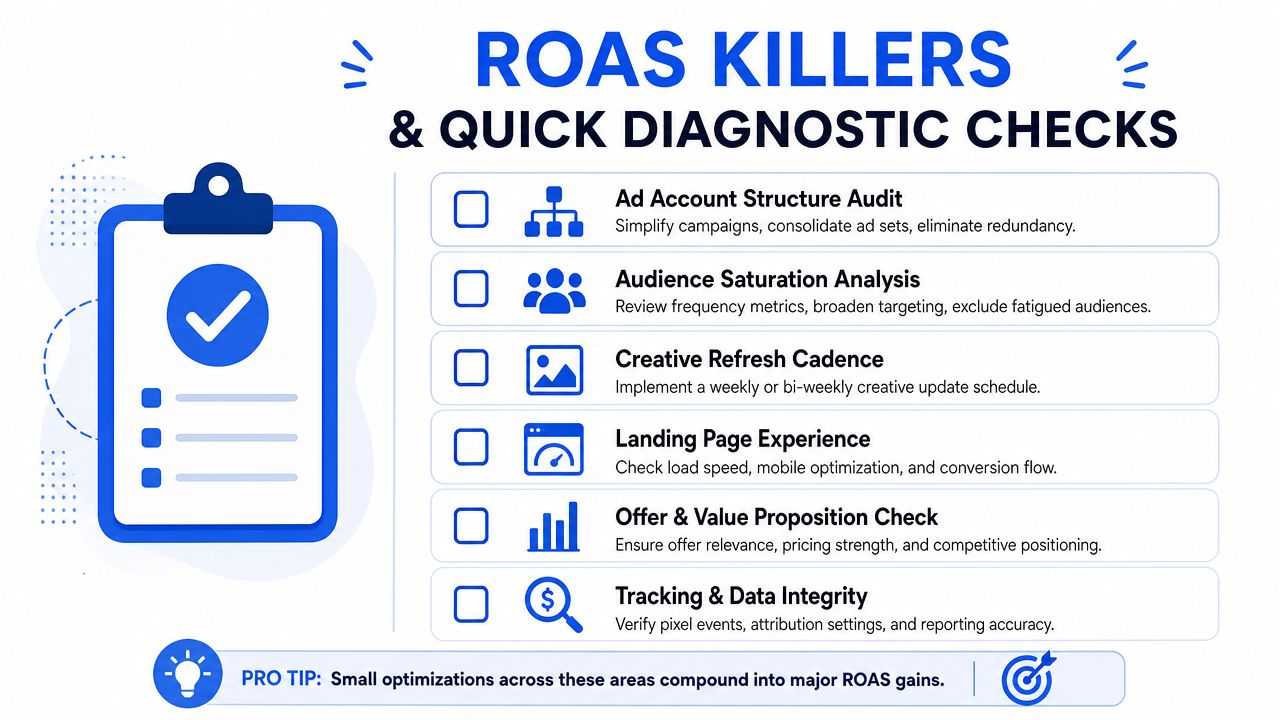
When performance drops, don't blame targeting first
Start with the obvious signals.
If CTR decays while CPM stays workable, the creative is usually tiring or the message has lost relevance. If CTR holds but purchase efficiency worsens, the leak may be post-click. That often means the product page, mobile experience, offer clarity, or checkout friction needs attention before you touch audience settings.
This is why I don't like “quick fix” optimisation sessions where teams edit five things in one afternoon. You learn nothing from that. All you get is a campaign that changed shape without producing a clear reason.
Bad diagnosis causes more account damage than bad creative.
A fast diagnostic order inside Ads Manager
Use the same order every time. It keeps the team from chasing noise.
- Check the ad first. Has the click signal weakened?
- Check the landing page next. Are buyers arriving but not moving?
- Check breakdowns. Is one placement, country, age range, or gender dragging the set?
- Check attribution assumptions. Are you reacting too aggressively to a narrow reporting window?
- Check structure. Did duplicates, overlaps, or messy edits make the account harder to interpret?
This sequence matters because creative issues are common, landing page issues are often ignored, and attribution confusion makes buyers overreact.
A working troubleshooting checklist
Use this as a practical review loop:
- Creative fatigue check: Compare current CTR behaviour to the ad's earlier baseline. If engagement quality has softened, rotate in a fresh angle before rebuilding the campaign.
- Post-click audit: Open the product page on mobile, follow the path yourself, and look for friction in page speed, trust elements, variant selection, and checkout flow.
- Offer clarity: Make sure the ad promise and the page headline still match. A strong hook with a weak on-page handoff kills conversion rate.
- Placement review: Some creatives degrade faster in one surface than another. Break performance down before you shut off the whole campaign.
- Audience saturation read: If a formerly strong ad now struggles across the same pocket, test adjacent audiences with the same core creative.
- Change log discipline: If multiple people touch the account, document edits. Otherwise you won't know whether performance moved because of fatigue or because someone changed the setup.
A lot of ROAS problems aren't dramatic. They're small leaks stacked together. Slightly weaker hook. Slightly slower page. Slightly messier account structure. Slightly worse attribution reading. On their own they don't look fatal. Together they wreck a campaign.
The buyers who stay profitable don't always find more winners. They diagnose losers faster.
If your team is launching lots of Meta creatives and spending too much time inside Ads Manager, Rapid Ads is worth a look. It solves the operational bottleneck this article focused on: bulk uploads, cleaner naming conventions, multi-account workflow, and keeping unwanted Advantage+ creative changes from drifting back into live ads. For dropshippers and media buyers running high-velocity tests, that's the difference between spending your day building ads and spending it reading results.