You're scaling a Meta account, and near-identical creatives are producing very different purchase costs across ad sets. Before replacing the ads, check what differs: the interest seed, the OR versus AND logic, customer suppression, and whether Meta can expand beyond your selections. A targeting change isn't an explanation until you've isolated it.
A useful Facebook ads list of interests should tell you more than which category names to paste into Ads Manager. It should separate audience mechanics from vertical-specific hypotheses, then give each hypothesis a fair comparison against broad targeting. Otherwise, you're collecting audience labels without learning which ones improve CPA or ROAS.
The distinction matters because an interest isn't a verified buyer attribute. Meta's documentation, summarized in JMIR Public Health and Surveillance, describes classifications derived from shared information, app usage, ad clicks, Page likes, and activity across and outside Meta services. Someone classified around a brand or hobby hasn't necessarily bought anything related to it.
Start with the mechanics below, then choose the vertical clusters that fit your offer. Every suggested interest name needs validation in your current Ads Manager interface. Availability varies, and a selectable interest may operate as an audience suggestion rather than an exclusive delivery boundary.
Table of Contents
- 1. Competitor Brand Pages as Interest Seeds
- 2. Interest Stacking with AND and OR Logic
- 3. Detailed Targeting Expansion Control
- 4. Exclusion Layering for Cleaner Interest Audiences
- 5. Pet Owner Interests for Pet and Pet Care Products
- 6. Home and Garden Interests for Home Goods and DIY Products
- 7. Fitness and Wellness Interests for Supplements and Active Products
- 8. Fashion and Apparel Interest Stacks for Clothing Brands
- 9. Parenting and Baby Product Interests
- 10. Travel Interests for Travel Gear and Experience Products
- How the Ten Targeting Plays Compare on Scale, Intent and Risk
- Turning the List into a Test Plan You Can Run This Week
1. Competitor Brand Pages as Interest Seeds
Competitor interests are affinity hypotheses, not access to a competitor's customer list. Search a relevant brand under Detailed targeting > Interests, but don't assume that having a Facebook Page makes that brand targetable.
Nike and Gymshark illustrate why brand seeds deserve separate thinking. Their audiences can overlap while representing different motivations, product preferences, and levels of purchase intent. Neither label proves brand loyalty or recent spending.
For a supplement DTC brand, compare a category-leader interest cluster with a broad health-and-wellness cluster and a no-interest control. Keep the offer, purchase optimization, placements, and creative identical. Retain the competitor hypothesis only when purchase economics justify it, not because its CTR looks stronger.
Keep the comparison interpretable
- Group deliberately: Combine closely related category leaders, not every recognizable brand in the market.
- Check availability: Record the exact selectable label rather than the brand name you originally searched.
- Name consistently: Use a format such as
INT_CompetitorBrandA_Feed_v1so reporting separates competitor seeds from category interests.
Rapid Ads' Duplicate Ad Set action can help clone the configuration while you replace the seed. Verify the published settings afterward rather than assuming duplication preserved everything.
Use your first-party data strategy to choose credible competitors and adjacent brands. Customer surveys, purchase histories, and support conversations offer better starting hypotheses than a list of famous logos.
2. Interest Stacking with AND and OR Logic
Adding Running and Fitness trackers to the same field doesn't necessarily create an audience interested in both. Same-field stacking broadens the initial selection; narrowing creates an intersection.
Meta's detailed targeting guidance explains that interests within the same field use OR logic, while Narrow Audience or Define further, where available, creates an AND relationship between groups. Confirm the current audience configuration before treating that relationship as a hard delivery restriction.
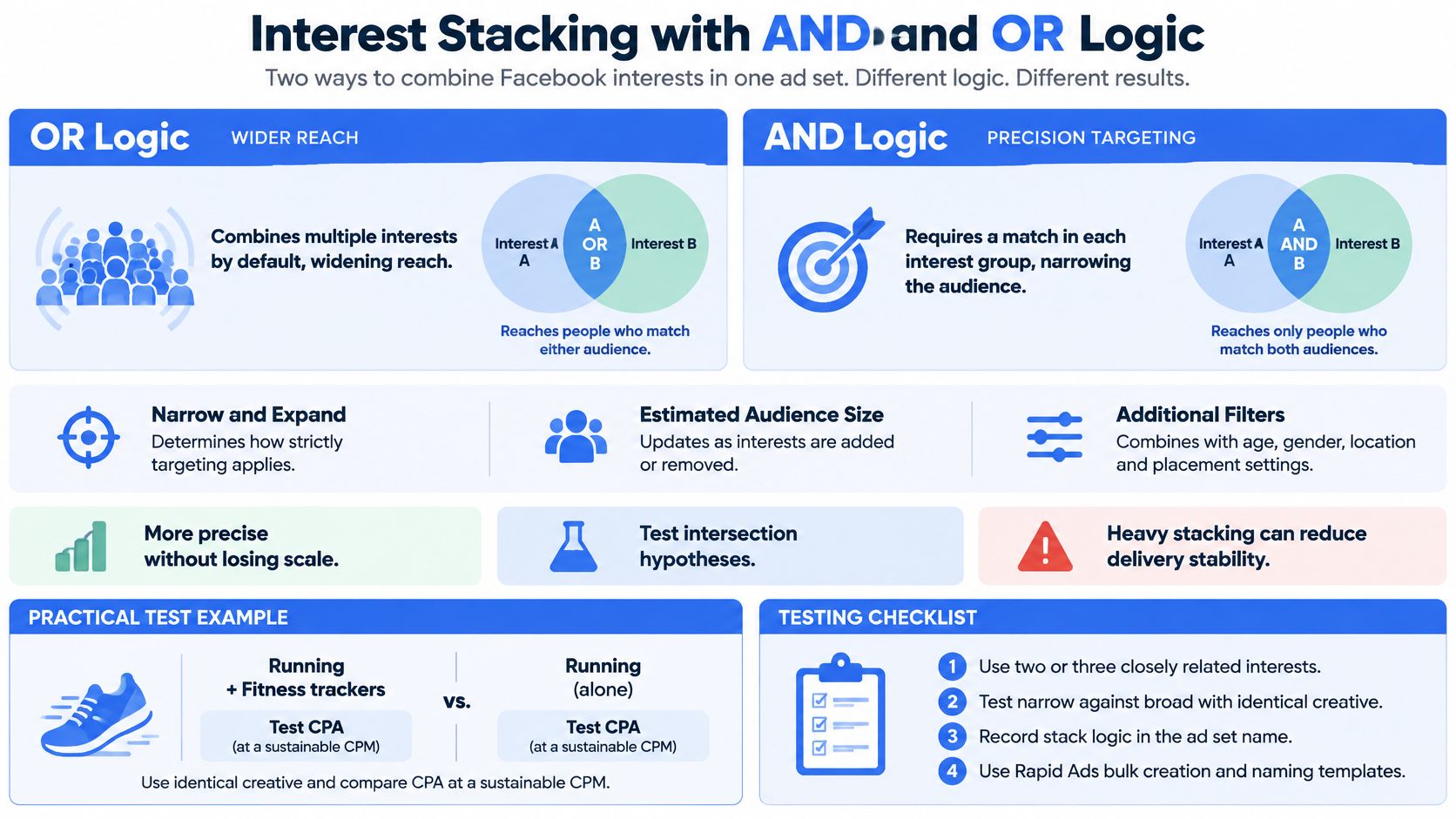
For a running-shoe offer, compare Running alone with Running AND Fitness trackers. Keep the shoe demonstration and landing page unchanged. The intersection needs to justify any increase in CPM through stronger purchase conversion and sustainable CPA.
A home-coffee brand could similarly test Coffee narrowed by Home cooking. That suggests a home-preparation hypothesis, but it doesn't establish that everyone reached makes coffee at home.
Practical rule: Add a narrowing layer only when you can explain the commercial distinction it represents.
Write the intended logic into the name, such as INT_Running_AND_Trackers. Record expansion separately, because an AND relationship in the seed isn't proof of exclusive delivery.
For batch launches, naming templates and bulk ad set creation reduce transcription errors. They don't replace reviewing the final audience description in Ads Manager.
3. Detailed Targeting Expansion Control
Check whether expansion is controllable before designing an expansion-off experiment. Some campaign configurations won't give you that choice.
Meta's Advantage+ detailed targeting documentation explains that detailed-targeting inputs can function as suggestions and that expansion applies automatically, without an opt-out, for conversion, app-install, value, and several other optimization goals. An interest-led ad set can therefore reach people outside the seed.
For a pet supplement brand, the practical comparison may be interest suggestions versus no suggestions, not strict targeting versus expansion. Describe the test accurately. Otherwise, you'll attribute results to a restriction that wasn't enforced.
Separate audience automation from creative automation
- Audience expansion: Changes whom Meta can reach beyond the selected seed.
- Creative enhancements: Change how an ad's assets or presentation may appear.
- Audience controls: Define the restrictions available for that campaign configuration.
Rapid Ads' auto-disable feature concerns unwanted Advantage+ creative enhancements. It shouldn't be interpreted as a way to bypass mandatory audience expansion.
Record the audience mode and expansion state beside the interest hypothesis. If a genuine on/off comparison is available, change only that setting and evaluate downstream outcomes.
Don't promise to measure the exact share of purchasers who matched an inferred interest. Standard reporting may not reveal that classification. Review how Facebook ad sets organize delivery settings before cloning tests across accounts with different interface options.
4. Exclusion Layering for Cleaner Interest Audiences
The useful exclusion layer today is usually first-party suppression, not an excluded interest.
Meta's exclusion update states that Detailed Targeting exclusions began disappearing from Ads Manager on March 31, 2025, and can't be used in new ad sets. Don't build a prospecting strategy around including a premium-shopping interest while excluding Discount shopping.
For a skincare brand acquiring new customers, exclude an eligible purchaser Custom Audience and an appropriately maintained customer list. Choose the purchase lookback around replenishment behavior and the acquisition objective, rather than copying a universal duration.
Separate suppression from qualification
Suppression removes known audiences you don't want in that acquisition test. Qualification uses price, product positioning, creative, and landing-page messaging to discourage poor-fit prospects you can't identify directly.
- Purchasers: Suppress existing buyers when measuring new-customer acquisition.
- Website visitors: Exclude them only when you need a cold-prospecting comparison.
- Customer lists: Refresh them so the exclusion reflects current records rather than an old export.
A premium gift-box business can qualify price-sensitive shoppers by showing the product price and premium contents upfront. That's more dependable than searching for a removed interest-exclusion workaround.
A smaller prospecting audience isn't automatically a cleaner one. Excluding visitors can also remove people close to buying.
Build and document the relevant Facebook Custom Audiences, then keep suppression labels distinct from interest names. Saved defaults help maintain consistency, but verify audience eligibility in each account.
5. Pet Owner Interests for Pet and Pet Care Products
A dog-treat offer needs dog-product relevance, not merely people who enjoy animal content. Search available labels around dogs, cats, pet food, grooming, and pet supplies, while treating each as an inferred interest rather than verified ownership.

For a dog-treat brand, compare a dog-focused cluster with a general Pets seed and broad targeting. Use the same dog-specific demonstration across the comparison. Changing both species targeting and creative would make the audience result difficult to interpret.
Test the household problem
A cat-litter brand can compare a cat-related seed with a cat-and-home-cleaning hypothesis where narrowing is available. Keep the message focused on litter tracking, cleanup, or odor management, with claims supported by the product.
The SouthShore Fine Linens pet bedding tips offer an adjacent content angle for household cleanliness. Use that kind of customer problem to develop creative, not as evidence that an interest audience will convert.
Separate species when the product or message changes materially. Don't fragment every breed into an ad set unless the economics and test budget justify it.
Rapid Ads can bulk-upload species-specific creative and apply consistent names. Keep the audience experiment separate from the creative experiment, then assess repeat-purchase behavior before declaring an acquisition winner.
6. Home and Garden Interests for Home Goods and DIY Products
Interior design, Home improvement, Gardening, and DIY represent different purchase motivations. A decorative lamp, a repair tool, and a seed kit shouldn't inherit the same audience because they belong in a home catalog.
For furniture, test Interior design against Home improvement with the same room-in-use creative. Keep shipping charges, financing messaging, and landing-page presentation consistent. A cheaper click doesn't compensate for an audience that rejects the delivered price.

Match the seed to the project
- Decorating: Show the room, dimensions, materials, and finished appearance.
- Maintenance: Demonstrate the task, compatibility, and practical result.
- Gardening: Match the product to local growing conditions and the buyer's available space.
A garden-tool business should test during a relevant local buying window, not assume identical seasonality across markets. For higher-ticket products, allow for the account's normal consideration delay before comparing purchase economics.
Family gardening offers another distinct hypothesis. Content about choosing plant growing kits for kids suggests a parent-and-child activity angle rather than a specialist horticulture angle.
Rapid Ads can group assets by product or room for batch launches. Keep those labels separate from targeting labels so a strong kitchen creative doesn't get mistaken for proof that every home interest works.
7. Fitness and Wellness Interests for Supplements and Active Products
Start with the activity, not a presumed health condition. Running, strength training, yoga, and general fitness can suggest different product uses, but none proves a medical need.
Meta announced the removal of sensitive detailed-targeting options associated with subjects including health, with the change taking effect on January 19, 2022, according to The Boston Globe's coverage of Meta's announcement. Validate available activity interests instead of rebuilding an old condition-based audience.

For running gear, compare Running with an available marathon-related interest and a broad control. Show the same product use and evaluate purchase CPA, returns, and margin rather than interpreting activity relevance as intent.
Keep product claims separate from targeting
A supplement catalog containing 240-count BCAA vegetable capsules can test activity-led positioning without claiming that the audience has a deficiency or requires supplementation. Copy should explain the actual product and avoid unsupported outcomes.
Use saved, reviewed copy templates to reduce accidental claim changes during bulk launches. Templates aren't a compliance guarantee, and a targeting label doesn't authorize personal-attribute language.
Monitor whether higher CPM comes with stronger conversion quality. A focused activity seed can be commercially useful even when impressions cost more, but only if the resulting CPA and contribution margin support it.
8. Fashion and Apparel Interest Stacks for Clothing Brands
Fashion targeting becomes more useful when you separate style, occasion, and price positioning. A broad Fashion label doesn't distinguish a streetwear buyer from someone browsing formalwear inspiration.
A published Meta interest inventory from Primal reports an estimated global audience range of roughly 1.3–1.6 billion for Online Shopping. That's an estimated platform category, not a count of clothing buyers or a forecast of reachable customers in your market.
For a streetwear label, test available Streetwear and sneaker-related interests as a coherent OR cluster against Fashion and a broad control. Keep the same outfit creative and product assortment across that audience comparison.
Separate audience testing from styling tests
- Audience test: Hold creative constant while changing the interest hypothesis.
- Creative test: Hold the audience approach constant while comparing styling, models, or hooks.
- Commercial review: Compare purchase CPA with returns, discounts, and margin by product mix.
For workwear, show the garment in its intended setting and make fit, fabric, and use clear. Don't assume an expensive-looking interest label identifies people with the purchasing power or workplace requirements you need.
Buying judgment: When a previously useful fashion audience weakens, check asset fatigue and stock availability before replacing the seed.
Rapid Ads' Copy-From / Copy-To workflow can reuse the same creative set across style hypotheses. Preserve the original asset names so you can distinguish audience effects from creative substitutions.
9. Parenting and Baby Product Interests
Parenting content affinity isn't verified pregnancy or a precise household life stage. Search available Parenting, Baby products, nursery, and toy-related interests, but avoid treating the label as personal knowledge about the viewer.
For nursery furniture, compare Parenting with Baby products using the same product demonstration. Focus on dimensions, assembly, materials, delivery, and practical room use. Don't write copy that presumes the viewer is pregnant or creates emotional pressure around being a good parent.
Let creative qualify the use case
- Nursery products: Show scale, storage, access, and compatibility.
- Toddler products: Demonstrate age-appropriate use and explain relevant limitations.
- Gifts: Make recipient suitability, packaging, and delivery expectations clear.
A toy brand can test a gifting angle against an everyday-play angle, but that's a creative experiment. To isolate targeting, first deliver the same gifting creative to the interest audience and broad control.
Avoid narrowing age or device settings merely because they're available. Those restrictions need a commercial or operational reason, and their role can differ between audience suggestions and controls.
Review product-specific advertising restrictions, claims, and imagery before launch. For consumables, assess repeat orders alongside initial purchase CPA so you don't favor cheap acquisitions that fail to retain.
Saved naming and copy templates help agencies compare life-stage themes across markets. Localize product suitability and language rather than duplicating assumptions about family composition.
10. Travel Interests for Travel Gear and Experience Products
A person who follows destination content may be browsing, not booking. Treat Travel, Backpacking, Hiking, Camping, and photography-related interests as separate audience hypotheses, then compare each with a broad control using CPA and ROAS.
For luggage, test a Travel seed against a backpacking-related cluster and broad targeting. Keep the packing demonstration, price, warranty language, and landing page consistent so the audience is the main variable. Business-travel luggage needs a relevant use case; shared interest in bags alone does not establish a fit.
Match the offer to the trip
Test gear when customers are preparing for the relevant trip. For experiences, align the audience's geography with booking availability, cancellation terms, and the offer shown in the creative.
- Gear creative: Show capacity, handling, storage, and the product in use.
- Experience creative: Show the destination or activity, then state what the booking includes.
- Market reporting: Separate countries when shipping costs, climate, language, or availability differ.
For camping equipment, compare Hiking OR Camping with a narrower intersection where Ads Manager allows it. Check the audience size estimate for each combination, and keep a narrowing layer only when the estimate still allows meaningful delivery. Judge the trade-off on CPA and ROAS against broad targeting, not audience size alone.
Group campaigns by destination or product line when that makes seasonal launches easier to manage. Before publishing in each market, check local audience estimates and booking conditions. Keep interests as testable seeds, not proof of travel intent.
How the Ten Targeting Plays Compare on Scale, Intent and Risk
Audience size and intent are estimates, not guarantees. A large audience can still contain few likely buyers, while a tighter audience may limit delivery. Treat each interest or targeting mechanic as a testable hypothesis, then compare its CPA and ROAS with a broad control under consistent campaign settings.
| Item | Best for | Audience size | Intent level | Main risk |
|---|---|---|---|---|
| Competitor Brand Pages as Interest Seeds | Testing competitor audiences for conquesting | Mid to large; depends on the brand's fan base | High, but approximate | Mixed or loosely matched fans |
| Interest Stacking with AND and OR Logic | Reaching people at the intersection of related interests | Adjustable; heavy stacking can make it small | Medium to high | Overly narrow targeting can limit delivery |
| Detailed Targeting Expansion Control | Testing strict interest targeting against automated expansion | Can broaden beyond selected interests | Medium; suggestions can widen reach beyond the seed | Expansion can dilute targeting and obscure results |
| Exclusion Layering for Cleaner Interest Audiences | Removing existing buyers or low-quality audience segments | Smaller than the included audience | Medium to high; suppressed buyers are removed from the prospect pool | Over-exclusion can remove likely buyers |
| Pet Owner Interests for Pet and Pet Care Products | Promoting pet products and repeat-purchase goods | Often broad; niche interests are smaller | Medium to high for specific owners | Broad interests may include non-buyers |
| Home and Garden Interests for Home Goods and DIY Products | Marketing home, garden and DIY products | Broad | Medium; often considered purchases | Broad intent and seasonal swings |
| Fitness and Wellness Interests for Supplements and Active Products | Prospecting for fitness, supplement and activewear products | Large; activity interests are narrower | Medium to high for specific activities | Competition, policy limits and restricted options |
| Fashion and Apparel Interest Stacks for Clothing Brands | Targeting shoppers by style, occasion or price point | Large, with variable intent | Low to medium; higher with style-specific stacks | Casual browsing and creative fatigue |
| Parenting and Baby Product Interests | Marketing baby, nursery and family products | Often large | High during relevant life stages | Broad life-stage signals and product restrictions |
| Travel Interests for Travel Gear and Experience Products | Promoting travel gear, bookings and experiences | Large and seasonal | High during planning windows | Casual browsing, seasonality and high competition |
The first four plays change how audiences are built: competitor interests seed a test, AND and OR logic shape the audience, Detailed Targeting expansion can extend it, and exclusions remove selected groups. These mechanics involve trade-offs between control and reach. For example, strict stacking can constrain delivery, while expansion can bring in people beyond the interests you selected.
The remaining plays apply interest clusters to specific verticals. Their stated intent reflects relevance to the product, not confirmed purchase intent. Judge each cluster by its results against the broad control, and keep it only if CPA or ROAS supports the added targeting constraint.
Turning the List into a Test Plan You Can Run This Week
Pick two relevant plays, not every available interest. A competitor seed and an activity-led cluster are enough to answer useful questions if you compare them with a broad control and avoid changing the offer at the same time.
Write the hypothesis before opening Ads Manager. For example, a specialist running accessory may convert more efficiently with activity suggestions than without them. That statement is testable; an audience name such as Fitness winners isn't.
Build comparable delivery conditions
Keep creative, landing page, optimization event, attribution setting, geography, placements, bid strategy, and suppression consistent. Set expansion explicitly where the interface allows it, and document mandatory automation where it doesn't.
- Budget allocation: ABO can make exploratory allocation easier to read. If you use CBO, account for unequal spend before treating ad-set results as a fair comparison.
- Experiment design: Use Meta's A/B testing workflow when you need a cleaner causal comparison than parallel ad sets can provide.
- Measurement: Check purchase values, currencies, event deduplication, and backend orders before interpreting ROAS.
- Documentation: Save exact interest labels, audience mode, Custom Audience exclusions, creative IDs, and launch settings.
Read results after a full learning cycle and enough time for the account's normal conversion delay. A learning-status change alone doesn't prove that the sample is sufficient. Don't interrupt the test with repeated budget, audience, or creative edits and then interpret the result as a single controlled comparison.
Scale the commercial winner
Compare CPA and ROAS alongside contribution margin and customer quality. For lead generation, use qualified-lead cost and downstream revenue rather than form submissions alone. For ecommerce, separate new-customer acquisition from existing-customer purchases and examine whether product mix or discounts explain the apparent winner.
If an interest seed wins under expansion, record the conclusion accurately: that suggestion improved results under that delivery configuration. You haven't proved that every purchaser belonged to the selected interest, or that strict targeting would perform better.
Consolidate losing or redundant hypotheses instead of preserving an expanding archive of underfunded ad sets. Scale the winner deliberately, watch whether its economics hold at higher spend, and keep the broad comparison available for future creative or market changes.
The useful output isn't a permanent list of best interests. It's a repeatable record of which seed, creative, offer, and delivery configuration produced commercially better results.
Rapid Ads supports bulk creative uploads, reusable naming conventions, and ad-set duplication for structured Meta audience tests. Visit Rapid Ads to organize your next interest-versus-broad launch while keeping creative assets and reporting labels consistent.

