Most advice about Facebook ad headline generators starts with volume. Twenty lines in a minute, ten angles per prompt, more variants than you could ever test. Volume isn't the constraint.
Meta recommends roughly 40 characters for the headline field, against 125 for primary text and 25 for the description, and longer text may be truncated across placements and devices (Meta Business Help Center). A generator that ignores that ceiling hands you copy you'll shorten by hand. One that respects it hands you a line that still has to survive naming conventions, Advantage+ settings and a readable test.
Drafting is the solved part. A 2026 Typeform survey of more than 2,000 marketers found 79% use AI for copywriting, and most still edit the output to make it sound more human (Typeform AI data report). What breaks is downstream. Character checks per placement, winners re-keyed into Ads Manager, ad sets named so two weeks of results stay legible.
Fix the measurement before the copy. Set the hypothesis and the sample size in advance, which this hypothesis and sample size planning guide walks through, then choose a tool that feeds it.
Ten tools follow, judged on what happens after the headline is drafted. Character discipline, variant count, and whether the output travels to Ads Manager without re-keying.
Table of Contents
- 1. Clickem Facebook Ad Headline Generator
- 2. Made to Spark Facebook Ad Copy Generator
- 3. HookAds Facebook Ad Headline Generator
- 4. HubSpot Campaign Assistant
- 5. WRITER Facebook Ads AI Agent
- 6. AICreate AI Ad Copy Generator
- 7. AdFlint AI Ad Generator
- 8. Jasper Social Media Ad Agent
- 9. Anyword Ad Copy Generator
- 10. Zuops Free Facebook Ad Copy Generator
- How the 10 Facebook ad headline generators compare on output, access and publishing
- Choosing a Generator Based on What Happens After the Draft
1. Clickem Facebook Ad Headline Generator
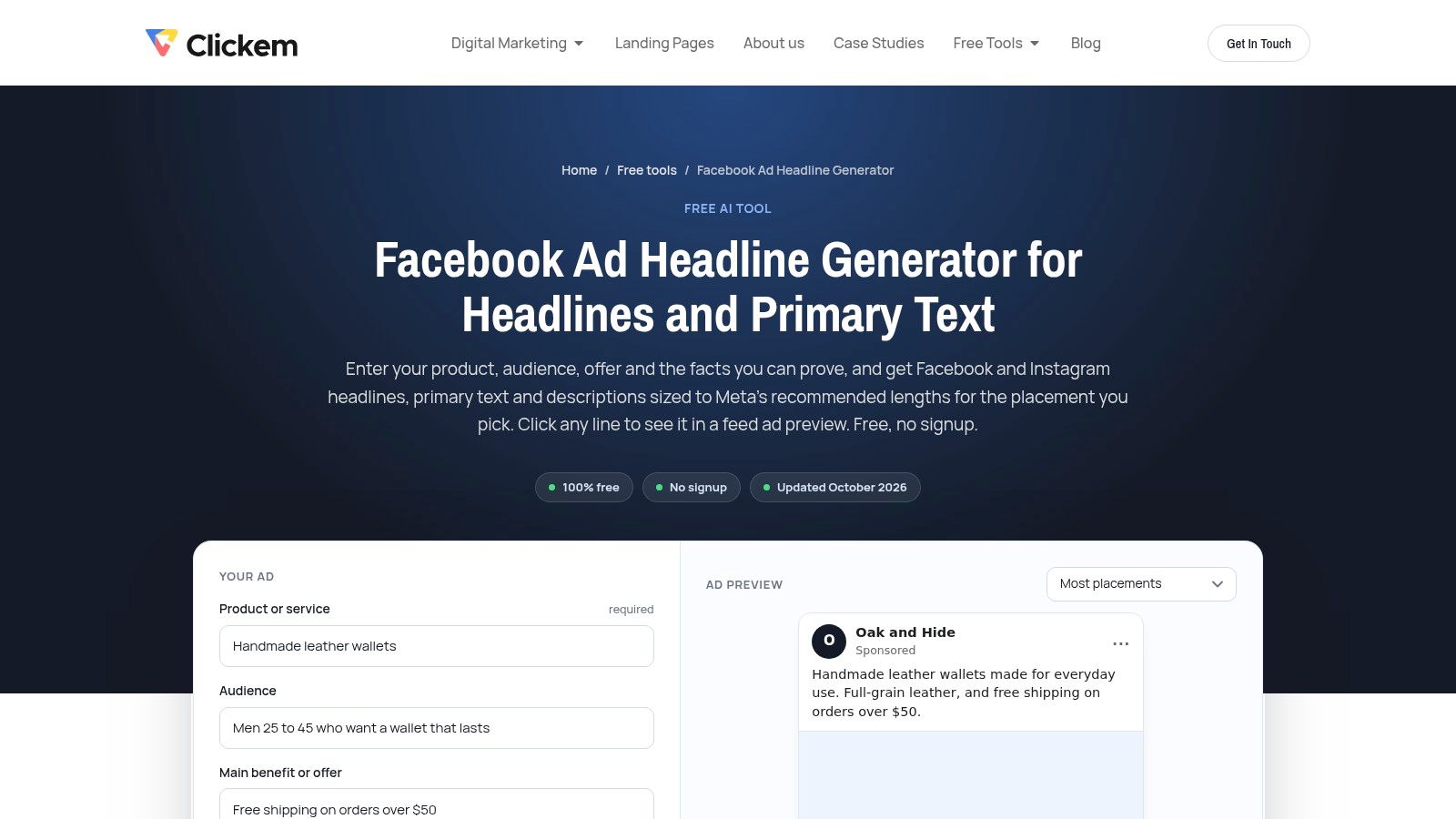
Clickem's Facebook ad headline generator is the narrowest tool here and the most disciplined about placement. It asks for the product, the audience, the offer and the facts you can prove, then returns headlines, primary text and descriptions sized to the placement you select.
The fact box is the feature worth noting. Requiring substantiated claims pushes you away from invented discounts and review quotes, the fastest route to a rejected ad and a wasted test.
What the output looks like
- Placement-aware counts: pick a placement and the limits and preview switch to Meta's recommendation for it, which is the check most generators skip.
- Clickable lines: tapping a line drops it into a feed ad preview so you can see where a long headline would be cut.
- CSV export: every line downloads with its length and whether it fits, the only export format worth having for bulk work.
- Template fallback: when the AI service is busy it falls back to templates built from your facts, so the run still returns something usable.
A finished run looks like this, with each headline shown at feed size:
It stops at the draft. No testing, no publishing, no naming. Use it to produce the lines, then put them through a known Facebook ad copy structure before anything reaches Ads Manager.
2. Made to Spark Facebook Ad Copy Generator
Three finished packages is a thin test cell. Made to Spark's Facebook ad copy generator returns that count each run: primary text, headline and description, and only after you set an objective. Traffic, conversions or awareness changes the promise. A click-led line and a conversion-led line should not share wording. The selector locks that choice before editing.
Three complete variations from a single run, each with its own headline:
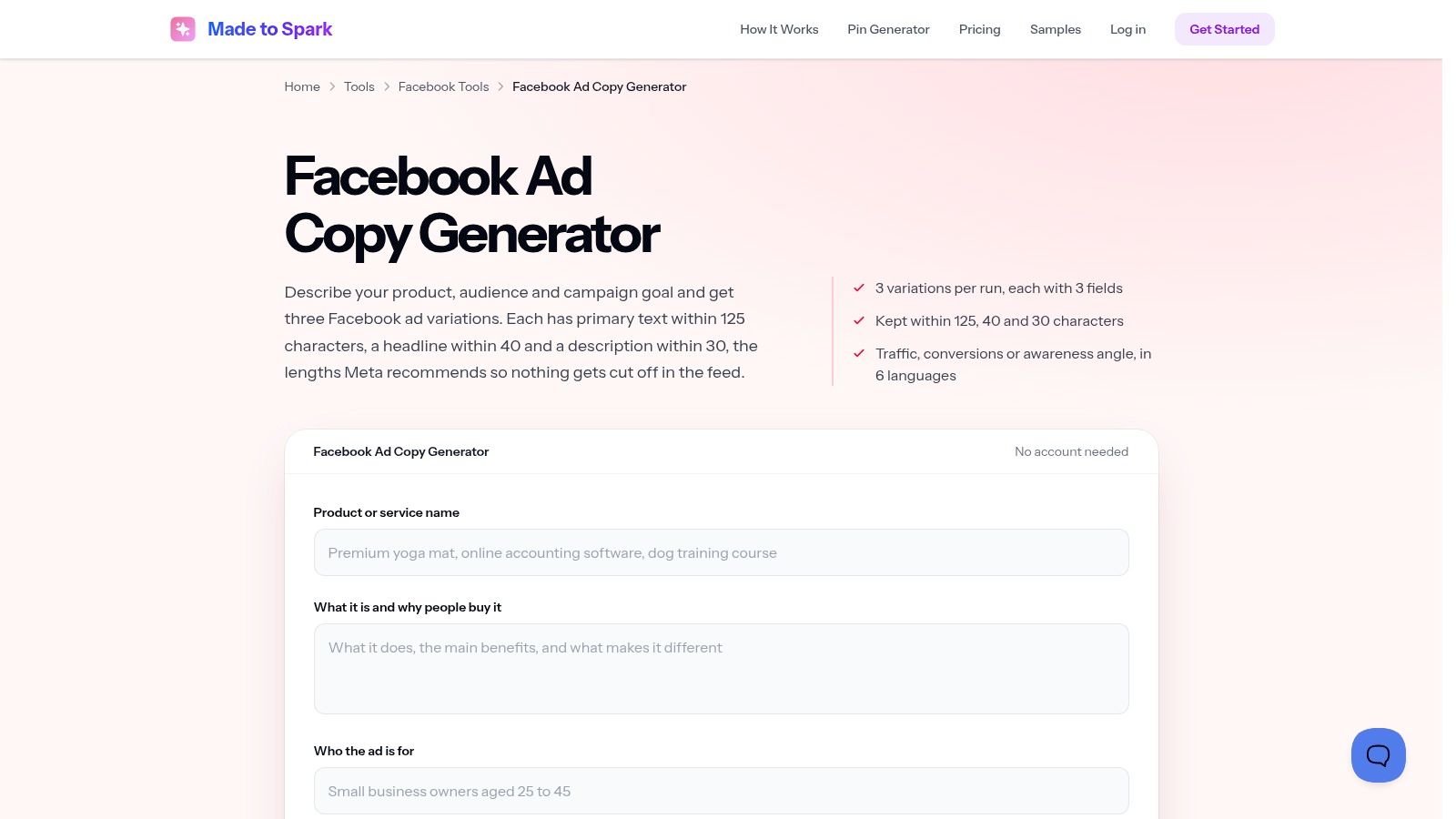
Three variations against a global audience
DataReportal's Digital 2025 report puts Facebook's global ad reach at about 2.28 billion people at the start of 2025, up roughly 93 million, or 4.3%, year on year, and second among social platforms. One template still has to work across languages, markets and purchasing power. Variant count decides whether you can test, or only restate one idea.
A translated headline needs the same truncation check as the original. A longer translation can fail a length the source language passed.
Three variants is a test, not a campaign. If all three sell the same benefit in different words, you have one headline in three costumes.
Nothing reaches Ads Manager without re-keying. No account connection, no naming, no publish. Match the drafts to ad copy examples that already convert in your account, then cut anything over platform length.
3. HookAds Facebook Ad Headline Generator
Eight headlines per run, aimed at the length Meta publishes for the headline field, with a character counter in the same toolkit. HookAds' Facebook headline generator sits among several free marketing utilities, including tools for hooks and ad copy, so you can draft an opening line and the supporting text in one place.
The count is the useful part. Eight lines covers benefit, urgency, offer, objection and proof in a single pass, provided you prompt for angles instead of letting it restate one idea five ways.
Character limits aren't placement safety
Hitting the general headline length gets a line through the truncation check on most surfaces. It doesn't protect you from the crop. Meta's Advantage+ creative can vary aspect ratio using original or cropped versions of the asset, and can switch on enhancements that appear in a For review tab once the ad publishes (Meta Advantage+ creative guidance). A headline written to sit under a square crop can land under a vertical crop with a different amount of clear space.
The headline tool sits alongside the rest of the free utilities:
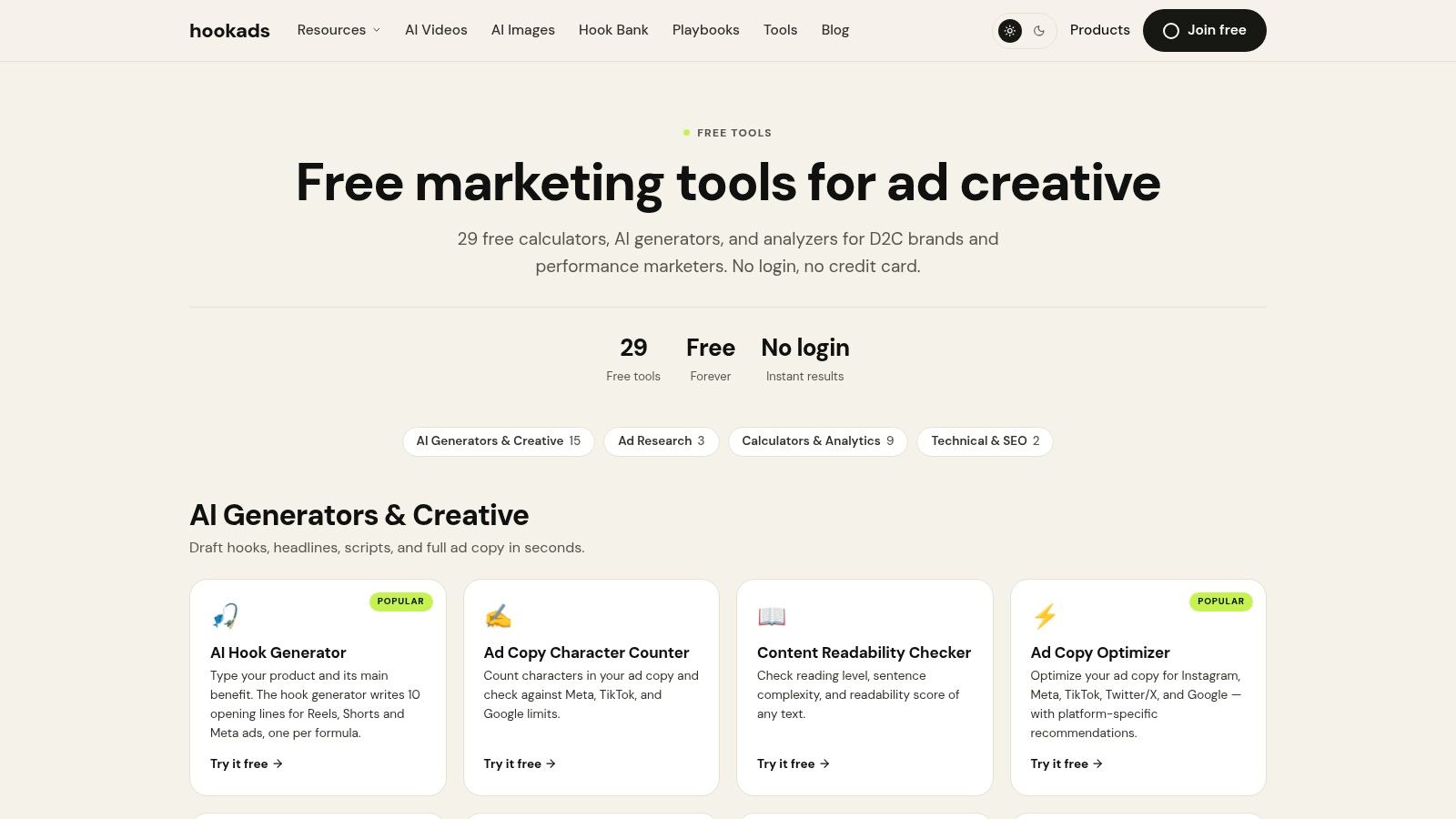
There's no campaign workflow, no export and no publishing. Free without a login, which is the right price for something you'll use twice a week and then put down.
4. HubSpot Campaign Assistant
HubSpot's Campaign Assistant writes Facebook ad copy alongside Google ads, LinkedIn ads, landing pages and email. You supply campaign details, choose a writing style, then review or regenerate. The Meta output is complete ad copy rather than a headline in isolation, which suits a brief spanning several channels that has to stay consistent across them.
The trade-off is scope. For a matrix of forty headline variants, a general campaign assistant is the wrong shape. It's built to produce one good asset per brief, not a controlled family of variants that differ by one element.
Campaign Assistant takes a brief and a writing style, then returns a full ad draft:
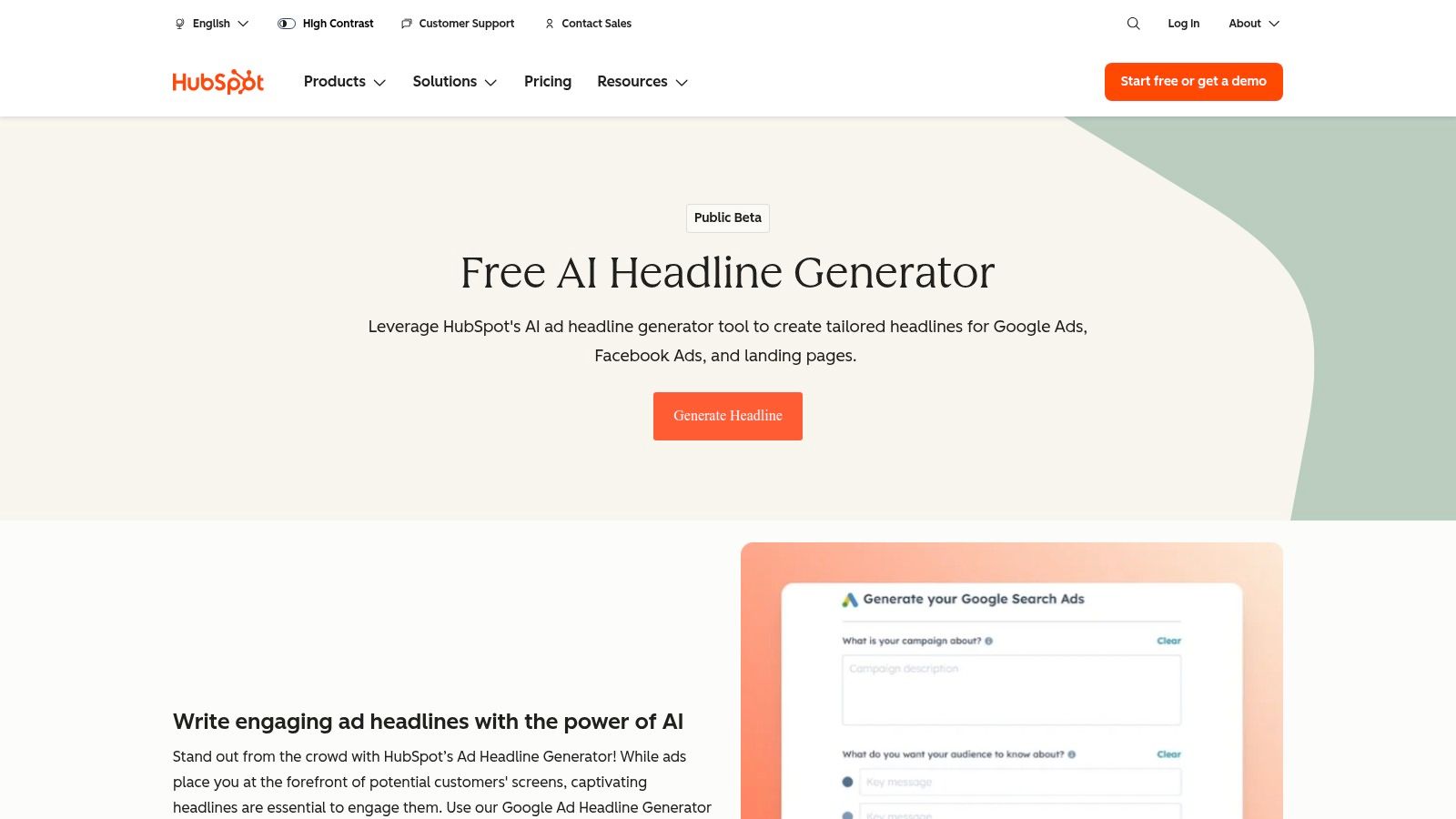
The account question
It requires a HubSpot account, which is a real cost in time if you're not already running campaigns there. For teams using HubSpot for lifecycle email and forms, the ad copy lands in the same workspace as the campaign it supports, and matching landing-page and ad copy stops being a copy-paste job.
Practical rule: give the assistant the offer, the proof and the audience in one paragraph. Hand it a headline brief and you get a headline that could belong to any advertiser in the category.
Access is advertised as free. It stops at drafting, with no placement-by-placement character checks, no export and no ad-account connection.
5. WRITER Facebook Ads AI Agent
WRITER's Facebook Ads AI Agent drafts a whole Facebook ad from campaign inputs, headline included. It's an agent rather than a form, so the campaign context goes in as prose and the copy comes back in the shape the channel expects. That's faster than filling four fields if you already have a brief written.
The trial structure is the honest part. A limited number of free uses lets you test output against your own product and market before committing, and the agent page doesn't state the price for continued access, so the cost conversation happens after you've judged the copy.
An agent brief rather than a form, so campaign context goes in as prose:
Complete ads versus controllable variants
For an agency producing one ad per client per week, whole-ad drafts are efficient. For a media buyer running five angles on one offer, the whole-ad draft is the wrong unit. The headline has to move while the primary text holds, or you can't attribute the difference to anything.
Write the control by hand once, then use the agent for variations you wouldn't have written yourself, and label each angle in the sheet so the winner tells you something. The page doesn't describe placement-specific character counting, so budget time for manual checks and expect to make them.
6. AICreate AI Ad Copy Generator
AICreate's AI ad copy generator returns three variations per run across Facebook, Instagram, Google, LinkedIn, TikTok and X. You choose platform, goal and tone, then get fields for headline, description and CTA. If your media plan runs beyond Meta, one brief producing copy for two channels is a genuine saving on briefing time.
The cost of that breadth is specialisation. Nothing in the flow knows the headline length Meta recommends, so a line that reads well can still truncate in a feed placement.
Platform, goal and tone are chosen before the copy is written:
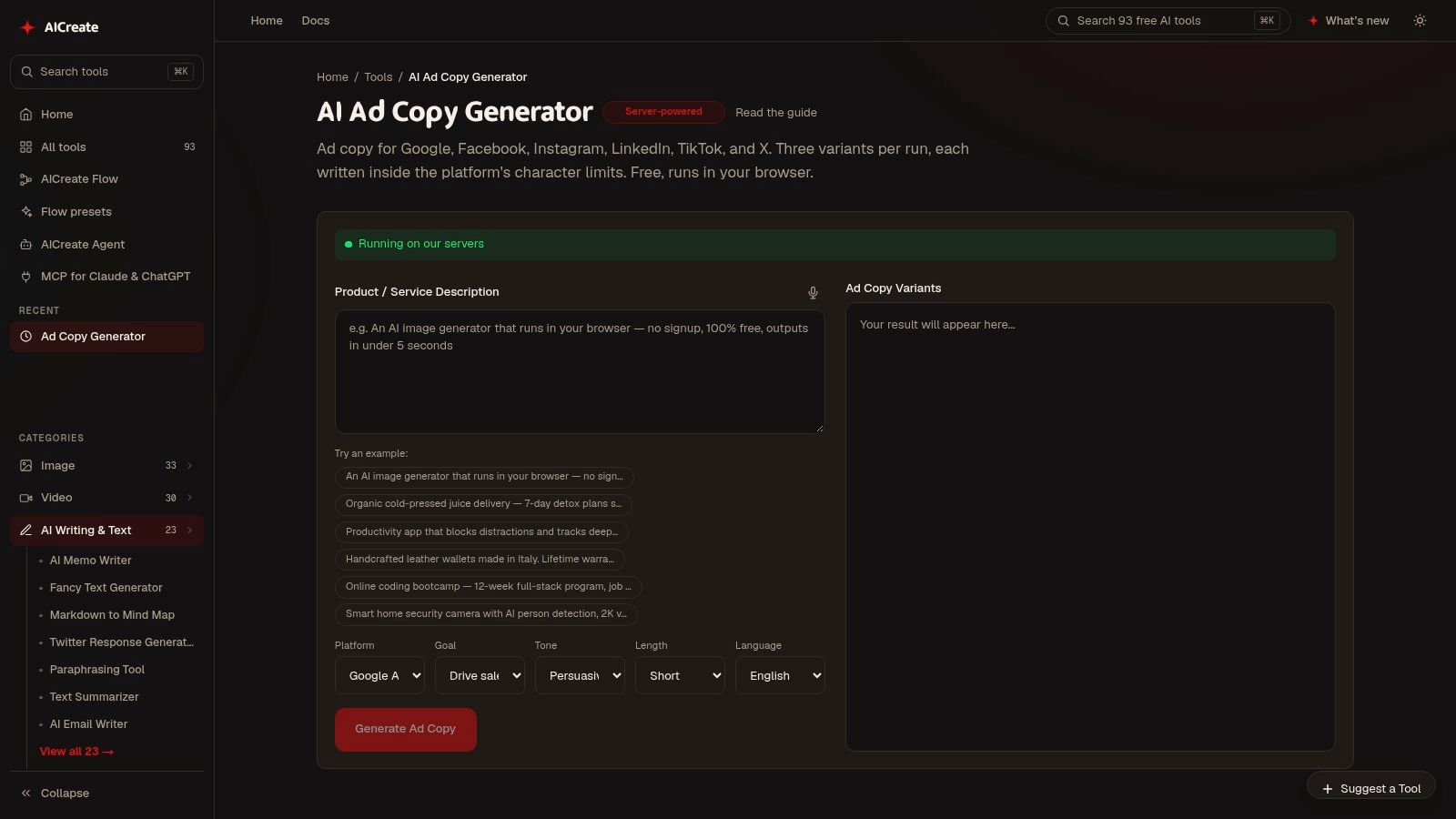
Use it for the offer, not the line
Platform-agnostic tools are strongest at offer framing and weakest at placement detail. Take the angle AICreate returns, then rebuild the line to platform length in a tool that counts characters and previews the crop.
Free access with no signup or watermark is advertised, which makes it cheap to trial. Check the output for brand voice, factual accuracy and policy-sensitive claims before it reaches an ad account, and read this guide to picking an AI ad copy generator if you need a repeatable review step.
7. AdFlint AI Ad Generator
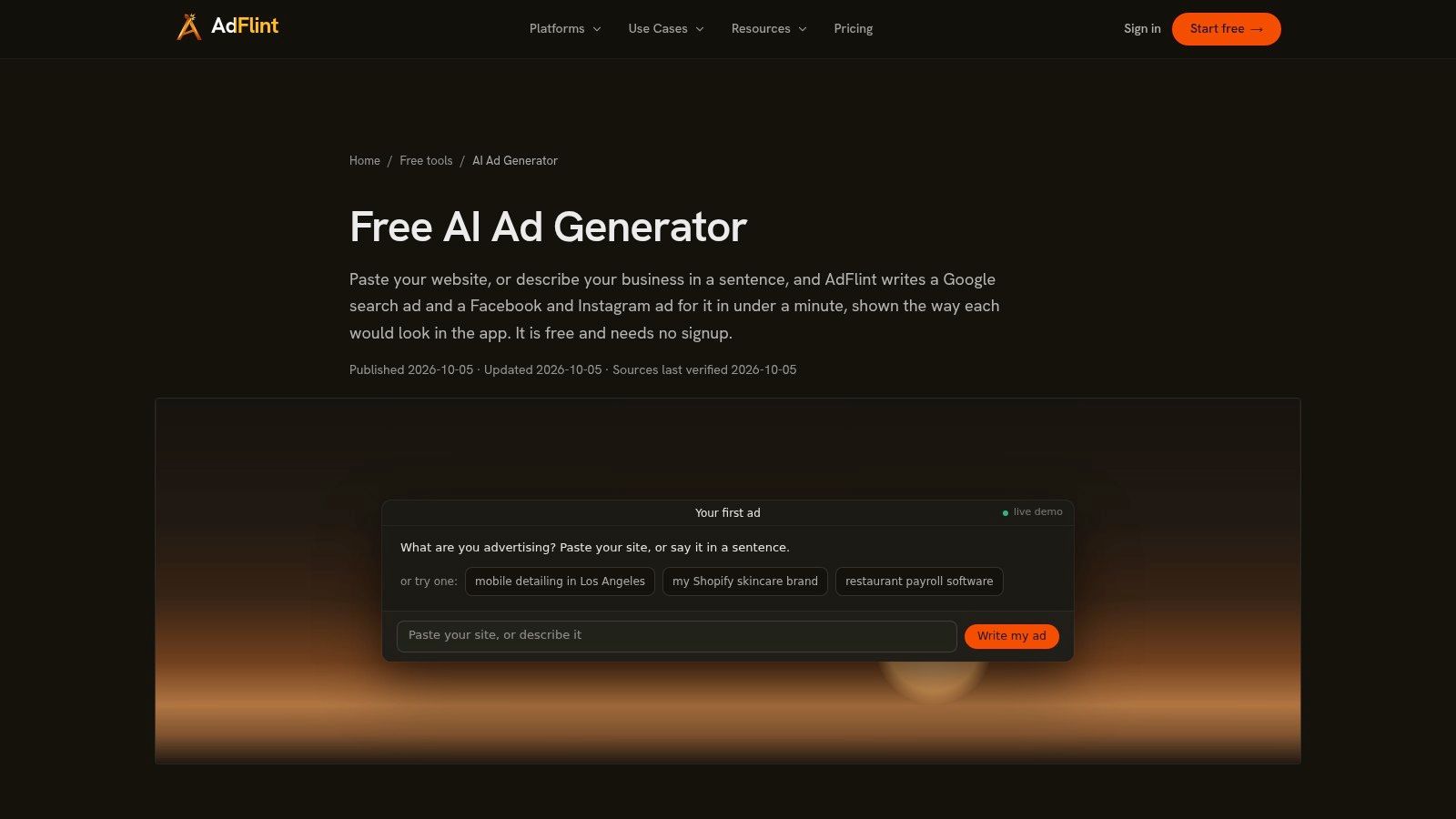
AdFlint's AI ad generator starts from a website URL or a short business description and returns a Google search ad and a Meta ad in one run, with primary text and a headline shown in a preview. It's the fastest route from a product page to a first draft when nobody has written a brief.
Speed has a predictable failure. A draft pulled from a URL knows what the site says, not what this week's offer is. Add the discount, the shipping term and the audience before you generate, or the copy will describe your category instead of your campaign.
A URL is enough to produce a Google ad and a Meta ad in one pass:
Why copy has to survive several creatives
Meta's Flexible ad format allows up to 10 images and videos in a single ad, after which delivery chooses which asset or combination to show, for campaigns using the Traffic, Engagement, Sales and App promotion objectives (Meta Flexible ads help). Flexible may not be available to every advertiser. Where it is, a headline naming one specific image breaks as soon as another asset is served.
Write the line so it holds next to any of the ten. Free access without an account is advertised.
8. Jasper Social Media Ad Agent
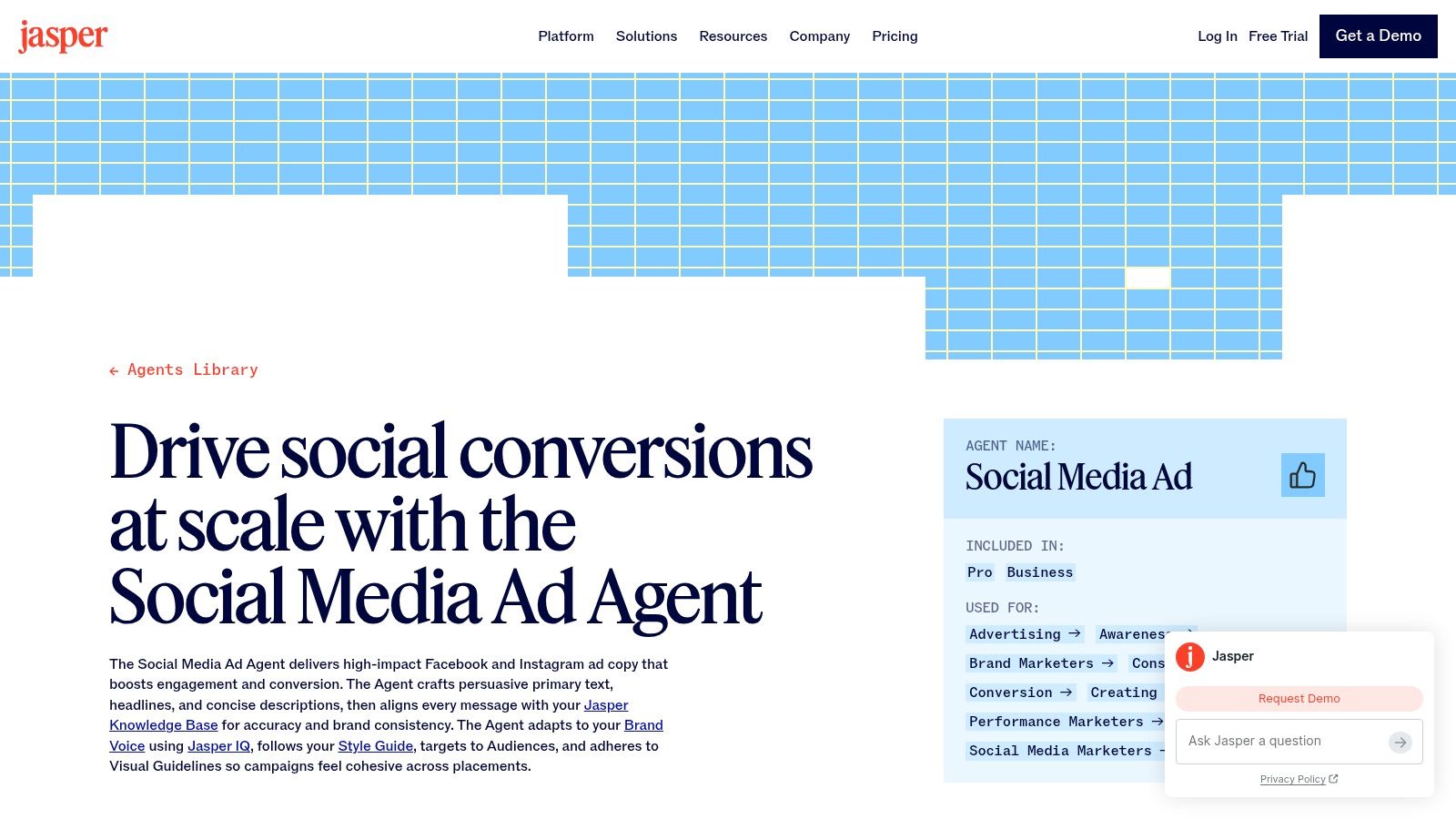
Jasper's social media ad agent writes Meta headlines, primary text and descriptions, and draws on brand voice, style guides, audience profiles and knowledge-base material. That input list is the product. It's built for teams where four people write ads and all four have to sound like one brand.
For a single advertiser testing one offer, that's overhead. For an agency running twelve accounts, it's the difference between usable drafts and a rewrite queue.
Brand voice, style guide and audience profiles feed the agent before it writes:
Specificity beats polish
Keyword-specific AI ad copy outperformed generic templates in online A/B tests by as much as 9% in click-through rate, generated 12% more impressions and reduced cost per click by 0.38%, according to a benchmark compiled in Blazehive's generative AI marketing statistics. Treat those as an upper bound. The underlying experiments differ in auction dynamics, audience mix and attribution window, and none of them ran in your account.
The narrower lesson is that prompts naming an audience and a pain point beat interchangeable promotional wording. Jasper's audience profiles are the mechanism for that, which is why the setup work pays back on every ad written afterwards.
The agent page doesn't list a standalone price, and it's more tool than occasional headline generation requires.
9. Anyword Ad Copy Generator
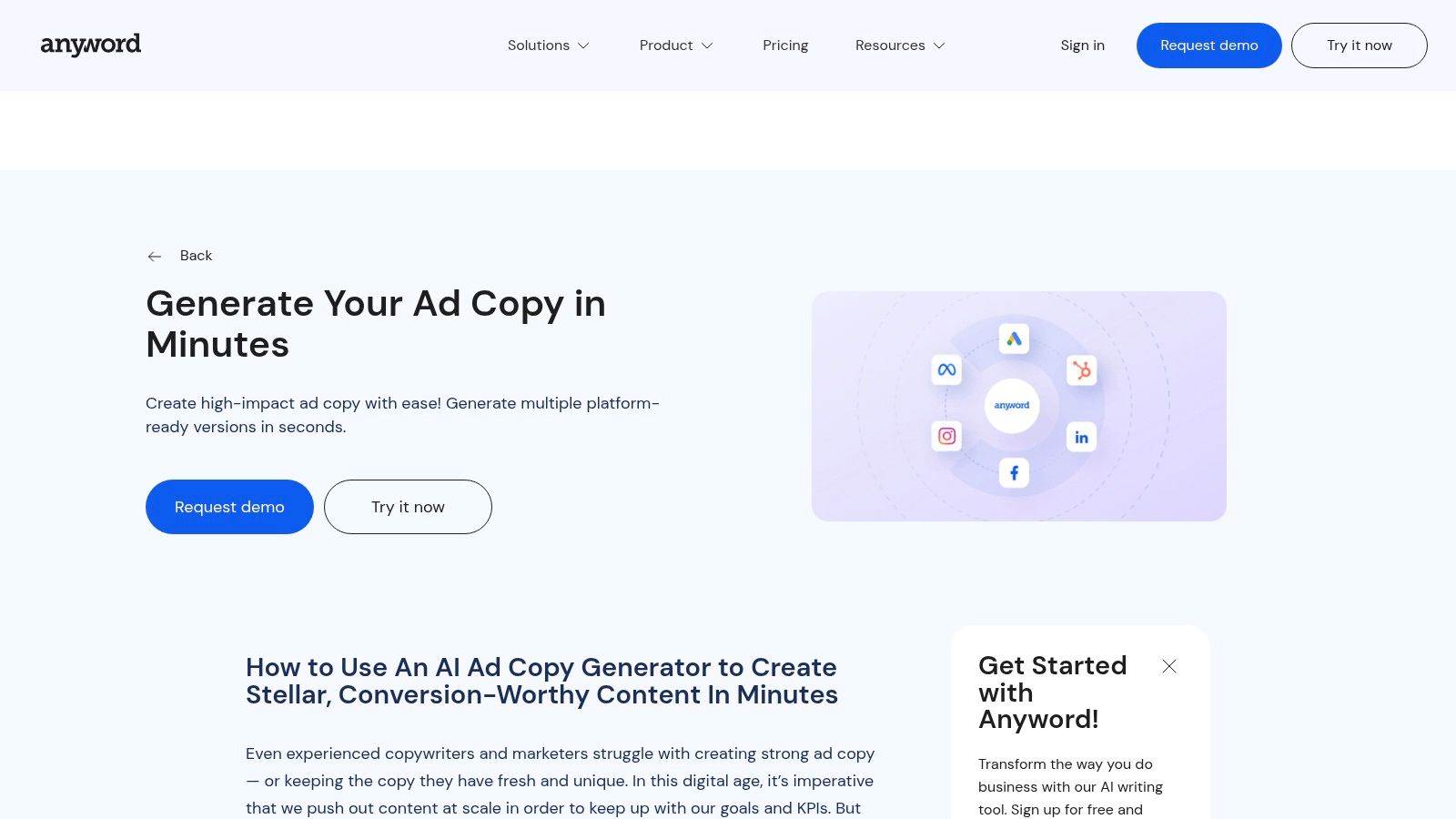
Anyword generates and improves ad copy, including headlines, and adds predictive copy scoring on eligible plans. The scoring is the differentiator. Rather than asking which of five lines you prefer, you get a ranking to argue with, and when your control is strong, arguing with it is the right instinct.
A predictive score is a model's estimate of relative performance, not a campaign result. Meta reports at ad level, so a per-variant score is often the only signal you'll have before spend.
Predictive scoring sits on top of the standard generate-and-edit workflow:
Put the score against a real baseline
WordStream reported an average Facebook traffic-campaign CTR of 1.71% in 2025, up from 1.57% in 2024 (Search Engine Land's Facebook ad cost coverage). That figure is what a predicted lift has to beat in your account, not in a demo. If your control already sits above it, a high-scoring variant needs to clear your own number before you move budget.
A seven-day trial is listed on the pricing page and ongoing use is a paid subscription. Features and pricing vary by plan and billing term, so confirm which tier includes scoring before you build a workflow on it.
10. Zuops Free Facebook Ad Copy Generator
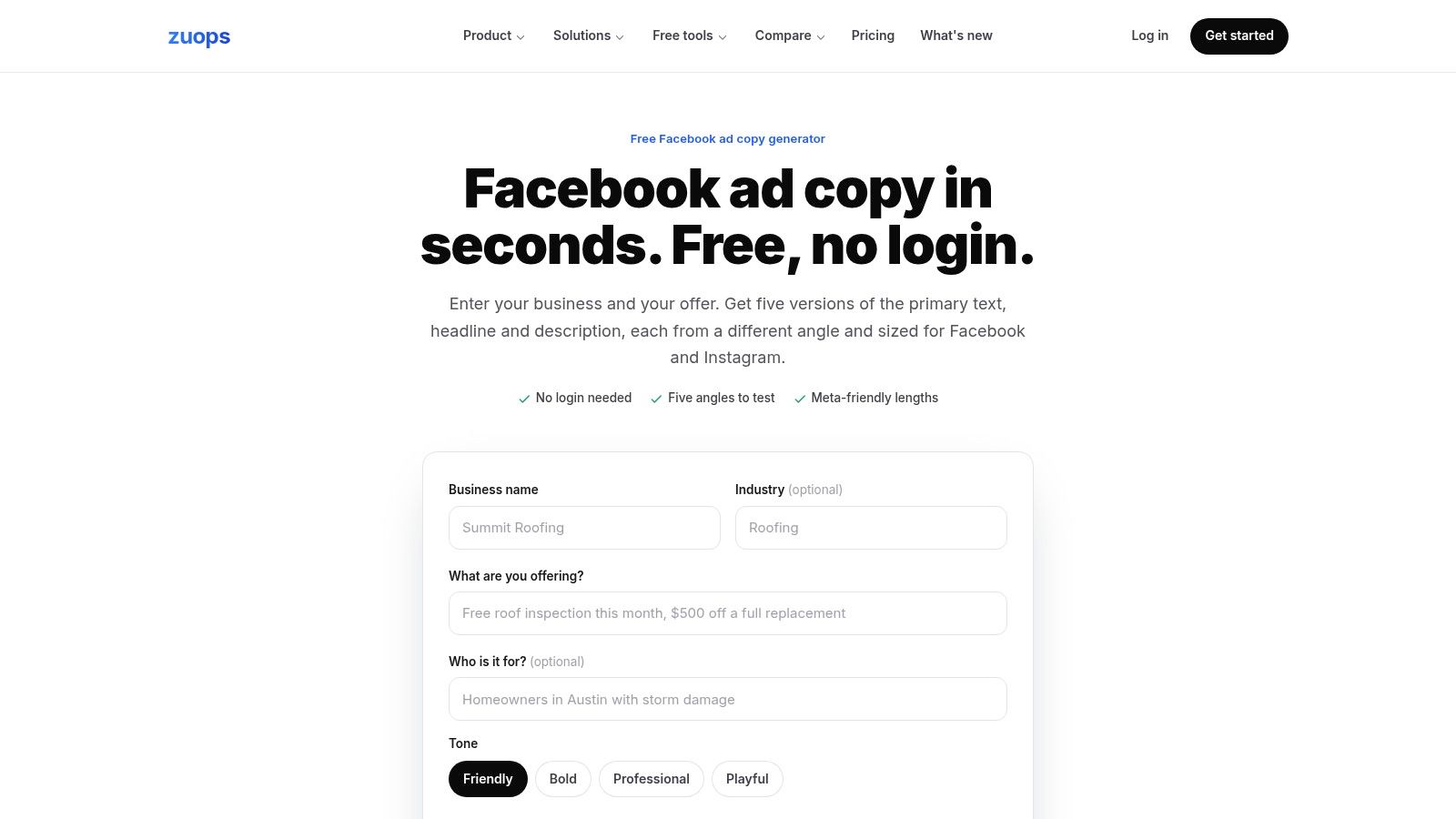
Zuops' free Facebook ad copy generator returns five versions of Facebook and Instagram ad copy, headlines and descriptions included, from inputs covering the business, the offer, the audience and the tone. Tone options run friendly, bold, professional and playful. No login required.
Five versions with a tone switch is a crude but workable way to force angle diversity. Run the same offer four times, once per tone, and you get twenty lines in different registers rather than twenty rewordings of the same claim.
Five versions per request, with tone selected before generation:
Five is Meta's own number
Meta's Advantage+ creative text generation can produce up to five variations of primary text and headline, and can use personas to build them, available in Ads Manager, Facebook Pages and Meta Business Suite (Meta text generation help). Support depends on ad format, placements and catalogue use.
That's the bar any generator should clear: enough variants to fill Meta's own multi-option slots, with each one carrying a different angle. If all five say "shop now" in different words, the ad still has one headline.
No ad account connection or publishing is described, so verify claims and character lengths by hand before anything goes live.
How the 10 Facebook ad headline generators compare on output, access and publishing
| Item | Output per Run | Free Access | Publishes to Ads | Best For |
|---|---|---|---|---|
| Clickem Facebook Ad Headline Generator | Headlines, primary text, and descriptions | Free, no signup | No publishing described | Quickly drafting and previewing Meta ad copy |
| Made to Spark Facebook Ad Copy Generator | Three variations with primary text, headline, and description | Not specified | No | Comparing complete drafts across campaign goals |
| HookAds Facebook Ad Headline Generator | Eight headline options | Free, no login | No publishing described | Generating short headline ideas |
| HubSpot Campaign Assistant | Facebook ad copy and other marketing content | Advertised as free; HubSpot account required | No publishing described | HubSpot users creating ad and campaign content |
| WRITER Facebook Ads AI Agent | Complete Facebook ad copy, including headlines | Limited free uses | No publishing described | Trying occasional full-ad drafts |
| AICreate AI Ad Copy Generator | Three variations with headline, description, and CTA | Free access advertised; no signup | No publishing described | Creating ad copy across multiple platforms |
| AdFlint AI Ad Generator | Google and Meta ads with a Meta preview | Free, no account advertised | No publishing described | Drafting ads from a URL or short business description |
| Jasper Social Media Ad Agent | Meta headlines, primary text, and descriptions | Not specified | No publishing described | Teams producing brand-consistent ad copy at scale |
| Anyword Ad Copy Generator | Ad copy and headline variations | Seven-day trial listed; ongoing use is paid | No publishing described | Refining and comparing copy with predictive scoring |
| Zuops Free Facebook Ad Copy Generator | Five ad-copy versions with headlines and descriptions | Free access advertised; no login | No | Quickly comparing Facebook and Instagram ad angles |
Choosing a Generator Based on What Happens After the Draft
Match the tool to the bottleneck. Occasional headline ideas call for a free drafter, briefs spanning Google and Meta call for a multi-platform generator, and copy at volume across accounts calls for a brand-voice agent with audience inputs. None of those differences matters as much as what happens in the ten minutes after the draft lands.
Then run the checks the tools don't run for you. Test every headline against the length each placement allows, not the general recommendation. Change one element at a time, keep the offer, creative, audience and landing page frozen, and label the angle on each variant so a winner means something when results arrive.
Retest sooner than feels comfortable. Vaizle's benchmark dataset put Facebook advertising CTR at 3.492% in 2025, up from 2.734% in 2024, a 27.74% year-over-year increase (Vaizle's Facebook ad benchmarks). A market that moves that far in twelve months turns last quarter's winning headline into a hypothesis, not a control.
The handoff is where the hours go
Bulk launch is the step that eats the day. Once the shortlist is ready, Rapid Ads publishes large creative sets to Meta in a single pass, enforces naming conventions at ad set and ad level, and keeps Advantage+ creative enhancements disabled so tested copy runs exactly as written. It's an Official Meta marketing partner, and in one comparison 100 creatives took 1h 57m by hand against 8m 39s through the platform. Rapid Lite starts at £14, $19 or €19 per month with up to 50 creatives per billing period.
That matters to a headline test more than to any other launch. Results stay readable only if ad sets are named consistently across accounts and an unreviewed enhancement doesn't rewrite the line you tested.
Rule of thumb: when a tool's output has to be retyped before it reaches Ads Manager, it isn't saving time. It's relocating the work.
Judge each generator on three questions, and you'll pick correctly. Does it respect the placement limits? Does it give you enough different variants to fill an ad's multi-option slots? Does the output survive the trip into the account without being re-keyed or edited? A tool that fails the third question costs more than it saves, however good the writing.
Pick one generator, one character counter and one naming convention, and run the full loop on ten headlines before you add an eleventh tool.
Rapid Ads is built for the step after the copy exists: drag in your headlines and creatives, group them into ad sets in seconds, and publish hundreds of ads to Meta in a single click, with naming conventions applied and Advantage+ creative enhancements held off. You can start on the forever-free plan with 10 uploads and no credit card, or move to a paid plan from $39, £29 or €34 per month. Visit Rapid Ads to launch your next headline test without re-keying a single line.