Most advice about the performance review process starts with cadence. Replace annual reviews with quarterly check-ins, the argument goes, and the system will improve. That advice is incomplete. Frequency can expose problems sooner, but it can't make an inconsistent manager fair, specific, or capable of following through.
The failure is usually managerial execution. One manager documents evidence throughout the year, another relies on memory, and a third avoids difficult ratings by marking everyone as strong. The company has one process on paper, yet employees experience several different systems.
That distinction matters because formal reviews remain widespread. A 2021 XpertHR survey of 344 US employers found that 63% conducted formal reviews once a year, while later benchmark data reported that 93.6% of organisations used a formal review process and 56.3% ran it annually. The benchmark figures are compiled by Bragbook. The review hasn't disappeared. It has become harder to defend when managers run it differently.
A workable system needs five connected stages: goals, evidence collection, rating, calibration, and development. Treat those as an operating cycle, not an HR form, and manager capability becomes the central design constraint.
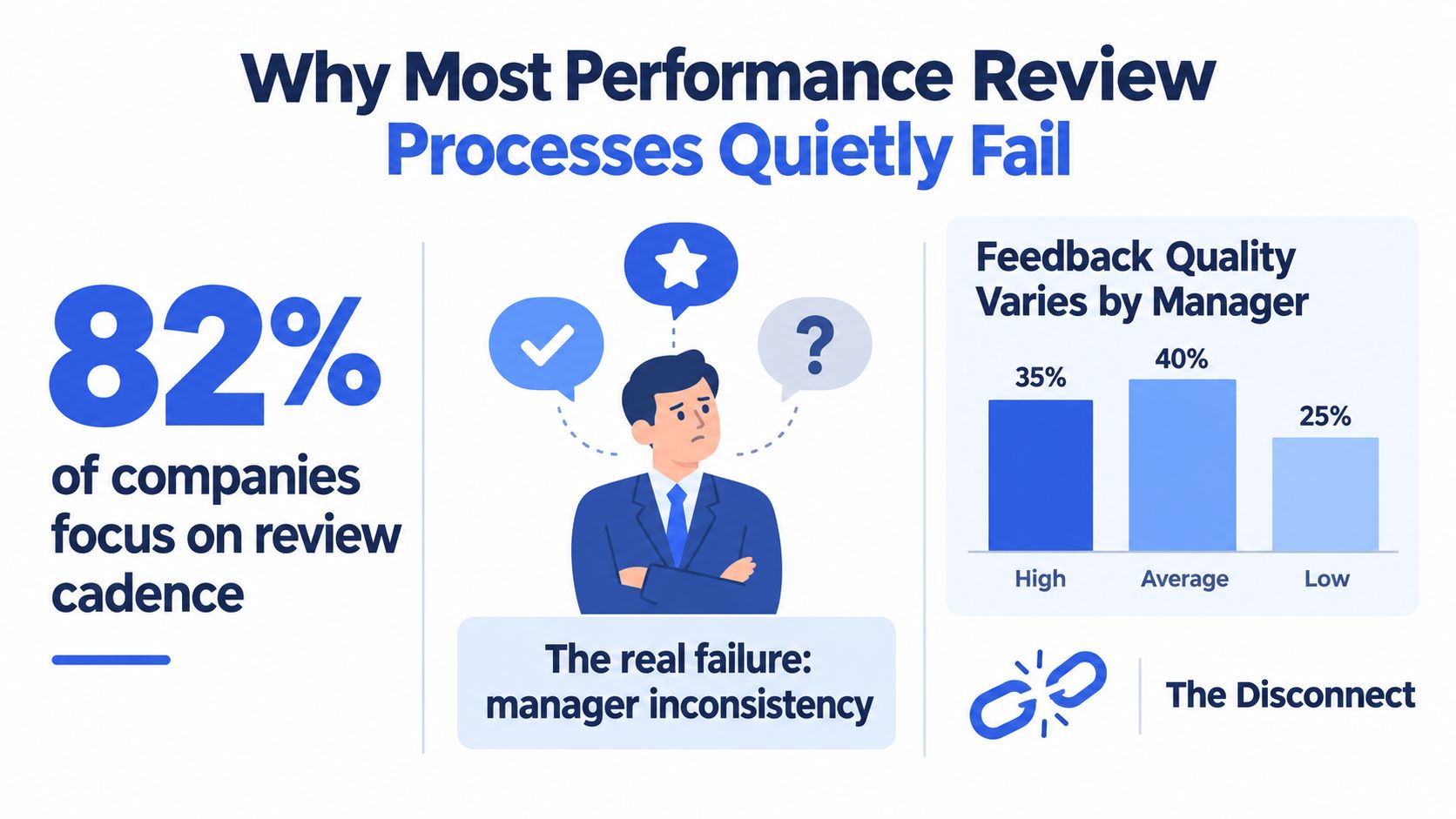
Table of Contents
- Why Most Performance Review Processes Quietly Fail
- Setting Goals That Make Reviews Worth Having
- Choosing the Right Review Cadence for Your Team
- Picking a Rating Scale That Survives Contact With Reality
- Running Calibration Sessions Without Political Theater
- Delivering Feedback That Employees Actually Act On
- Closing the Loop With Development Plans and Metrics
Why Most Performance Review Processes Quietly Fail
Annual rankings are not the main problem. Inconsistent manager execution is. A quarterly meeting cannot make vague feedback specific, memory-based evidence reliable, or an avoided rating fair.
The historical case against annual rankings remains strong. SHRM reported in 2015 that 6% of Fortune 500 companies had eliminated rankings, while CEB research found that more than 9 in 10 managers were dissatisfied with annual reviews and almost 9 in 10 HR leaders said the process didn't produce accurate information. Managers spent an average of 210 hours per year on performance management activities, and employees spent 40 hours each, according to SHRM's account of the research.
Changing the cadence does not repair the operating defect. One manager records evidence throughout the year, another relies on recent events, and a third gives everyone a strong rating to avoid conflict. The organisation has one process on paper, while employees experience several different systems.
Cornell's 2025 current-state report on performance management identifies unclear and untimely feedback, weak alignment with organisational goals, fragmented initiatives, and inconsistent manager capability as core problems. It reports that only 1 in 5 employees feel motivated by their company's system.
Five failure patterns to remove
- Goal drift: The employee is judged against priorities that changed without a documented reset.
- Memory-led evidence: A recent launch, incident, or difficult conversation displaces the rest of the review period.
- Rating inflation: Managers overrate people to avoid discomfort, preserve relationships, or protect their own reputation.
- Calibration theatre: Leaders discuss ratings without correcting inconsistent decisions or recording the reasons.
- Development evaporation: The meeting ends with good intentions, then the plan disappears from the manager's agenda.
The consequences are measurable. Research cited by Evalflow's review-statistics analysis found that only 14% of employees strongly agreed that reviews inspired improvement, 29% strongly agreed they were fair, and 26% strongly agreed they were accurate. Reported appraisal mistakes included failing to follow up on progress at 40.1%, overrating to avoid discomfort at 40.0%, and recency bias at 38.9%.
Operating rule: Shorter reviews help only when managers use shared evidence, common anchors, and scheduled follow-through.
Build the process around controls, not forms. Goals define the agreement. Evidence records what happened. Ratings convert evidence into judgement. Calibration tests that judgement against peers and standards. Development turns the decision into action. Cadence matters after those controls are in place.
Setting Goals That Make Reviews Worth Having
A review becomes defensible when the manager and employee can point to an agreed goal, the result, and the behaviour that produced it. Without that chain, the rating becomes a narrative contest.
Use three layers together:
- Outcome format: OKRs or SMART goals describe what must change, by when, and under what constraints.
- Role contribution: The goal cascade connects company priorities to team outcomes and individual ownership.
- Competency anchor: Behavioural expectations explain how the work should be delivered, especially where the outcome depends on collaboration, judgement, or leadership.
Keep the individual list to three to five meaningful goals. More than that usually creates a task inventory rather than a priority set. Company goals should flow into team goals, then into individual commitments. A manager should be able to explain the connection in one sentence.
Examples by role
An individual contributor engineer might own an objective to reduce system p99 latency, with quarterly milestones for diagnosis, implementation, monitoring, and validation. The competency anchor could require clear technical documentation and constructive incident participation.
A people manager needs a balanced set rather than a single hiring target. The plan might combine team retention, hiring velocity, and skip-level engagement feedback, while the competency anchor covers coaching quality and decision transparency.
A cross-functional product marketer could combine launch adoption with partnership-sourced pipeline. The outcome measures business movement, while the competency anchor assesses how effectively the marketer coordinates product, sales, creative, and external partners.
Check goals during regular one-to-ones. The purpose isn't to demand unchanged plans when the business has moved. It's to document the change, name the trade-off, and preserve a fair basis for the eventual rating.
Rewrite the goal before it reaches the review
Weak goal: “Improve campaign performance and support the team.”
Defensible goal: “Own the next product launch, document the testing plan, align channel owners before launch, and report adoption and partnership-sourced pipeline at the agreed review points.”
The second version still requires judgement, but it creates observable evidence. You can inspect whether the plan existed, whether alignment happened, whether reporting was timely, and whether the role delivered the agreed outcomes.
| Goal Formats Compared by Role | OKR Format | SMART Format | Competency Anchor |
|---|---|---|---|
| Engineer | Reduce p99 latency through defined technical milestones | Complete the agreed performance work by the review date | Documents decisions and supports incident learning |
| People manager | Improve team health while delivering hiring priorities | Complete hiring and team commitments within agreed constraints | Coaches consistently and communicates decisions clearly |
| Product marketer | Increase launch adoption and partnership-sourced pipeline | Deliver the launch plan and reporting by agreed dates | Builds effective cross-functional alignment |
Choosing the Right Review Cadence for Your Team
Annual reviews are efficient per touch and weak as a record of a full year. They invite memory errors, hide scope changes, and make the final conversation carry too much weight. Continuous feedback can improve freshness, but it demands documentation discipline that many managers don't maintain.
The practical answer is a hybrid: lightweight quarterly check-ins, semiannual calibration windows, and a documented annual summary. The quarterly meeting resets goals, reviews evidence, and identifies a development action. The calibration window tests consistency across managers. The annual summary consolidates the record instead of reconstructing it from memory.
A 50-person team illustrates the trade-off without pretending that every company uses identical meeting lengths. If each person receives four lightweight check-ins, the team creates 200 employee-manager conversations before the annual summary. Twice-yearly reviews create 100 formal conversations. An annual-only model creates 50 formal conversations, but it pushes more preparation, evidence recovery, and conflict into each event. The workload is therefore not just the number of meetings. It includes preparation, writing, calibration, appeals, and follow-through.
| Review Cadence Comparison | Cost (manager hrs/yr) | Signal Quality | Employee Sentiment |
|---|---|---|---|
| Annual | Lowest touch frequency, highest concentration of preparation | Weak freshness, vulnerable to recency bias | Often anxious and surprised |
| Semiannual | Moderate recurring effort | Better evidence continuity | Clearer expectations and fewer surprises |
| Quarterly | Higher manager capacity requirement | Stronger scope and progress visibility | Useful when conversations stay lightweight |
| Continuous | Tooling and documentation effort shifts throughout the year | Potentially strong if managers record useful evidence | Depends heavily on feedback quality |
A 12-day median review cycle in Lattice's benchmark data shows the value of tight ownership. Feedback collection took 1 to 2 weeks, release took about 4 days, and e-signature collection added 5 to 6 days, with a median completion rate of 89%. Lattice's benchmark explains the staged workflow.
Small teams can run quarterly reviews without forced machinery. Larger teams need stronger templates, manager training, and calibration ownership. High-growth and customer-facing teams should usually choose semiannual formal decisions even when quarterly conversations are added, because a wrong calibration affects hiring, promotion, account continuity, and team trust for longer than the meeting itself.
Picking a Rating Scale That Survives Contact With Reality
A rating scale fails when it creates false precision or gives managers an escape route. Numeric scales look objective, but a number without a behavioural anchor tells the employee very little. Narrative-only reviews feel humane until compensation, promotion, or performance concerns require a comparable decision.
Four common designs
Numeric scales are easy to report. A five-point scale compresses nuance, while a ten-point scale encourages managers to debate tiny distinctions that the evidence can't support. Use numbers only when every point has a written definition and examples.
Forced distributions can expose grade inflation in a large organisation, but they also encourage political behaviour when managers must place people into predetermined slots. They should never force a low rating when the team has delivered strong work.
Competency rubrics produce better conversations because they connect judgement to observable behaviours. They require more design work at the start, but they give calibration something concrete to test.
No-rating narratives can encourage richer feedback, yet they create confusion when the organisation must make compensation or promotion decisions. Removing the label doesn't remove the judgement. It often moves the ambiguity into a manager's prose.
| Rating Scale Comparison | Signal Quality | Fairness Risk | Admin Cost | Best For |
|---|---|---|---|---|
| Numeric | Moderate when anchored | False precision and inconsistent interpretation | Low to moderate | Teams with mature definitions |
| Forced distribution | Useful for detecting inflation | Political placement and unhealthy competition | Moderate | Large organisations with safeguards |
| Competency rubric | High when behaviours are specific | Anchors can become outdated | Moderate upfront | Most teams |
| Narrative only | Rich context, weak comparability | Unclear decisions and manager variance | High at decision time | Development conversations without formal decisions |
My default is a four-level competency scale:
- Does not meet: Misses core expectations and needs an immediate corrective plan.
- Partially meets: Delivers unevenly and requires focused support.
- Meets: Reliably delivers the role's expected outcomes and behaviours.
- Exceeds: Delivers beyond scope, raises the standard, or mentors others while sustaining core performance.
Small teams under 15 should avoid forced distributions. Organisations with 100 or more people can use light distribution guidance to spot inflation, but the rubric must remain more important than the curve. A rating should survive review by someone who wasn't in the room. If it can't, the scale is decoration.
Running Calibration Sessions Without Political Theater
Calibration isn't a negotiation between managers with the strongest personalities. It's an evidence review against a shared rubric. The facilitator should defend the standard, not the manager or employee.
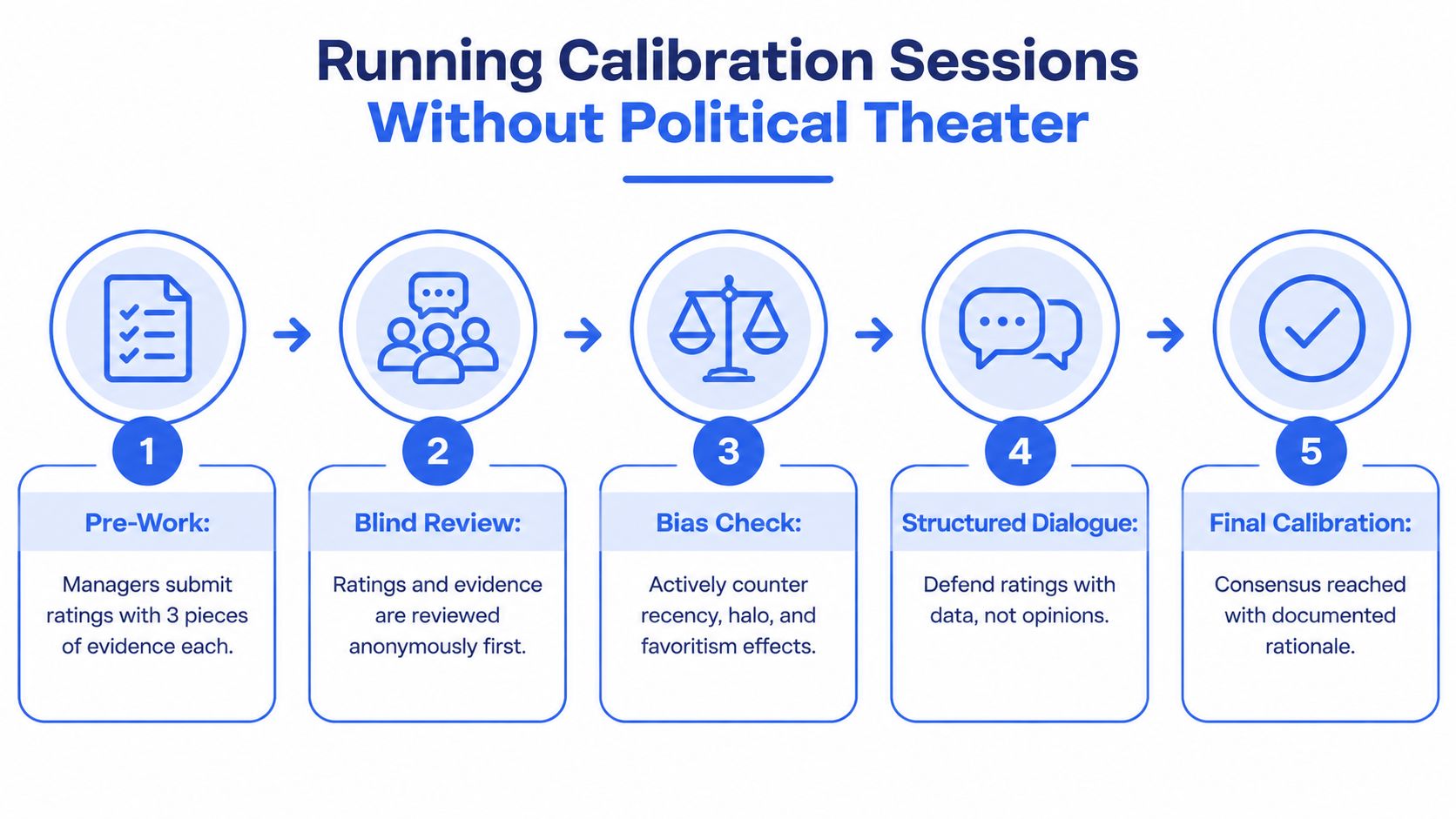
A five-step operating sequence
1. Prepare the record. Each manager submits the proposed rating with three pieces of evidence per score. Submit the material 48 hours before the session so the anchors exist before discussion. Evidence should cover outcomes, behaviours, and the context that affected the work.
2. Check the distribution. Review the proposed pattern before opening debate. If 80% of the team lands in the top box, pause and test whether managers applied the definition consistently. That doesn't mean the distribution must change. It means the evidence must justify the concentration.
3. Run the manager discussion. Start with the strongest and weakest cases, then use them to test the middle. Ask the same questions each time: What was the agreed goal? What evidence covers the whole period? Which competency anchor supports this rating? What changed after feedback?
4. Record adjustments. Change a score only with a documented rationale. “The group felt differently” isn't a rationale. Write the evidence or rubric interpretation that caused the change, and identify who owns the update.
5. Send the summary. Return a concise post-calibration record to skip-level leaders. It should show adjustments, unresolved questions, and any manager capability issue that needs coaching before the next cycle.
Bias controls must be procedural
Recency bias is reduced by dated evidence, not by reminding managers to “be objective.” Halo effects are challenged by separating outcomes from behaviours. Favouritism is exposed when managers must defend comparable cases using the same anchors.
Calibration earns trust when the organisation can explain both the decision and the rule that produced it.
Use an anonymous first pass where practical, then disclose manager context for the structured discussion. The Meta Ads Manager calibration workflow is a useful visual reminder that a process works only when each step has a defined owner and decision rule.
Delivering Feedback That Employees Actually Act On
A manager can have the correct rating and still deliver a useless review. The failure usually happens when the conversation stops at what happened and never reaches what changes next.
Consider a product marketer whose launch delivery was strong but whose cross-functional follow-through was inconsistent. The manager shouldn't begin with a verdict.
A practical conversation script
Manager: “Start with your self-assessment. Which outcomes best represent your work, and where did your approach fall short?”
Employee: “The launch shipped on time and adoption reporting was clear. I struggled to keep the partner team aligned after the initial launch meeting.”
Manager: “I agree that the overall rating is Meets. The launch outcome was solid, but the evidence shows a recurring coordination gap.”
Manager: “On the launch project, you delivered the agreed adoption report on the review date. In the following planning cycle, the partner owner missed two handoffs because the dependencies weren't confirmed in writing. The result was avoidable rework for product and sales.”
Manager: “The next change is to make cross-functional ownership visible before work starts, then follow up against that record rather than relying on meeting agreement.”
That sequence contains a rating, context, specific evidence, behaviour, and impact. It doesn't soften the message with vague praise, and it doesn't turn one missed handoff into a character judgement.
Convert the conversation while both people are present
Manager: “Let's turn that into a development plan. Choose one skill to build, one project to lead, and one outcome we'll revisit in 90 days.”
The employee might choose stakeholder planning, lead the next partner launch, and measure whether every dependency has a named owner and written follow-up. The manager commits to reviewing the plan in one-to-ones, not merely asking about it at the next review.
Feedback theatre produces an emotional meeting with no durable artefact. Close every review with a written summary covering the rating, evidence, agreed changes, support required, and next checkpoint. The employee signs to confirm receipt and can add a response. That makes accountability bilateral rather than an HR chase at year-end.
Closing the Loop With Development Plans and Metrics
A review has failed if nothing changes after the conversation. The development plan should sit beside the rating, not beneath it as an optional paragraph.
Use three horizons:
- 30-day quick wins: One behaviour to practise, one manager support action, and one visible deliverable.
- 90-day skill build: One skill, one project where the employee can apply it, and one outcome that shows progress.
- 6-month career move: A broader responsibility, capability gap, or exposure opportunity connected to the next role.
The manager owns the conditions. The employee owns the preparation and action. HR owns the system integrity, including whether managers complete the work rather than merely submit forms.
| Development Plan Template and Review Process Metrics | What to Capture | Owner | Cadence |
|---|---|---|---|
| 30-day action | Behaviour, support, deliverable | Employee and manager | Monthly |
| 90-day skill build | Skill, project, outcome | Employee and manager | Quarterly |
| 6-month career move | Experience needed for progression | Manager and employee | Semiannual |
| Review completion | Submitted, discussed, signed status | HR or People Operations | Each cycle |
| Calibrated distribution | Ratings before and after calibration, with rationale | HRBP and leadership | Semiannual |
| Feedback logged | Dated evidence tied to goals or competencies | Manager | Ongoing |
| Goals updated | Scope changes and trade-offs | Manager and employee | Quarterly |
| One-to-one frequency | Whether planned conversations occurred | Manager | Monthly |
| People outcomes | Pulse movement, promotion, and attrition by rating band | HRBP | Quarterly |
Read the metrics together. A high completion rate means paperwork moved, not that feedback improved. A perfectly symmetric bell curve after calibration may show that managers capitulated to a shape rather than applied evidence. Promotion and attrition by rating band can reveal whether ratings predict decisions, but they can't explain the cause without qualitative review.
The three leading indicators deserve the most attention: feedback logged, goals updated, and one-to-one frequency. They predict whether the annual summary has enough evidence to be useful. Review them quarterly with the HRBP, then coach managers whose records are thin before the next formal cycle.
For performance marketers and agency owners, the same discipline applies to campaign reviews. A manager reviewing Meta Ads output should define the KPI hierarchy, preserve naming conventions, validate tracking inputs, and use one extraction workflow before judging the operator's performance. Rapid Ads can support that operational record by bulk uploading creatives, enforcing ad and ad set naming conventions, auto-disabling unwanted Advantage+ Creative enhancements, and managing multiple ad accounts from one dashboard. The tool doesn't replace judgement. It makes the evidence trail less dependent on manual Ads Manager work.
The rebuild is complete only when a manager can answer three questions without improvising: what was agreed, what evidence exists, and what will happen next. If your team can't answer those questions, change the operating controls before changing the cadence.
Audit your current review cycle against the five stages, then give managers a shared evidence template and a scheduled calibration window before the next rating round. For the same evidence-first discipline in Meta Ads operations, visit Rapid Ads to bulk upload campaigns, enforce naming conventions, manage multiple accounts, and keep Advantage+ Creative settings from drifting during launches.
