The popular advice around a Meta credit card is usually wrong for serious advertisers. The first question shouldn't be which card earns the best rewards. It should be whether Meta will still accept that card when your account reaches the spend profile that matters to your business.
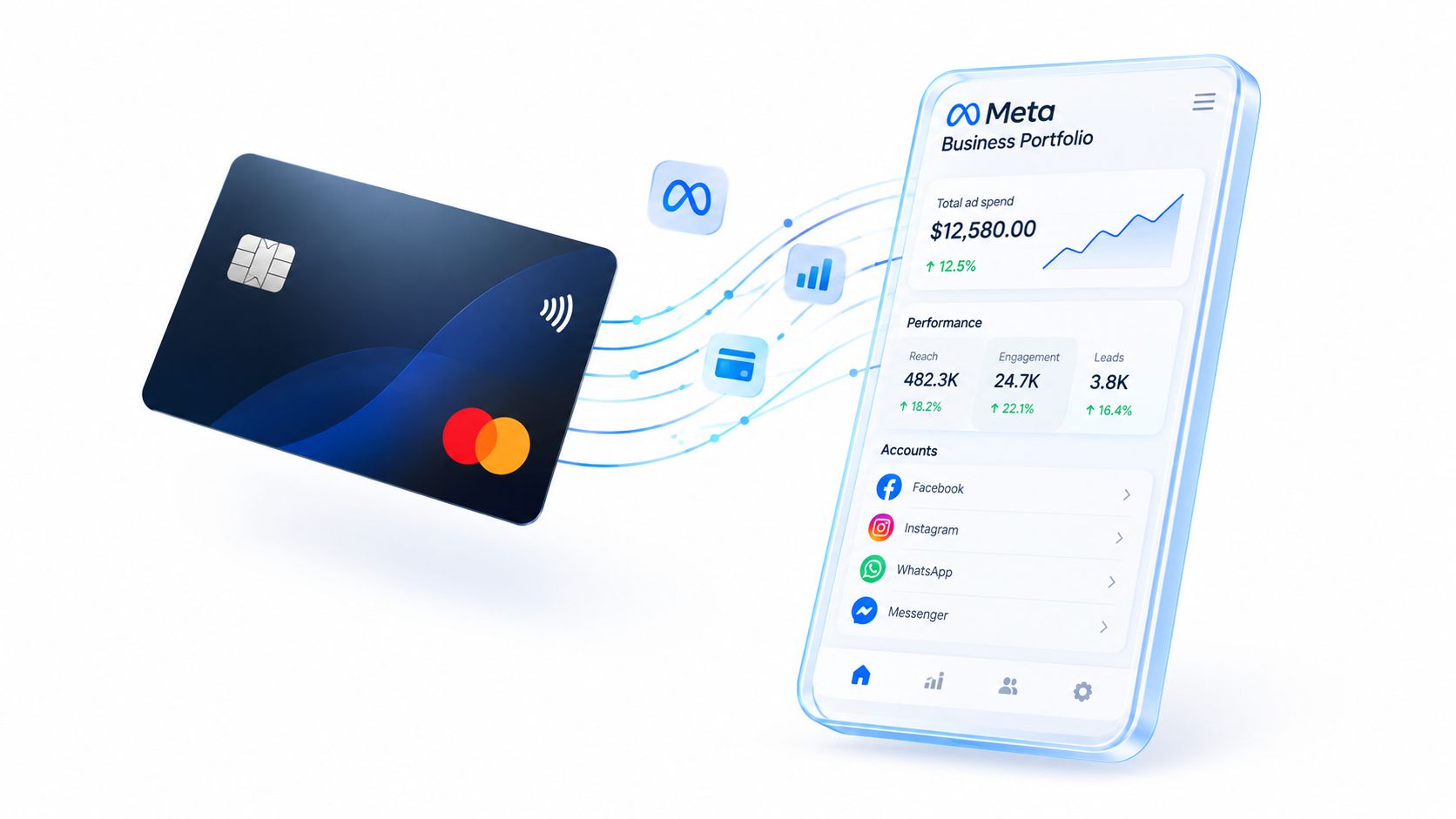
For performance marketers, “Meta credit card” usually means a card attached to an ad account in Billing & payments, not a universally available Meta-branded consumer product. That distinction has become operationally important. Independent reporting says some advertisers were notified in February 2026 that card payments would be removed, with a move to monthly invoicing or direct debit required by March 31, 2026, and ads pausing from April 1, 2026 if the change wasn't completed. The exact eligibility rule and spending threshold haven't been publicly disclosed, so treating card billing as permanent creates avoidable continuity risk. Melio's analysis of Meta ad billing changes documents the account-dependent shift.
A rewards calculation matters only after delivery continuity is secure. If a payment method fails, Meta doesn't care that the card worked for ordinary ecommerce purchases. The account needs an approved funding route, sufficient authorization headroom, and a fallback that has already been tested.
The practical audit is therefore straightforward. Identify what “Meta credit card” means in your account, understand threshold and prepaid mechanics, map the failure workflow, compare card billing with invoicing and direct debit, then build a fallback before a payment-policy notice becomes a delivery incident.
Table of Contents
- Introduction Why Meta Credit Card Means Something Different in 2026
- What a Meta Credit Card Actually Refers To Today
- How Meta Billing Really Works Thresholds Prepaid Limits and Timing
- When Card Payments Fail and How to Keep Ads Serving
- Card Versus Invoicing Versus Direct Debit for Meta Ads
- Privacy Ads Targeting and Creative Control Implications
- Choosing Your Meta Payment Setup and Staying Future Proof
Introduction Why Meta Credit Card Means Something Different in 2026
The stable-rewards assumption fails because Meta's payment infrastructure is no longer a simple card-at-checkout arrangement. Meta's own documentation describes account-level controls around prepaid funding, while independent reporting indicates that some higher-spend advertisers are being moved away from card payments. The result is a funding system where account history, payment reliability, eligibility, and billing configuration can matter as much as the card itself. Meta's prepaid funding documentation explains that daily top-up and stored balance limits are based on advertising and payment history.
That changes the risk calculation for a buyer running Sales campaigns through CBO, an agency managing several Business Portfolios, or an ecommerce team using cards to smooth the gap between acquisition spend and incoming revenue. Rewards are incremental value. A paused account can interrupt learning, delay launches, break promotional timing, and create manual recovery work across campaigns and ad sets.
The question buyers should ask first
Don't start with “Which card should I use for Meta Ads?” Start with:
Will this ad account still be eligible for card billing, and what will serve as the fallback if it isn't?
Meta began notifying some advertisers in February 2026, according to multiple independent reports, and the transition was reported as moving affected accounts to monthly invoicing or direct debit by March 31, 2026. Those reports also state that Meta hasn't published a complete eligibility rule or exact spending threshold. AdAmigo's account-transition guide highlights that uncertainty.
That uncertainty is itself a signal. A mature account shouldn't depend on an undocumented ceiling. It should maintain a known payment path, an alternate method, and an internal escalation process for notices inside Ads Manager or email.
The rest of the analysis treats the card as one component in a payment stack. The relevant outcome isn't points earned per transaction. It's uninterrupted authorization when Meta's threshold billing, prepaid controls, or account eligibility changes.
What a Meta Credit Card Actually Refers To Today
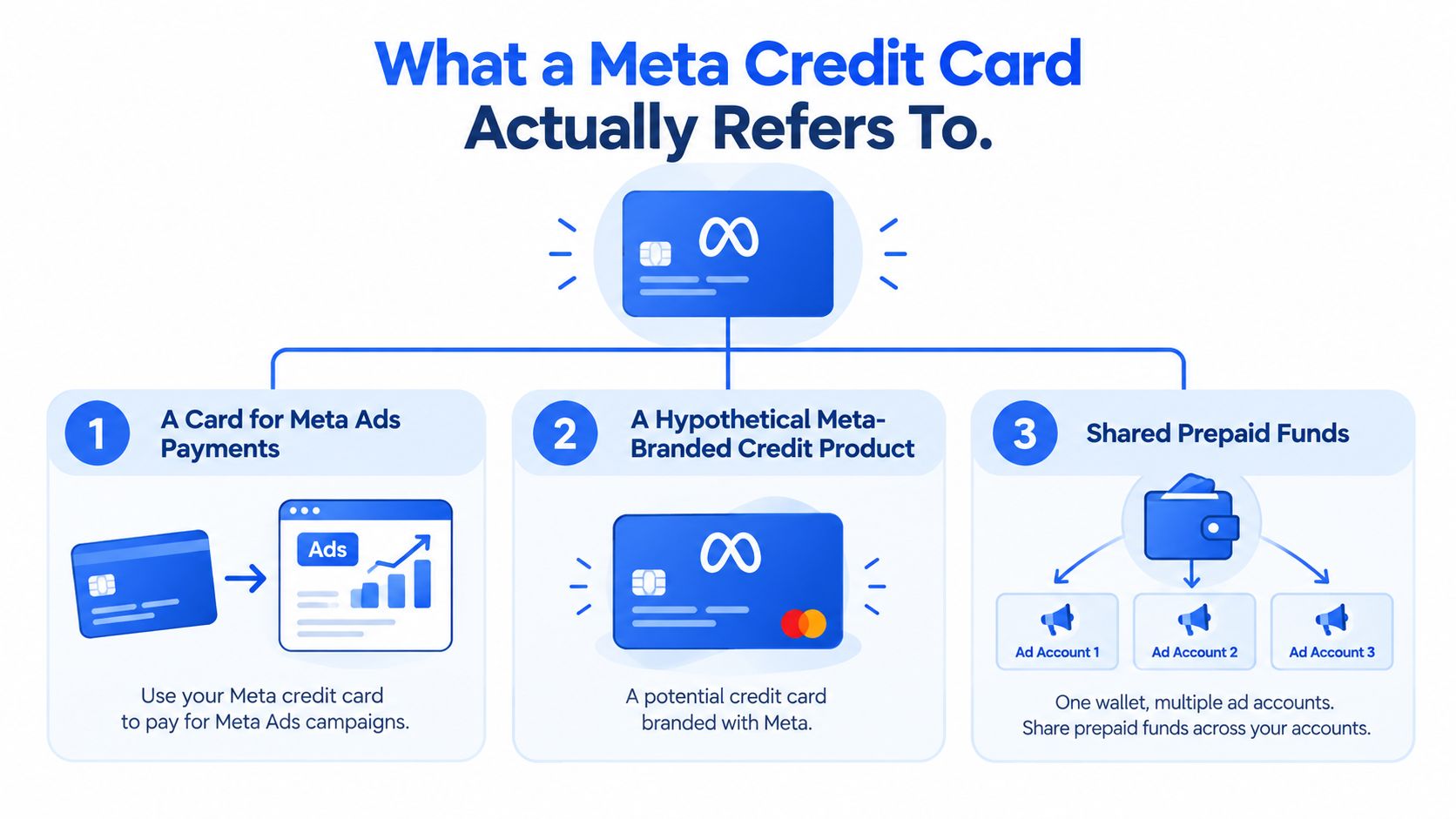
The phrase Meta credit card carries three different meanings, and confusing them leads to poor account decisions.
The first is ordinary: a business or personal credit card saved as the payment method for Meta Ads. In Ads Manager, this is the instrument used to settle accumulated advertising charges. The second is a hypothetical Meta-branded credit product, which isn't the operational definition most media buyers need when they search the term. The third is Meta's funding infrastructure, including Shared Prepaid Funds, where organizations can use debit or credit cards to fund advertising across eligible ad accounts. Meta's business payment documentation describes Shared Prepaid Funds and the reported 2026 restriction on card payments for some advertising accounts.
Card versus funding infrastructure
A useful model is fuel card versus fuel tank.
The card is the payment instrument. It supplies authorization and, where permitted, may provide rewards or short-term cash-flow flexibility. The prepaid balance or Shared Prepaid Funds arrangement is the tank. It determines how much money can be stored, how much can be added, and which ad accounts can draw from that balance.
Meta's system separates those functions because payment risk isn't limited to whether a card number is valid. Meta also manages stored funds, top-up frequency, account history, and the reliability of previous payments. That separation explains why an approved card can still sit behind a capped prepaid balance or become unavailable to an account moved to another billing route.
For a media buyer, the operational definition is narrower: inspect the payment method attached to the relevant ad account under Billing & payments, then determine whether the account uses automatic threshold billing, prepaid funding, invoicing, or direct debit. Shared Prepaid Funds matters more for organizations funding several ad accounts than for a single test account, because a business-level payment choice can affect how money is distributed across the advertising structure.
Which interpretation applies to you
Use the first meaning if you're evaluating a card for ordinary campaign billing. Use the third if you're managing multiple ad accounts or a Business Portfolio with centralized funding. Treat the second meaning as a search-intent distraction unless Meta has explicitly offered your organization a specific financial product.
The key decision cue is simple: don't search for a “Meta card” as though it were a universal rewards product. Audit the payment method and funding model shown in your own Ads Manager account.
How Meta Billing Really Works Thresholds Prepaid Limits and Timing
Meta doesn't normally charge a card for every impression, click, or campaign action. Under threshold-based billing, advertising spend accumulates as unpaid balance until it reaches the current billing threshold or the monthly billing date arrives, whichever comes first. Advertisers can lower that threshold from the Billing & payments area in Ads Manager. Meta's billing-threshold guidance describes both the trigger and the control.
That creates a gap between delivery and authorization. A campaign can spend continuously while the card remains uncharged, then generate a single authorization event when the threshold is reached. A buyer planning only around daily budget can therefore miss the constraint, which is whether the card has enough available credit and whether the issuer will approve the accumulated charge when Meta submits it.
The two prepaid limits
Prepaid funding adds two separate controls:
- Daily top-up limit: the maximum amount Meta allows to be added to an ad account in a day.
- Stored balance limit: the maximum prepaid balance the account can hold at any time.
Meta says these limits are based on advertising and payment history. Once the daily top-up limit is reached, it resets at 00:00 in the ad account's time zone, according to Meta's prepaid-funds documentation linked earlier.
Those controls change how a scaler should think about funding. A card with ample issuer credit may still be unable to fund the account at the required pace if Meta's account-level top-up limit is lower. Conversely, a high stored-balance limit doesn't remove issuer risk, because the underlying card or bank account must still authorize the top-up.
Billing triggers and controls
| Mechanism | What It Controls | Where to Manage It |
|---|---|---|
| Billing threshold | When accumulated unpaid spend triggers a charge | Billing & payments in Ads Manager |
| Monthly billing date | A scheduled charge when the billing date arrives before the threshold is reached | Billing settings in Ads Manager |
| Daily top-up limit | How much prepaid funding can be added during the account day | Meta payment infrastructure and account eligibility |
| Stored balance limit | How much prepaid money can remain in the account | Meta payment infrastructure and account eligibility |
| Payment history | The account-level basis Meta uses for certain prepaid limits | Established through advertising and payment behavior |
Operational rule: A card limit isn't the same as a Meta funding limit. Track both, because either one can interrupt delivery.
For accounts scaling from hundreds of dollars per day to tens of thousands, the relevant audit isn't just “Can the card handle the spend?” It is “Can Meta release, accumulate, and collect that spend under this account's current limits and history?” The answer can change even when the card issuer hasn't changed anything.
When Card Payments Fail and How to Keep Ads Serving
A declined Meta payment is a delivery incident, not merely an accounting notification. Meta's documented recovery flow starts inside Billing and payments. Open the affected ad account's payment methods, select Pay now, retry the balance, and use another card if the charge continues to fail. Meta's payment-failure instructions describe that retry and alternate-card workflow.
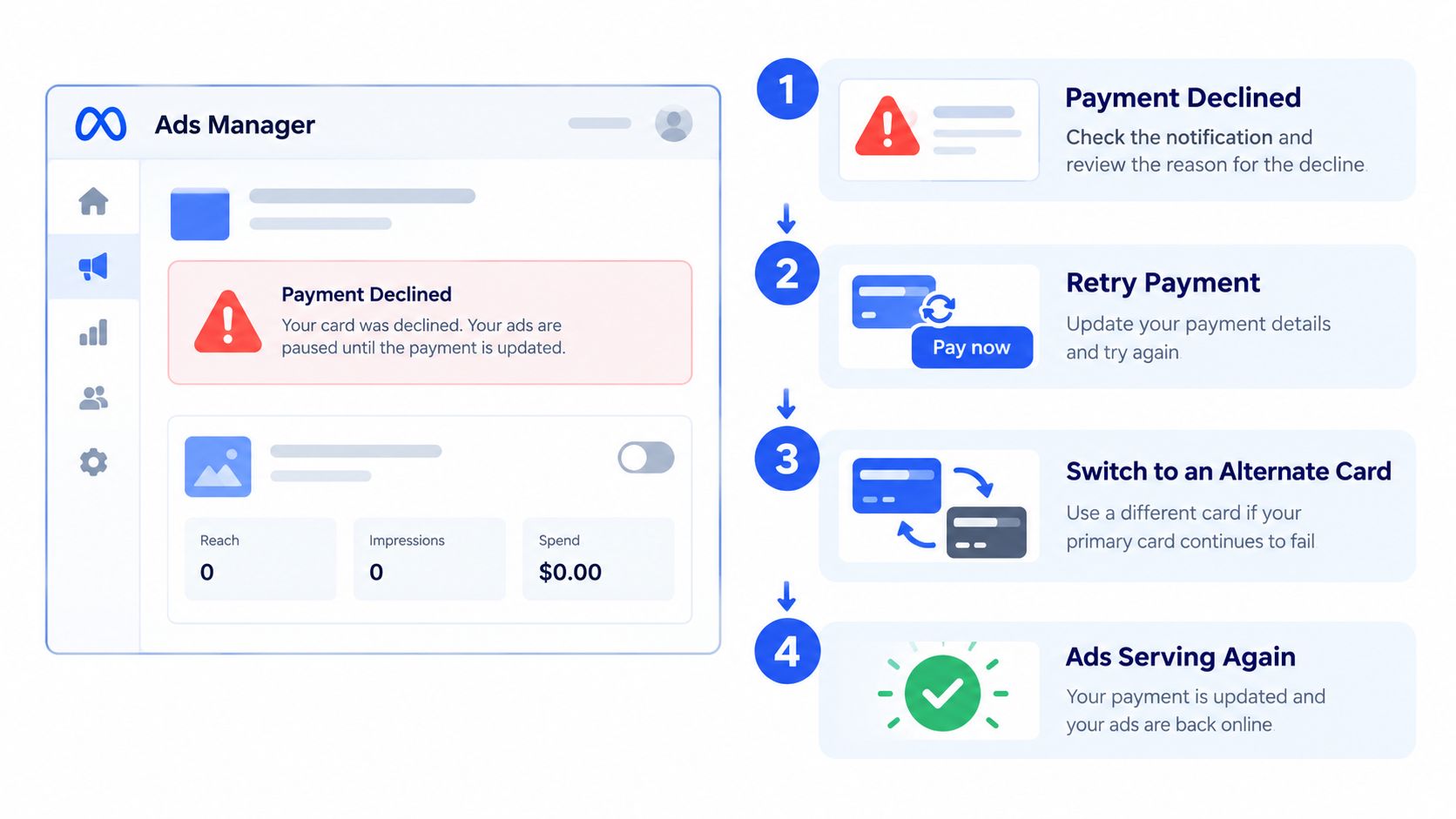
The sequence matters because repeatedly editing campaign budgets won't fix a blocked authorization. The unpaid balance needs to be settled first, and the replacement payment method must be acceptable to both Meta and the card issuer.
A rapid diagnosis workflow
Open Billing and payments. Confirm that the alert belongs to the correct ad account rather than another account in the same Business Portfolio.
Use Pay now. Retry the outstanding balance through the payment-method interface. A transient issuer response can clear without changing campaign structure.
Switch to an alternate card. If the retry fails, select a verified backup rather than waiting for the primary issuer to resolve the decline.
Check issuer controls. Ask the issuer to confirm online payments, recurring payments, card-not-present transactions, billing-address matching, and available credit. A card can work for normal ecommerce and still fail Meta's authorization pattern.
Recheck delivery. Confirm that the account has cleared its balance and that campaigns, ad sets, and ads are eligible to deliver before resuming scale.
The common mistake is adding a backup only after the primary card fails. A backup that has never been tested is a theory, not redundancy. It can carry an address mismatch, an unsupported currency arrangement, an internal card lock, or a limit that looks sufficient until Meta submits the accumulated balance.
The embedded walkthrough below provides a visual reference for the payment-recovery sequence.
What to monitor before a decline
Keep a payment log for each active ad account. Record the primary method, backup method, billing threshold, recent failed authorizations, account time zone, and the person authorized to approve a replacement payment.
For agencies, separate payment access from campaign access. A buyer may have permission to edit campaigns but not the corporate card or bank account needed to clear a balance. That permission gap can turn a fix measured in minutes into a support escalation.
Continuity test: Add the backup before you need it, validate its billing details, and document who can select it under Pay now.
Card Versus Invoicing Versus Direct Debit for Meta Ads
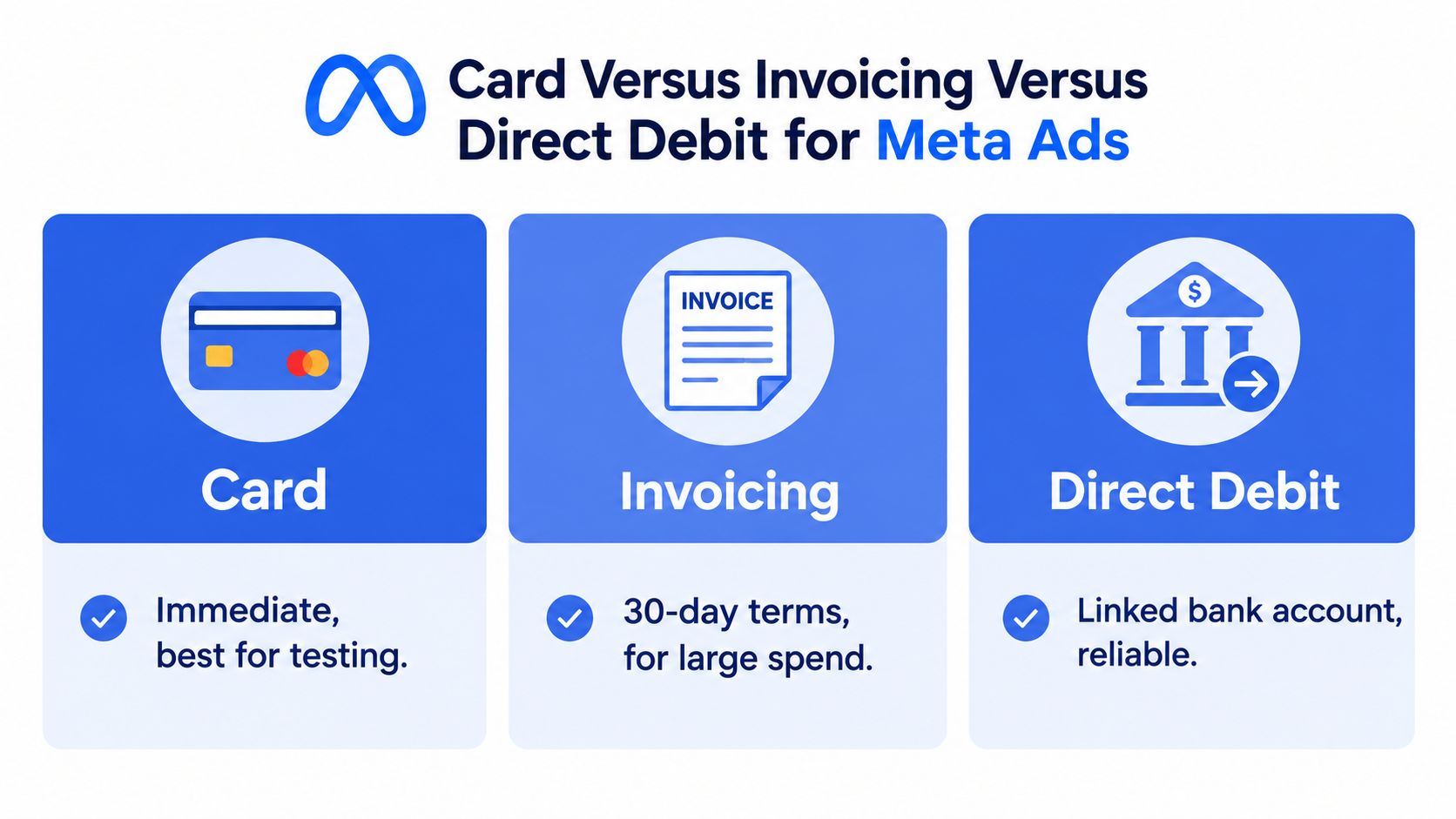
The three funding routes solve different problems. A card prioritizes speed and familiar authorization. Monthly invoicing prioritizes consolidated accounting and an approved credit arrangement. Direct debit prioritizes bank-account settlement, but it introduces its own setup and authorization requirements.
The correct choice depends less on preference than on account eligibility, entity structure, cash conversion, and tolerance for payment interruption. Meta's reported 2026 policy change makes that choice more urgent for some advertisers because affected accounts are being directed away from cards by March 31, 2026, with ads reported to pause from April 1, 2026 if the transition isn't completed. Payments Dive's reporting on Meta's policy change notes that Meta hasn't disclosed the exact spending threshold or full scope of affected accounts.
Side-by-side operating comparison
| Payment route | Approval friction | Launch speed | Main failure exposure | Cash-flow profile | Accounting profile |
|---|---|---|---|---|---|
| Credit card | Usually familiar, but account eligibility can change | Fast when accepted | Issuer declines, card limits, billing-detail mismatches, Meta restrictions | Flexible card settlement, subject to issuer terms | Transaction-level reconciliation and card statements |
| Monthly invoicing | Higher eligibility and business-verification friction | Slower to establish | Credit-limit exhaustion or late invoice settlement | Consolidated bill, less dependent on card float | Centralized invoice and purchase-order workflow |
| Direct debit | Requires bank-account setup and authorization | Depends on approval and verification | Bank rejection, mandate issues, insufficient funds | Drawn from linked bank account | Cleaner bank-led settlement, but requires mandate controls |
The table exposes a trade-off that rewards-focused articles miss. Card billing can be operationally convenient but fragile if the account loses eligibility. Invoicing can reduce transaction noise but concentrates obligations into a larger settlement event. Direct debit removes dependence on revolving card authorization, yet it still needs treasury discipline and a funded account.
For agencies, invoicing may align better with client procurement than a shared corporate card, but only if the entity and account structure qualify. For an in-house growth team, direct debit can provide a practical fallback when card billing is restricted, provided finance can monitor the linked account and reconcile Meta charges correctly.
The right fallback is not universal
Don't select a method solely because it launches fastest. Select the route that your finance team can approve, monitor, and recover under pressure. A fallback that exists only in a policy document won't protect delivery.
Operationally, bulk campaign tooling becomes continuity insurance when a payment change forces a rebuild or reactivation workflow. Rapid Ads can bulk-upload creative, apply naming conventions at ad and ad-set level, manage multiple ad accounts from one dashboard, and automatically disable unwanted Advantage+ creative enhancements. That doesn't solve payment eligibility, but it can reduce the manual launch burden when buyers need to recreate or rapidly reconfigure campaigns after a billing interruption.
Privacy Ads Targeting and Creative Control Implications
A payment method isn't just a settlement instrument. It becomes part of the account's business and billing context, which means payment changes can trigger work across finance, Business Portfolio administration, and campaign operations. The safest approach is to limit access to billing information, keep entity details consistent, and avoid treating payment configuration as an isolated finance task.
Creative control creates a separate risk. Meta's Advantage+ creative enhancements are enabled by default for most new Sales, Leads, and App Promotion campaigns, and the settings apply at the ad level, not through one campaign-wide master switch. Duplicated or newly created ads can therefore inherit an unwanted state unless the buyer checks each ad. Volume Creative's walkthrough describes the ad-level workflow for reviewing and disabling individual enhancements.
Payment disruption can create launch drift
A billing pause doesn't directly rewrite creative settings, but recovery activity often does. Teams duplicate ads, rebuild ad sets, import replacement assets, or move work between accounts. Each intervention increases the chance that Advantage+ settings, UTMs, placements, or naming conventions diverge from the original test design.
Flexible Ads adds another setup constraint. Meta ties the format to Manual Upload, and it isn't available when Advantage+ Catalogue Ads is selected. The workflow is to disable Advantage+ Catalogue Ads, open Ad Setup, choose Manual Upload, and then select Flexible as the ad format. Metricool's Flexible Ads guide documents that constraint.
Preserve test identity
Naming must survive payment changes and account-level recovery. A practical convention is:
[Campaign Type] | [Audience] | [Creative Concept] | [Variation ID] | [Date]
Use the same logic at campaign, ad set, and ad level. File names can encode date, concept, hook, variation, and size, such as 20260115_UGC_PainPoint_V3_1080x1920, using the naming pattern documented in Instrumnt's bulk-upload guidance.
That structure protects reporting when objects are duplicated or relaunched. It also lets an agency identify which creative, audience, and launch batch changed during a payment incident without relying on memory or inconsistent platform labels.
Choosing Your Meta Payment Setup and Staying Future Proof
Treat card billing as an available privilege, not a permanent foundation. Meta continues to accept cards for some advertisers, but the reported 2026 transition shows that account eligibility can change without a publicly documented spending rule. A resilient setup starts with visibility, not rewards.
A practical decision matrix
| Operating situation | Primary setup | Fallback or next action |
|---|---|---|
| Solo buyer testing campaigns | Keep an accepted card | Add a second verified payment method before scaling |
| Ecommerce scaler with meaningful daily spend | Use the currently approved route | Prepare direct debit and review invoicing eligibility |
| Multi-client agency | Separate client and entity payment ownership | Document account-level fallbacks and finance escalation |
| Account receiving a card-removal notice | Follow the notice immediately | Complete invoicing or direct-debit transition before delivery pauses |
Start with an account audit. Record the current billing threshold, prepaid status, daily top-up limit, stored balance limit, account time zone, payment history issues, and every notification received during the February to April 2026 transition window. The threshold and prepaid controls matter because Meta can limit funding even when the issuer would approve more.
Next, add redundancy. Keep an alternate payment method available where the account permits it, confirm its billing details with the issuer, and document the Ads Manager path for Pay now. If Meta has notified the account about invoicing or direct debit, don't wait for a failed charge to begin finance approval.
Finally, run a fallback test before the next major seasonal push. Confirm who owns the Business Portfolio, who can change payment methods, who can approve an invoice or bank mandate, and how the team will preserve campaign naming, creative settings, and UTM logic during a reconfiguration.
The buyer who optimizes rewards before securing continuity is measuring the smallest part of the risk. The stronger payment stack combines an approved primary route, a tested fallback, clear finance ownership, and launch processes that can recreate campaigns without losing experiment identity.
Rapid Ads helps performance teams bulk-upload Meta creatives, enforce campaign and ad-set naming conventions, manage multiple ad accounts, support Flexible Ads through the correct workflow, and automatically disable unwanted Advantage+ creative enhancements. Visit Rapid Ads to reduce the operational workload when billing changes or payment interruptions force a fast, controlled relaunch.
