A standard TikTok view is a playback start inside one impression, and replays inside that same impression don't add another view. Stricter metrics, including 2-second and 6-second views, tell you whether anyone stayed.
That makes the popular advice to chase views a poor reporting rule. For a team managing Meta Ads at scale, a TikTok public counter deserves the same skepticism as an attractive delivery metric without a clear denominator: it shows activity, not necessarily attention, qualified demand, or conversion potential.
The useful question isn't “How do TikTok views work?” It's which reported event supports the decision you're about to make.
Table of Contents
- How TikTok Records a View
- View Metrics Compared by Threshold
- Signals That Outrank Follower Count
- How Views Expand in Recommendation Waves
- What 100000 Views Can Hide
- When Low Views Are an Audience Fit Problem
- Where to Read Each Metric in TikTok Ads Manager
- Read Retention Before You Scale Distribution
How TikTok Records a View
The operating rule is impression-based: playback starts, the video receives a standard view, and looping inside that exposure doesn't create additional standard views. If someone swipes away and later returns, that return creates a new impression and can generate another view.
Think of the count as video starts, not people. The same viewer can encounter the video again, so a total view count doesn't establish unique reach. Nor does the start tell you whether the viewer reached the offer, understood the demonstration, or watched through the closing frame.
That distinction matters when you're reviewing creative alongside Meta Ads Manager exports. You wouldn't substitute impressions for landing page views when assessing a funnel. Don't substitute TikTok playback starts for attentive viewers when deciding which creative deserves another test.
Reporting rule: Keep the metric name attached to the number. “Views” without a definition is an incomplete dashboard label.
Playback volume and attention are separate
Average play time can include replay seconds even when the standard view count doesn't increase. Someone who stays inside an impression and watches again can therefore contribute more playback duration without contributing another standard view.
For terminology checks across reporting surfaces, the view verification basics from FindClout provide useful context. Verification, uniqueness, watch duration, and programme eligibility should remain separate questions rather than being compressed into a single idea of a valid viewer.
Keep these stricter columns beside the headline total:
- Opening attention: 2-second views.
- Sustained attention: 6-second views.
- Retention: 100 percent watched and average play time.
- Programme eligibility: Qualified For You views.
The decision is straightforward: a public counter is distribution evidence, not a quality score. Before treating a high total as a creative win, identify how much of that exposure survived the opening and reached the substance of the video.
View Metrics Compared by Threshold
Start with the loosest event and work toward narrower questions. TikTok's video-play documentation distinguishes playback starts from 2-second views, 6-second views, full completion, and average play time, while excluding same-impression replays from standard views.
The table is a lookup, not a funnel whose rows you should add together. A single viewing session can satisfy several thresholds.
What each TikTok view metric actually counts
| Metric | Counts when | Replays | Do not treat it as |
|---|---|---|---|
| Standard video view | Playback starts in an impression | Excluded in the same impression; a swipe-away and return is a new impression | Watch time, unique reach or a qualified viewer |
| 2-second view | At least 2 seconds of playback in the impression | Excluded | The public view counter |
| 6-second view | At least 6 seconds, or completion if the video is shorter than 6 seconds | Excluded | A 100 percent completion on longer videos |
| 100 percent watched | The video is played through | Tracked separately from the standard view; don't infer replay counting from that rule | The headline view count |
| Average play time | Reported playback duration, including replay time | Replay time can be included | Another view |
| Qualified Creator Rewards view | Legitimate unique For You view | Unique-view rule applies; paid, promoted, artificial, fraudulent, disliked and under-5-second views are excluded | The public view counter |
TikTok's Video Insights API documentation also specifies that 2-second and 6-second video views exclude replays, with completion satisfying the latter threshold for a video shorter than six seconds.
Route each question to the right column
Use standard views to describe playback volume. Use the opening and sustained-attention thresholds to locate the point where viewers leave. Use completion and average play time together to assess how much of the asset viewers consumed.
Completion isn't interchangeable with the sustained-attention threshold. A short clip can satisfy that threshold by ending, while a longer video can reach the same milestone with most of its message still unwatched. Adding the columns would double-count overlapping events rather than produce a useful audience total.
Average play time belongs in a different category altogether. It measures duration, not another type of view. Replay-inclusive duration can improve while the start count stays unchanged, and a growing start count doesn't guarantee improving duration.
Qualified Creator Rewards views answer an eligibility question, not an advertising-performance question. They can help distinguish eligible organic viewing from broader playback totals, but they don't establish purchase intent.
For a media buyer, the practical endpoint is metric routing: delivery volume goes to starts, creative diagnosis goes to retention, monetisation eligibility goes to qualified views, and commercial performance still goes to CPA, ROAS, and the relevant conversion outcome. Don't let a convenient view column answer all of them.
Signals That Outrank Follower Count
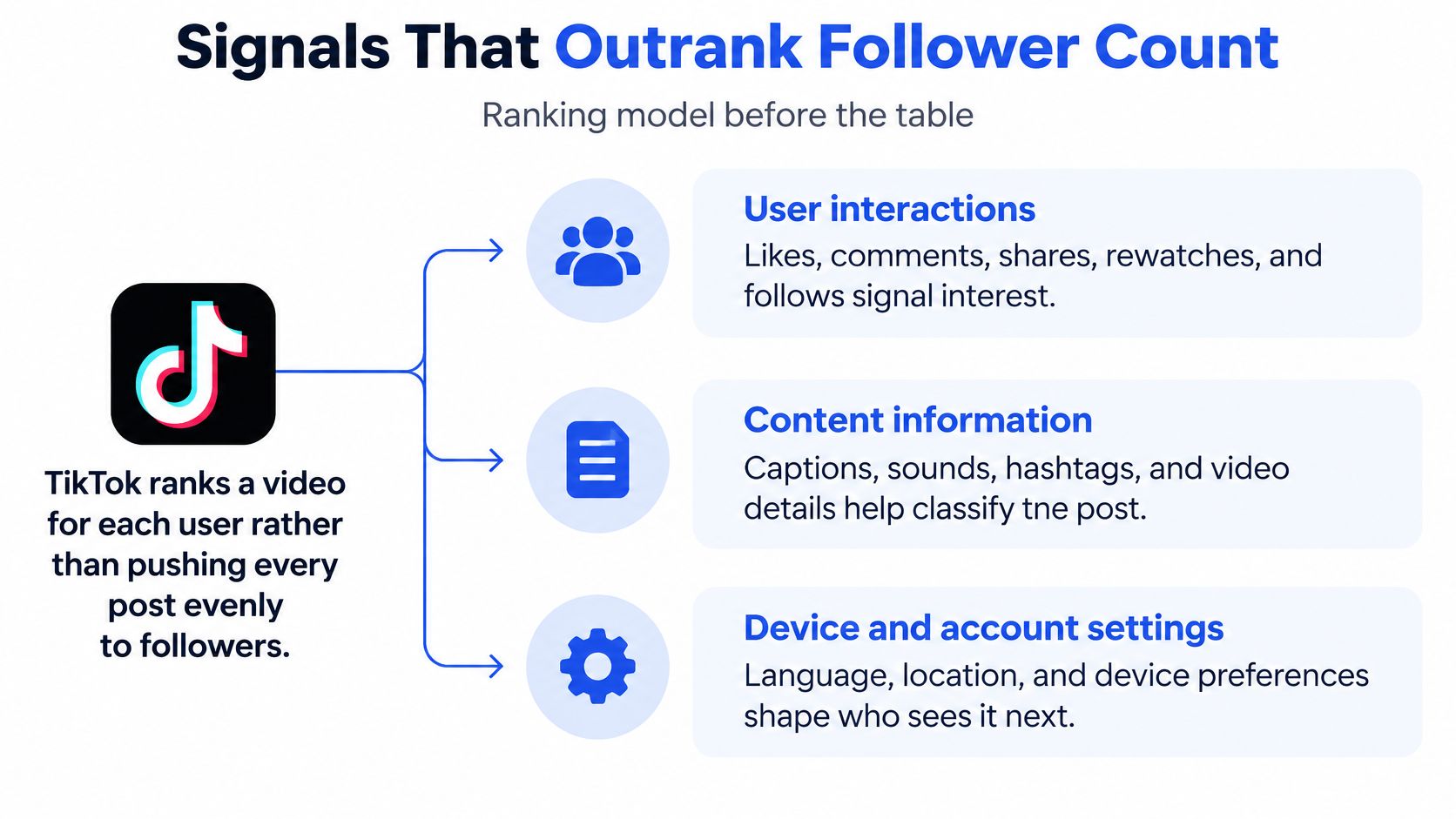
TikTok ranks videos for individual users rather than distributing every post evenly across followers. TikTok's recommendation guidance groups inputs into user interactions, content information, and user information, and says interactions such as time spent watching generally receive greater weight for most users.
That's a relative weighting statement, not a published scoring formula. An early hold supplies more useful evidence of interest than an immediate swipe-away, but there's no defensible universal retention cutoff that guarantees another distribution round.
Recommendation signals and what they change
| Signal | Group | Relative weight | What it changes |
|---|---|---|---|
| Time spent watching and finishing a longer video | User interactions | Generally weighted more heavily for most users | Evidence supporting further recommendation |
| Likes, comments, shares, follows and searches | User interactions | Important; no fixed ordering among these actions is published | Early audience learning and later ranking |
| Not interested | User interactions | Negative | Reduces recommendations of similar content |
| Topic, captions, sounds and hashtags | Content information | Contextual | Who is likely to understand and value the video |
| Same country as the creator | User information | Weaker than finishing a longer video | A relatively mild interest cue |
| Language and device or account settings | User and content information | Audience fit and delivery context, not a quality score | Who can receive and understand it |
| Follower count and past hit videos | Not a direct factor | No direct recommendation weight | Existing followers can provide more starting exposure |
The distinction between direct ranking weight and indirect exposure matters. An established account can start with an available audience without receiving a guaranteed ranking advantage for every new post. A smaller account can still reach strangers when the content matches their interests.
Test duration against an audience
Duration isn't a universal creative setting. TikTok's guidance includes a user's apparent preference for longer videos, so the appropriate length depends partly on who receives the asset and what they expect from it.
For controlled testing, keep the topic and audience conditions comparable. Change the opening while preserving the body, or tighten the body while preserving the opening. If you change the topic, language, duration, and offer together, the retention difference won't identify which edit helped.
A practical guide to getting TikTok views should feed that testing process, not replace it with a checklist of supposed algorithm tricks. Your useful output is a repeatable creative hypothesis: which audience stayed for which treatment, and where did the alternative lose them?
How Views Expand in Recommendation Waves
Say an ecommerce team publishes comparable product demonstrations with different openings. Both receive initial exposure, but only one continues reaching new viewers. The important difference isn't that the successful post already has more views. It's the viewing behaviour generated during its exposure.
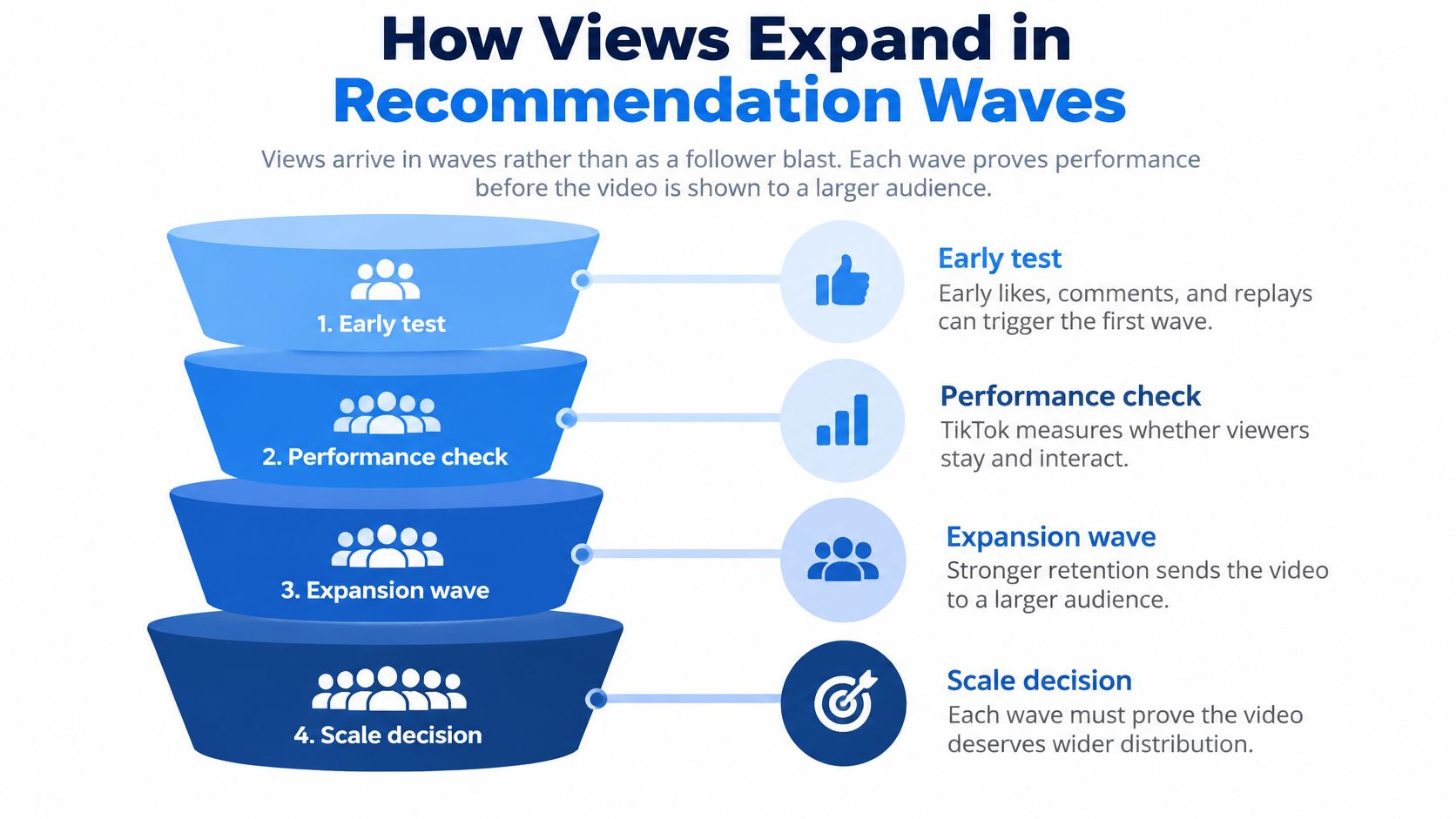
TikTok's creator guidance identifies watch time as a recommendation signal and describes how early likes, comments, and replays can help initiate recommendation while the system learns which audiences may value a post.
Read the sequence, not an imaginary cutoff
- Initial exposure: An early audience encounters the post, generating viewing and interaction data.
- Audience learning: TikTok evaluates those behaviours alongside content and user context.
- Additional recommendation: Strong interest can support exposure to other relevant viewers.
- Continuation or flattening: Distribution can continue, slow, or stop as subsequent audiences respond.
This is a useful model of recommendation, not proof of fixed test pools or a universal pass mark. A flat counter alone doesn't prove a retention failure, and a later surge doesn't reveal the precise ranking calculation.
For the product demonstrations, inspect whether the expanding variant also holds attention better among comparable viewers. If it does, the opening becomes a sensible candidate for another controlled test. If retention looks similar, investigate audience composition and source before declaring the hook responsible.
Views are an outcome of distribution and viewer response. A large total isn't itself evidence that the next audience will respond well.
Topic consistency helps make these comparisons interpretable. Taja AI's resource on planning your TikTok content pillars is useful for organising related subjects before comparing creative treatments.
Don't impose a made-up waiting period before reading results. Record the observation window, note whether distribution is still changing, and avoid comparing a newly published variant with a mature post as though both had equal exposure opportunities.
What 100000 Views Can Hide
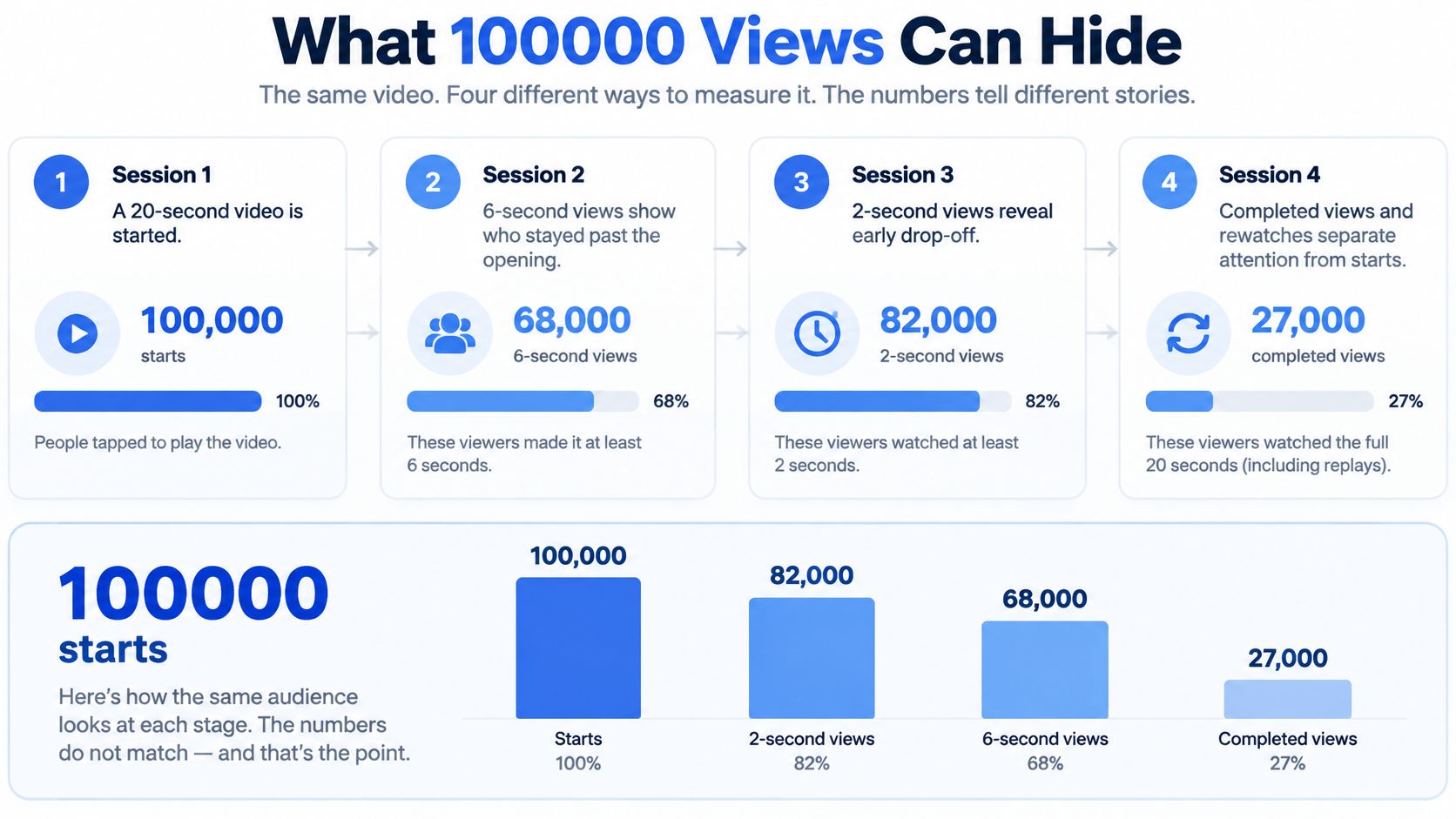
Consider these hypothetical viewing sessions, not measured campaign results. A viewer starts a longer video, leaves early, replays within an exposure, or returns after swiping away. Each action affects different columns.
For the example, use a twenty-second video for the initial sessions and a five-second video for the final session. The table shows incremental events; its playback-duration column describes contributed seconds, not a guaranteed increase in the reported average.
Counter outcome for each viewing session
| Session | Standard view | 2-second view | 6-second view | 100 percent watched | Average play time |
|---|---|---|---|---|---|
| 1. Watches four seconds then leaves | +1 | +1 | No addition | No addition | Adds four seconds of playback |
| 2. Replays inside the same impression | No addition | No addition from the replay | No addition from the replay | Completion reporting is separate; the standard-view rule doesn't establish its replay treatment | Adds replay seconds |
| 3. Swipes away and returns later | +1, new impression | +1 if return reaches the threshold | +1 if return reaches the threshold | Completion event if the return plays through | Adds return playback |
| 4. Five-second video watched to the end | +1 | +1 | +1 via completion | +1 | Adds five seconds of playback |
The replay session is a separate alternative within an ongoing impression, not a claim that someone can leave an impression and replay inside it. That distinction prevents a common reporting error: treating every repeat playback as another standard view.
A large counter can contain little eligible inventory
A hypothetical 100,000 starts could sit beside much smaller sustained-viewing and completion totals. That's an illustration of different counting rules, not a documented campaign result or an implied retention benchmark.
For monetisation, TikTok's Creator Rewards rules require legitimate unique For You views and exclude fraudulent, paid, promoted, artificial, disliked, and under-5-second views; reward calculations also incorporate average watch time and completion rate.
That means paid playback can contribute to a visible total without becoming qualified reward inventory. Passing the duration threshold alone also doesn't establish qualification because the other exclusions still apply.
For an agency report, keep the conclusions separate: how much playback occurred, how much attention followed, and how much viewing met programme rules. None of those totals independently establishes incremental sales. The counter can be accurate while the commercial interpretation is wrong.
When Low Views Are an Audience Fit Problem
A large follower count doesn't guarantee distribution. TikTok's explanation of For You recommendations says follower count and previous high-performing videos aren't direct recommendation factors, while captions, sounds, hashtags, language, and account context help shape recommendations.
That makes “the account is too small” an incomplete diagnosis. Before rebuilding the asset or blaming an account penalty, separate creative failure from audience mismatch.
Diagnose the location of the loss
| Observed pattern | Working hypothesis | Controlled response |
|---|---|---|
| Weak opening hold among relevant viewers | The opening doesn't establish relevance quickly enough | Replace the opening while preserving the body |
| Opening holds, later retention weakens | Pacing, explanation, or duration may be wrong | Test a tighter cut against a comparable audience |
| Home-market retention holds, another language or market fails | Viewers may not understand the message or context | Localise speech, captions, examples, and offer framing |
| Topic-normal retention with limited volume | Demand or traffic-source mix may constrain distribution | Compare related topics and sources before editing |
These are diagnostic hypotheses, not automatic causal findings. An opening can look weak because the wrong audience received it. A completion rate can look better because the replacement cut is shorter.
Compare results by market, language, traffic source, and video length wherever those breakdowns are available. Don't blend domestic organic viewing with foreign paid delivery and label the result a content score.
A market-level retention collapse is a reason to check intelligibility before rewriting the entire creative.
Rebuild the comparison before the video
Use a recent, consistent observation window and a topic-matched baseline. Treat ranking weights as contextual rather than permanent, and avoid turning an old account average into a universal pass mark.
For a DTC demonstration, check whether the product benefit is understandable without local knowledge. Read the captions on a phone, confirm that the spoken claim matches the visible action, and inspect whether the offer applies in the receiving market.
The resulting decision may be to change distribution rather than creative. If relevant viewers stay but an unsuitable audience leaves, a wholesale rewrite could remove the very elements that worked.
Where to Read Each Metric in TikTok Ads Manager
Start at the ad level in TikTok Ads Manager. Campaign and ad-group aggregates can hide creative differences, just as a blended Meta Ads Manager campaign row can conceal very different ad-level outcomes.
Keep the reporting surface attached to every export. An advertising metric, an organic post metric, and a Creator Rewards metric shouldn't silently become the same spreadsheet column.
Build an ad-level export
- Open the ad rows and customise columns. Add standard video views, 2-second views, 6-second views, video watched at 100 percent, and the available average-play-time field. Retain the exact exported field names.
- Align the date range. Use the same reporting window across compared ads, and flag assets that began delivery later.
- Separate delivery context. Use placement or source breakdowns where available. Keep paid results identifiable rather than treating paid For You placement as organic recommendation.
- Read organic posts separately. Open post-level account analytics and record available watch-time, completion, and traffic-source information. Leave unavailable fields blank rather than substituting a different metric.
- Export identifiers with outcomes. Include account, campaign, ad group, ad, and creative identifiers so similar names don't cause accidental joins.
For the distinction between post counters, analytics, and viewer information, use the guide to checking TikTok views.
Make the denominator explicit
Calculate 2-second rate as 2-second views divided by standard video views, and 6-second rate as 6-second views divided by standard video views. These are analytical ratios, not new TikTok counting definitions.
Label both denominators in the sheet. Don't compare one analyst's impression-based rate with another analyst's start-based rate under the same retention heading.
Keep average play time separate from aggregate playback duration. Also distinguish per-view and per-user fields if both appear in the interface; they don't answer the same question.
For teams accustomed to Meta Ads Manager's Columns, Breakdown, and Export workflow, the discipline is familiar: preserve definitions before combining rows. Don't carry over a Meta metric merely because its name looks similar, and don't assume every paid field has an organic equivalent.
Read Retention Before You Scale Distribution
Audit a single recent post before changing budget or commissioning a replacement edit. Pull total views, 2-second views, 6-second views, 100 percent watched, average play time, and the organic For You versus paid or promoted split, where available.
Then compare it with a relevant audience and length baseline. “Weak” means weak against that comparison, not below an invented platform-wide benchmark.
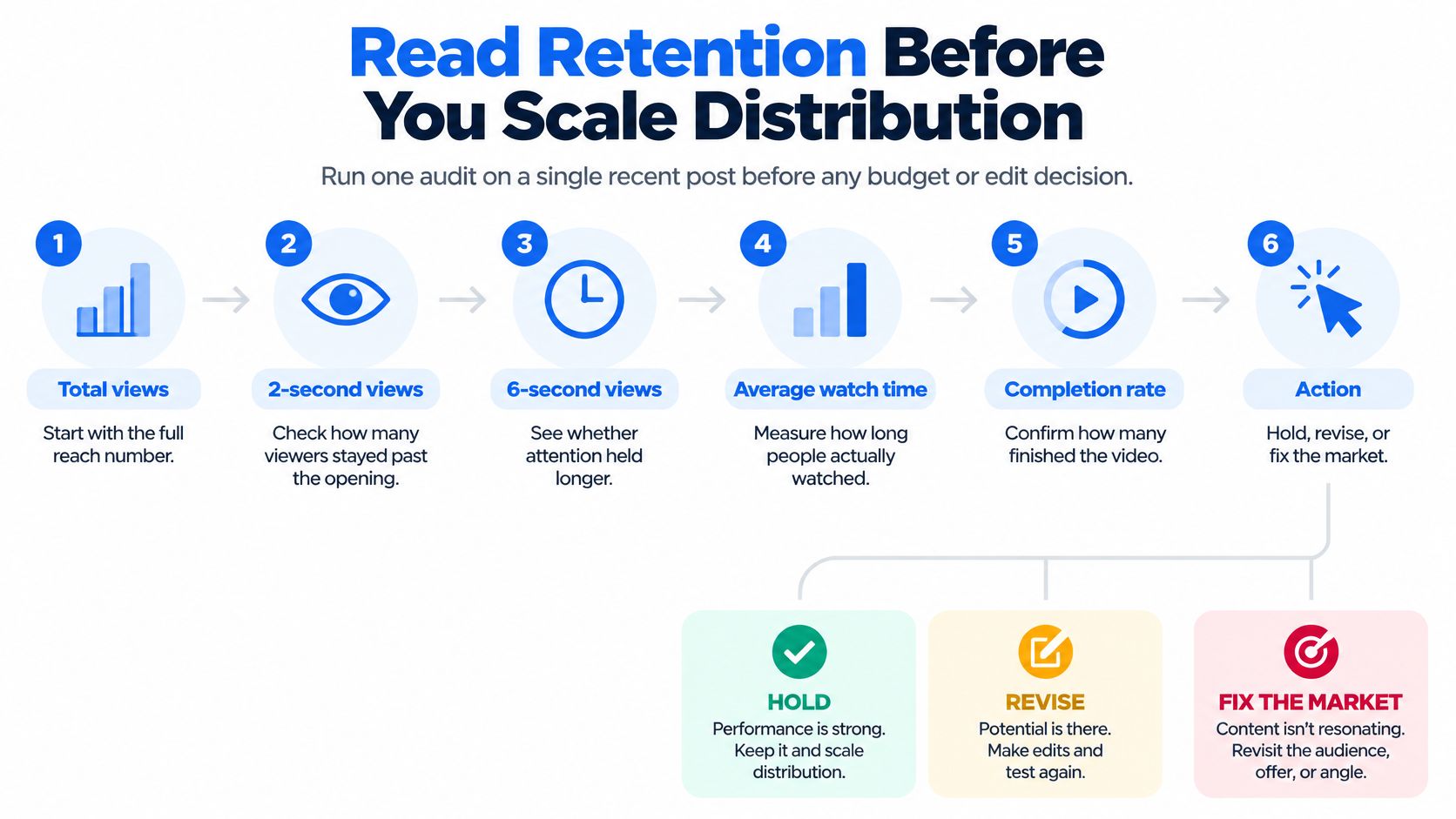
Decision by retention pattern
| Pattern | Strongest evidence | Action |
|---|---|---|
| High starts, weak 2-second views | Opening fails in the first seconds among comparable viewers | Revise the opening |
| 2-second views hold, weak 6-second or completion | Pacing or length problem is plausible | Revise pacing or length and retest |
| Home market holds, another market fails | Language or cultural fit needs investigation | Fix the market before judging the creative |
| Counter driven by paid or promoted views | No independent organic For You demand evidence | Hold and don't scale on the raw counter |
| Early hold and a second organic wave | Retention is consistent with further recommendation | Scale testing, subject to paid conversion economics |
For an opening revision, ShipTeaser's guide to hook viewers in the first three seconds provides a focused editing resource. Treat that framing as a creative technique, not a universal TikTok view threshold.
For later drop-off, review video completion rates alongside duration and average play time. A shorter cut that finishes more often isn't automatically the better sales asset if you removed the explanation needed to convert.
Separate creative confidence from budget confidence
An additional organic wave supports a creative hypothesis. It doesn't prove that the asset will meet CPA or ROAS targets in a paid campaign, especially when the audience, placement, or conversion objective changes.
Use organic retention to select candidates, then validate commercial performance under controlled paid delivery. For Meta testing, preserve the opening, offer, and intended creative treatment rather than introducing unrelated edits during upload.
The final decision should name an action and its evidence: hold distribution, revise the asset, fix the market, or advance a controlled scale test. Don't approve a budget increase because the public counter is the largest number on the page.
Rapid Ads offers bulk Meta creative uploads, consistent ad and ad-set naming, and automatic disabling of unwanted Advantage+ creative enhancements, so your next test preserves the treatment you intended to measure. Visit Rapid Ads to organise your validated creative variants and launch them across your Meta accounts without rebuilding each ad manually.
