Your Meta Ads account is ready for a launch, the creatives are approved, and the campaign structure is final. Then a server-side integration fails because an access token expired, a former contractor's credential is still active, or a token copied into a dashboard appears in an error log. The campaign may keep spending, but your conversion events, reporting, or automated workflows no longer behave predictably.
That isn't a token-generation problem. It's an API token management problem. Treating tokens as static strings creates sprawl, unclear ownership, excessive permissions, and painful emergency rotations. Treating them as living credentials gives every token a purpose, an owner, a scope, a renewal path, and a defined end.
Table of Contents
- Why API Tokens Are Lifecycle Artifacts, Not Static Secrets
- Generating Tokens the Right Way
- Storing Tokens Across Code, Config, and Secrets Managers
- Short-Lived Tokens vs Long-Lived Tokens
- Rotating and Revoking Tokens Without Breaking Services
- Scoping Tokens with Least Privilege and Monitoring Usage
- Lessons From Real Token Incidents and Failures
Why API Tokens Are Lifecycle Artifacts, Not Static Secrets
A token shouldn't be considered complete when an administrator clicks “Create.” It becomes an operational asset the moment a system assigns it to a person, service, pipeline, or automated agent. From there, somebody must know where it lives, what it can access, how long it should remain valid, and what happens when the workload changes.
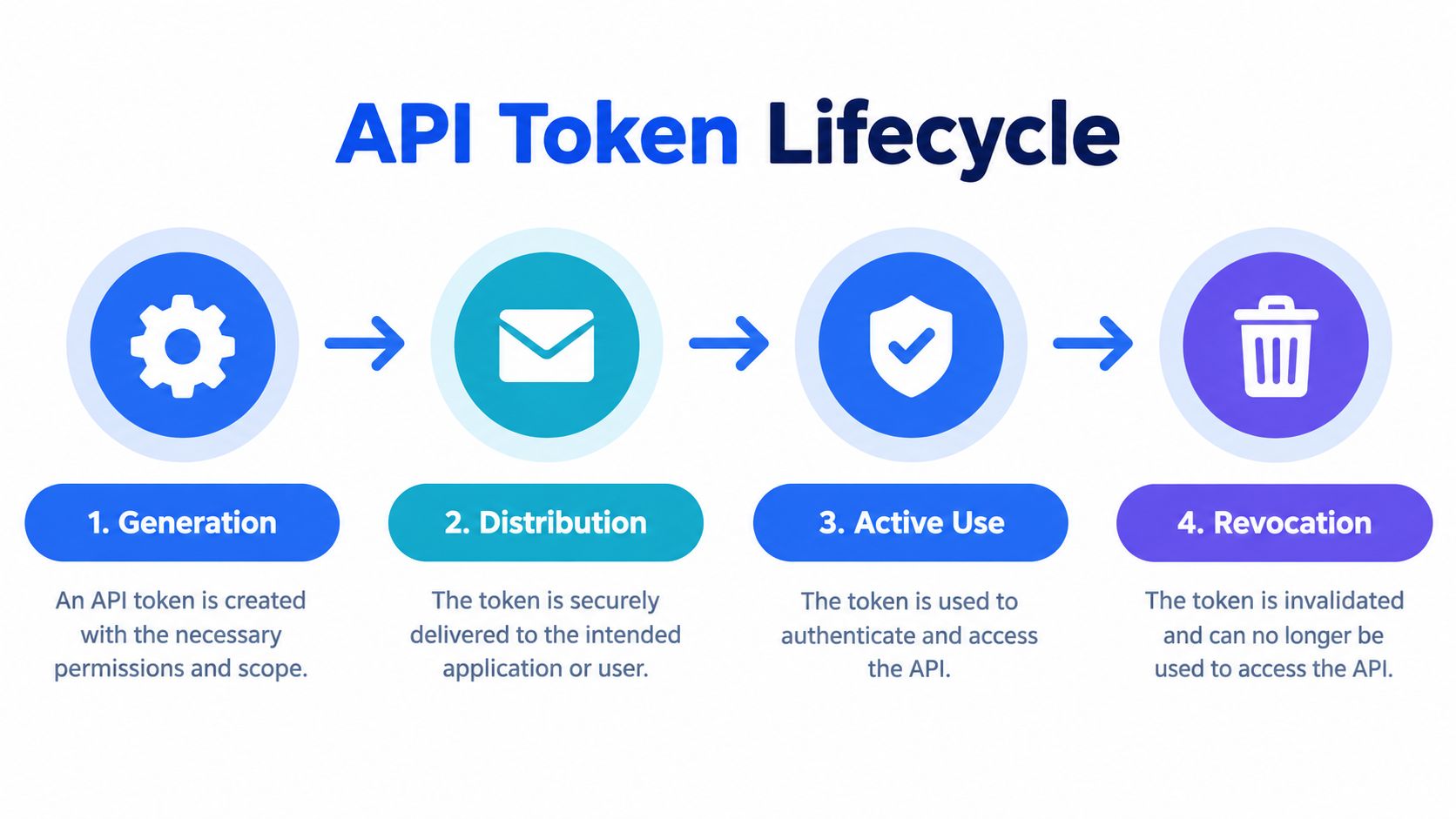
The lifecycle has five planning stages:
- Generation, where the system creates unpredictable credentials.
- Assignment, where the token receives an owner, workload identity, scope, and purpose.
- Distribution, where the credential reaches the intended application without appearing in source code, tickets, or logs.
- Active use, where requests are authenticated, monitored, and evaluated against policy.
- Retirement, where the token expires or is revoked and every dependent client stops using it.
The commonly visualised operational flow compresses those stages into generation, distribution, active use, and revocation. That model is useful, but assignment deserves separate treatment because an unowned token is difficult to investigate even when the credential itself is technically secure.
Each stage has a different failure mode
A weak generator creates credentials that attackers can guess or collide with. Poor assignment produces shared tokens that nobody wants to revoke. Unsafe distribution leaks credentials through repositories, chat messages, configuration exports, or deployment logs. Unmonitored active use lets unusual requests continue unnoticed. Missing retirement leaves former employees, abandoned jobs, and obsolete integrations with access they no longer need.
Okta documents a lifecycle model in which API tokens are valid for 30 days, renew automatically when used in an API request, and are revoked after more than 30 days of inactivity. Administrators can inspect creation, last-used, and expiration times, while creation and revocation events enter system logs. That combination of expiry, activity tracking, and auditability is more useful than a token that remains valid until someone remembers to delete it. Okta's API token documentation provides a concrete example of this approach.
Teams working with advertising integrations can also compare implementation details in the AdCrunch REST API keys guide. The important question isn't whether a token looks complicated. It's whether the organisation can identify its owner, limit its authority, detect misuse, replace it safely, and prove that the old credential no longer works.
Generating Tokens the Right Way
Secure token generation starts with randomness, not formatting. A token that contains a timestamp, sequential account identifier, campaign name, or predictable suffix may look professional while exposing information an attacker can use. Human-readable context belongs in metadata, not in the secret itself.
Use a cryptographically secure random generator provided by the platform or language runtime. Don't use a regular pseudo-random function intended for simulations, a sequential database ID, a short hash, or a homemade encoding scheme. Base64 can encode bytes, but it doesn't create entropy. Encoding a predictable value produces a predictable token with a different alphabet.
Choose a format that supports operations
A practical token format separates a non-secret routing prefix from a high-entropy secret. A prefix can help a secret scanner identify the credential type and can tell an operator whether a token belongs to production, staging, or a particular service. It mustn't encode permissions, passwords, or sensitive customer information.
Store the token's meaningful context beside it:
- Owner metadata: Identify the team, service account, or agent responsible for the credential.
- Purpose metadata: Record the API, environment, business process, and integration that use it.
- Scope metadata: Store the allowed resources and actions outside the secret value.
- Lifecycle metadata: Record creation, planned replacement, last validation, and retirement status.
- Incident metadata: Preserve a reference to the change or ticket that authorised creation and revocation.
The secret value should be shown only when the platform creates it, then stored in an approved secret store. A dashboard that displays the full value later turns routine administration into another disclosure path.
Run this pre-production checklist
Before adopting a token format, test the generator and the surrounding workflow rather than only generating a sample string.
- Confirm that the randomness source is designed for security.
- Verify that the system never reuses a value after deletion or rotation.
- Check that logs, analytics events, exceptions, and audit records mask the secret.
- Make the token distinguishable to scanners without making the secret predictable.
- Confirm that administrators can revoke one token without invalidating unrelated workloads.
- Test how the API responds to malformed, expired, revoked, and incorrectly scoped credentials.
The most useful token is not the one with the most elaborate appearance. It's the one that an operator can issue, identify, limit, replace, and invalidate without guessing where it has travelled.
Storing Tokens Across Code, Config, and Secrets Managers
A generated token becomes vulnerable wherever people copy it. Hardcoding a credential in a client library is the obvious failure, but configuration files and deployment tooling can create the same exposure with less visibility. A token committed to a private repository can still appear in forks, build artefacts, backups, or developer machines.
Keep application code free of secret values. Configuration should reference a secret by name or inject it at runtime, rather than storing the token beside campaign IDs, API endpoints, or feature flags. Environment variables are better than source-code literals for many deployments, but they aren't automatically safe. Process inspection, crash reports, verbose debugging, container manifests, and deployment output can expose them.
Match the storage layer to the workload
| Location | Useful for | Main failure mode | Safer operating pattern |
|---|---|---|---|
| Source code | No secret values | Accidental commit and permanent history | Store only a secret reference |
| Local configuration | Developer testing | Leaked .env files and backups |
Use short-lived development credentials |
| CI/CD secret store | Build and deployment jobs | Broad pipeline access and printed variables | Restrict job permissions and mask output |
| Dedicated secrets manager | Production services | Excessive IAM access or weak audit review | Grant workload-specific retrieval rights |
| Runtime memory | Active requests | Debug dumps and crash collection | Prevent secret logging and limit retention |
A dedicated secrets manager solves storage and access control, but it doesn't solve ownership. If every engineer and every pipeline can read every token, the vault has become a centralised sprawl system. Bind retrieval to the workload identity, separate environments, and make access auditable.
Practical rule: A token should be readable by the process that needs it, not by every person or pipeline that might troubleshoot it.
Audit the places tokens actually appear
Search repositories, CI variables, container definitions, infrastructure state, ticket attachments, internal wikis, and error-monitoring payloads. Scan both current files and history because deleting a secret from the latest commit doesn't remove it from previous revisions. Rotate a credential after exposure. Removing the visible string without revoking the underlying token leaves the incident unresolved.
Pay particular attention to dashboards that include request headers in error messages. A failed API call can become a credential leak if the application records the entire request for debugging. Redact the authorization header before logging, and make test fixtures visibly invalid so nobody mistakes them for production credentials.
Short-Lived Tokens vs Long-Lived Tokens
Token lifetime is a risk decision, not a convenience setting. A short-lived access token limits the period in which a stolen credential can be useful, but it requires reliable renewal. A long-lived token reduces refresh complexity, yet gives an attacker more time to replay it and gives the organisation more places to forget it.
| Decision factor | Short-lived access token | Long-lived refresh or persistent token |
|---|---|---|
| Exposure window | Narrower | Wider |
| Operational demand | Requires refresh and retry handling | Simpler until replacement is needed |
| Best fit | High-risk APIs, interactive sessions, agent calls | Controlled back-end renewal and carefully protected service workflows |
| Primary failure | Refresh outages and clock or cache problems | Forgotten credentials and prolonged misuse |
| Storage requirement | Secure in transit and at runtime | Strong protection, rotation, and revocation are essential |
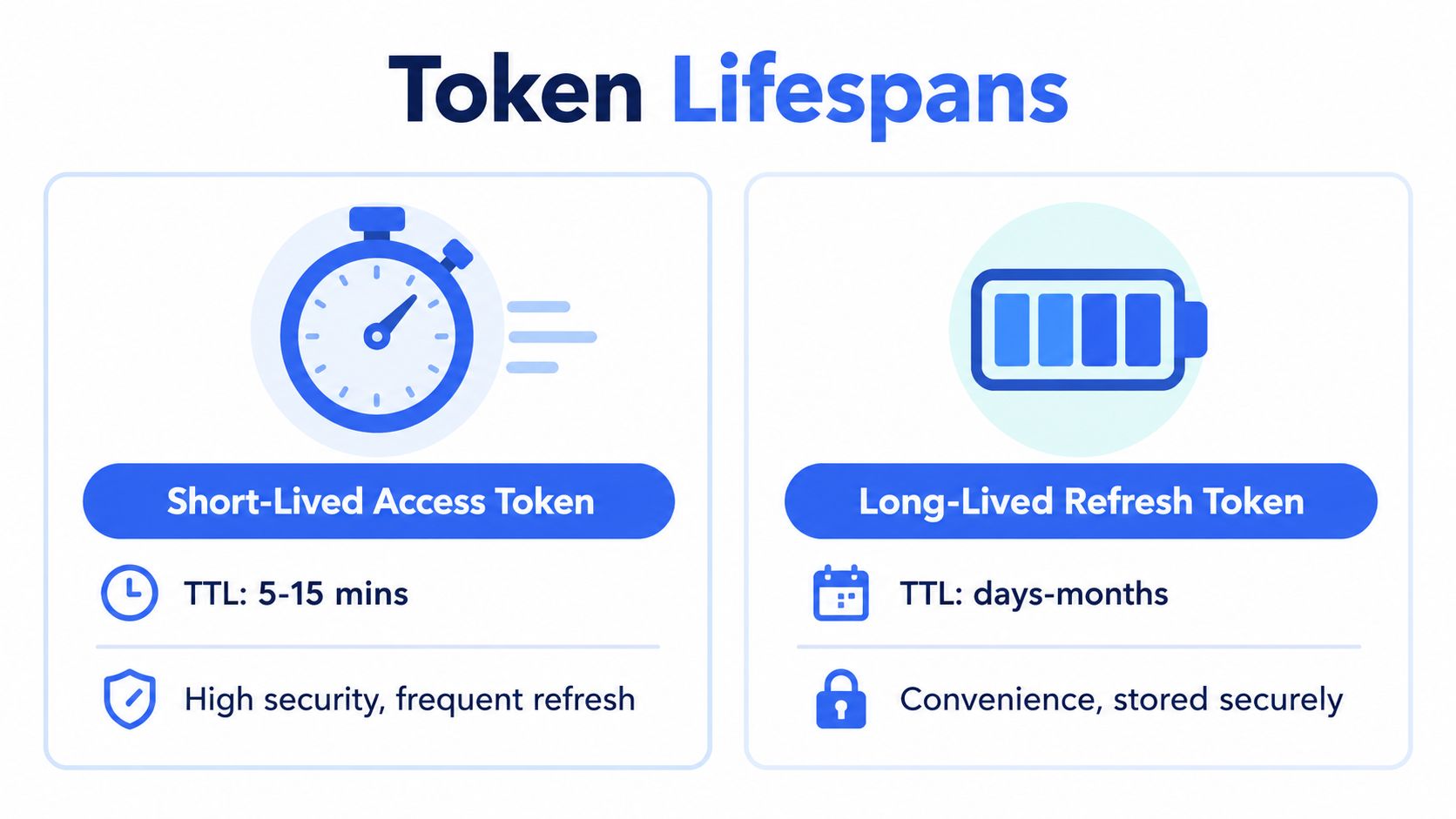
Industry guidance recommends access tokens in the 5 to 15 minute range for high-risk APIs, with refresh tokens maintaining the session without exposing a long-lived access credential. OAuth security guidance describes this pattern and notes that sensitive workloads may require frequent renewal. The exact choice should follow the consequences of misuse, not the preferences of the integration developer.
Apply different rules to different callers
A mobile client usually needs a refresh flow because forcing a person to authenticate after every short access-token expiry creates a poor experience. A service-to-service job can often request a fresh credential through its workload identity. A scheduled job should fail clearly and alert an owner when renewal fails, rather than silently retrying with an obsolete token.
Agent traffic deserves stricter treatment. An automated caller may generate requests continuously, invoke several tools, or move between workers. Give it a narrow audience and scope, bind it to the expected client where possible, and require behavioural monitoring. A persistent token copied into an agent prompt, queue message, or automation script is difficult to control after distribution.
For refresh credentials, enforce expiration and rotation rather than allowing them to accumulate indefinitely. One vendor benchmark cited in the available guidance sets a ceiling of 200 active refresh tokens per user per application, revoking the oldest after that limit. The advanced Okta API key guidance also discusses access tokens lasting 5 to 60 minutes and refresh tokens lasting 7 to 30 days with enforced rotation. These are useful operating ranges, not universal defaults.
Rotating and Revoking Tokens Without Breaking Services
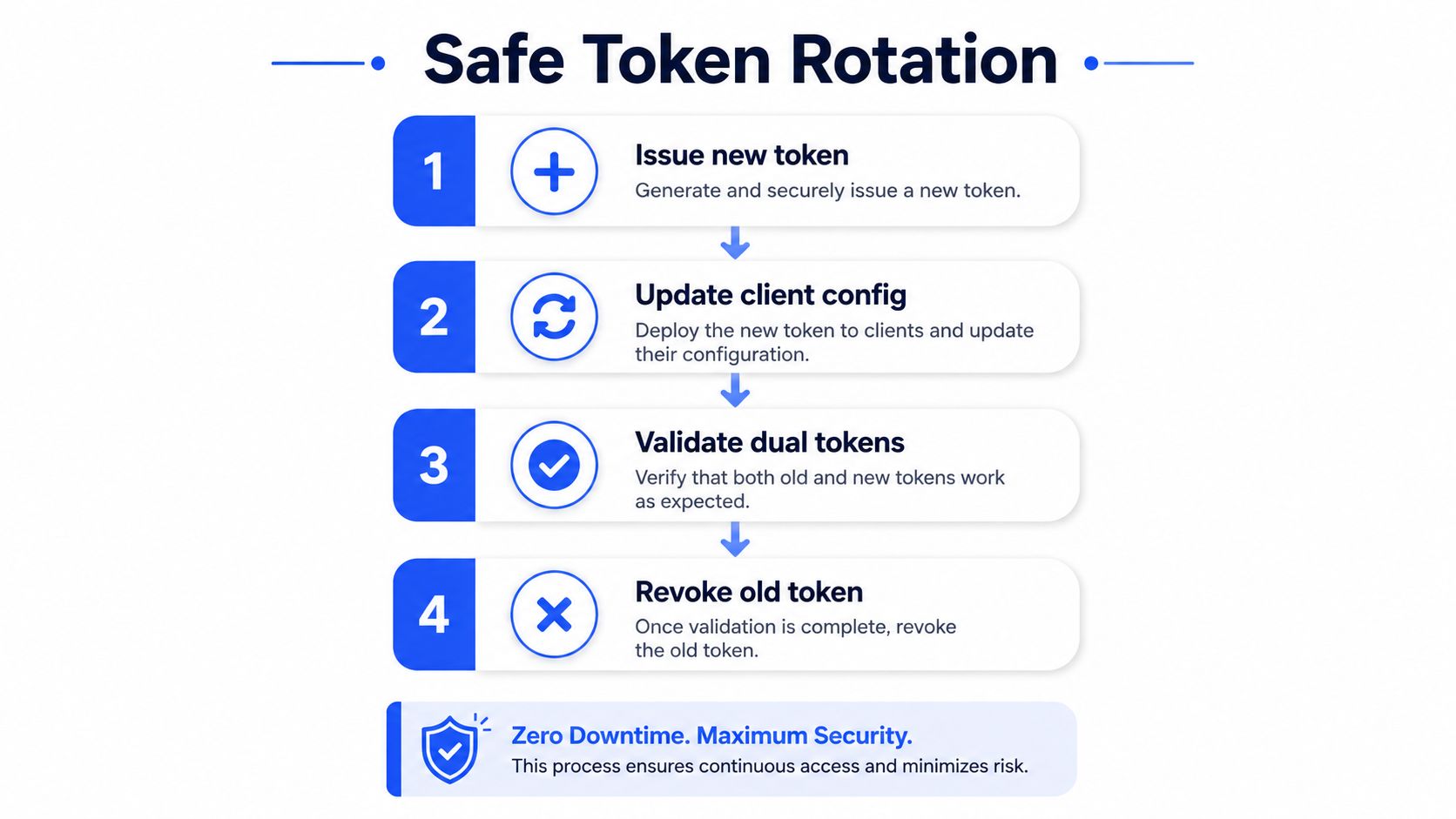
The safest rotation is planned before the old token becomes a problem. The most common mistake is to create a replacement, update one client, revoke the original immediately, and discover that an overlooked cron task or cached worker still depends on it. The result is an avoidable outage that makes teams reluctant to rotate next time.
Use an overlap workflow:
- Issue the replacement with the same or narrower permissions.
- Store it in the approved secret location without changing application code.
- Update clients in stages, starting with a canary worker or non-critical integration.
- Validate requests with the new credential and watch errors, latency, and usage.
- Keep the old credential available only for the planned overlap window.
- Revoke the old token, then verify that requests using it fail.
- Remove the old value from caches, deployment variables, and local files.
The overlap must be long enough for active jobs and deployment processes to converge, but not so long that two fully privileged credentials remain active without purpose. A service that accepts two tokens indefinitely has not completed rotation. It has created another form of credential sprawl.
Coordinate clients, caches, and jobs
Long-running workers often load secrets only at startup. Updating the secret manager won't change the value already held in memory, so the deployment process must restart or reload those workers. Proxies and connection pools can also retain authentication headers longer than expected. Test the complete path, not only the issuing system.
Mobile clients create a different problem because some users may remain offline while a credential changes. Use a controlled refresh mechanism and preserve a clear fallback path. For server integrations, deploy the replacement before revoking the old token, and instrument authentication failures so a bad rollout is visible immediately.
Watch for operational traps:
- Duplicate execution: A retry during rotation can run a billing or publishing action twice if the client doesn't use idempotency controls.
- Stale cache values: A proxy may continue sending a revoked header until its cache or worker reloads.
- Orphaned accounts: A service identity can survive the team or project that created it.
- Partial deployment: One region or worker pool may keep using the previous secret.
- Unverified revocation: The control plane may show a token as revoked while an intermediary still permits cached requests.
Revoke immediately after suspected exposure, employee offboarding, repository leakage, or a change in required permissions. Don't wait for the planned rotation date when the credential may already be compromised.
Scoping Tokens with Least Privilege and Monitoring Usage
A token with a short lifetime can still cause serious damage if it can read every account, alter billing settings, publish campaigns, and delete resources. Least privilege must define the allowed API paths, HTTP methods, resource identifiers, audience, and client identity. “Read-only” is useful, but it may still expose sensitive data across an unnecessarily broad account boundary.
For a Meta Ads integration, separate reporting access from campaign mutation and separate campaign mutation from billing or administrative actions. A token used by a scheduled reporting process shouldn't inherit the permissions required by an ad publishing service. Give each workload its own credential so a compromised reporting job doesn't become a publishing credential.
Make monitoring part of the permission model
Permissions reduce the blast radius. Monitoring tells you when a legitimate credential behaves illegitimately. Capture token identifier, workload, endpoint, method, account or resource, timestamp, response status, and request volume without recording the secret itself.
Useful signals include:
- Unexpected geography: A token normally used by a known deployment appears from a different region or network context.
- Unusual reuse: The same credential appears across unrelated clients, environments, or user agents.
- Volume spikes: Request activity changes sharply from the established pattern.
- Scope probing: A caller repeatedly receives forbidden responses across resources it shouldn't access.
- Audience mismatch: A token issued for one service reaches another API.
- Rotation anomalies: The old and new credentials remain active beyond the approved overlap.
The Postman State of the API report is useful background for the growing challenge of distinguishing human, automated, and agentic callers. For teams working with automated systems, the guide to security risks in agent workflows adds practical context around identity, tool access, and uncontrolled actions. The security issue is no longer only whether a token is stored securely. It's whether the organisation can still associate that token with the correct workload after it has moved through queues, logs, scripts, and workers.
Use a repeatable operating procedure
Create the token with the narrowest useful scope. Store it in a secrets manager. Validate signature, issuer, audience, expiry, and client binding on every request where the protocol supports those controls. Send events to the SIEM, alert on behavioural deviations, and connect alerts to an incident runbook that names the person responsible for revocation.
Don't rely on a single dashboard or a monthly manual review. Automated repository scanning, scheduled inventory checks, revocation hooks, and offboarding workflows catch the failures that busy teams otherwise discover only during an incident.
Lessons From Real Token Incidents and Failures
The same incident patterns recur because each one exposes a missing lifecycle control.
A developer commits a token while testing a server-side integration. The repository scanner finds the string later, but the team only deletes the commit and leaves the credential active. The correct response is to revoke first, inspect request history, issue a scoped replacement, and search every build artefact and deployment location where the old value may have travelled.
A deployment pipeline fails after an expiration date passes. Nobody owns renewal, so the job retries with the same invalid credential and creates noisy failures. The fix is an explicit owner, an expiry alert, a tested renewal path, and a deployment check that validates the replacement before the old token is retired.
A mobile or automation system accumulates refresh credentials because every reauthentication creates another token. The unused values expand the number of credentials an attacker can replay. Enforce rotation, remove stale entries, and make the inventory visible to the team that owns the application.
Revocation lag creates a different symptom. The control plane reports success, but a cached worker continues making requests with the old value. Operators should verify rejection from the actual client path, clear relevant caches, inspect gateway logs, and confirm that no worker pool remains active with the retired secret.
Run a quarterly review that checks ownership, scope, last use, expiry, storage locations, active refresh credentials, and offboarding status. Keep the review tied to concrete actions, not a spreadsheet that nobody updates.
Rapid Ads helps performance teams manage the credential-dependent workflows around Meta advertising by supporting bulk uploads, consistent ad and ad set naming, multi-account management, and controls for disabling unwanted Advantage+ creative enhancements. If token rotation and campaign operations are creating avoidable manual work, visit Rapid Ads to evaluate a workflow that keeps large-scale launches more controlled and repeatable.
